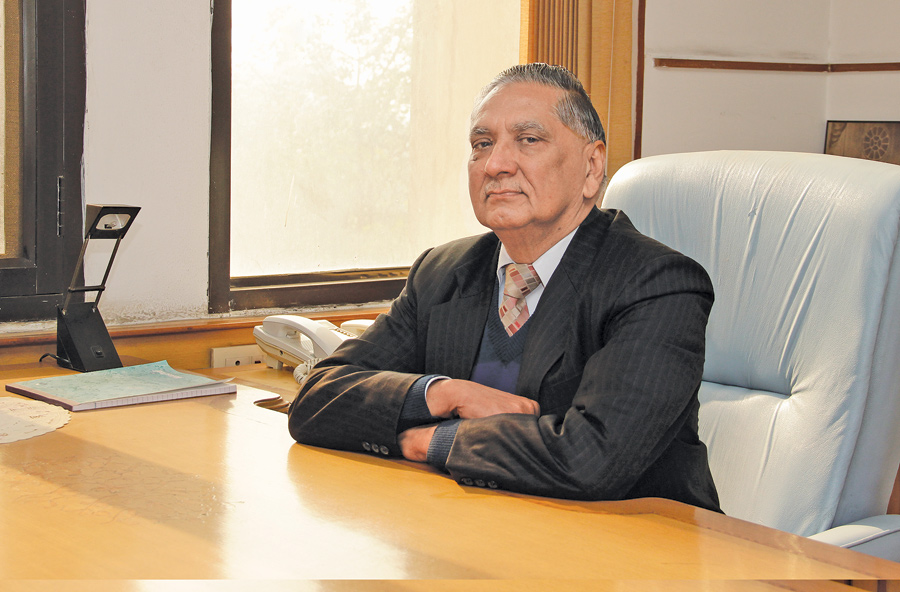
Textile conglomerate Vardhman Group has a laser-sharp focus on excellence, continuous customer-driven innovation, original strategies and a series of technological collaborations. The company has successfully positioned itself as one of the strong players in the textile value chain with sizeable capabilities in cotton yarn, acrylic yarn, fabric and sewing threads. Vardhman also boasts of a longstanding association with globally recognized partners like A&E for threads, Marubeni Corp. for cotton yarns, Nisshimbo Textiles Inc. for readymade garments, and Tokai Senko for fabric dyeing in order to bring into the country world-class textile products. In a freewheeling conversation with AO, DL Sharma, MD, Vardhman Yarns & Threads, shares his perspective on many topics of importance to the textile industry, most importantly on why India is missing opportunities in the global scenario…
Although India has the potential to be amongst the best in textiles and compete against the likes of China, still in terms of market space, the country hasn’t taken its rightful place, much to the disappointment of the industry. Even in recent times, despite China’s increasing costs, Indian textile industry has not been able to take advantage in the global market primarily due to the failure to meet stringent delivery schedules and also parameters of price-competitiveness. “At the far end of the value chain, spinning was doing well but because of over-capacity it has lost out presently due to soft demand.
The fact is that India has good capacities in spinning and weaving due to adequate raw material availability, but large portions of this is shipped out to garment destinations in other countries, whereas India is losing on the value connect due to various challenges in the system,” reasons Sharma.
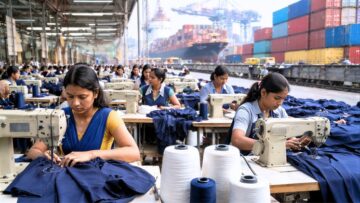
Amongst the main challenges in the Indian textile chain, according to Sharma, is relatively higher labour cost as compared to other competing countries, which has also acted as a barrier for investment friendliness in the field of garmenting. Though, China’s labour cost is increasing, but due to higher factor productivity, they are able to still maintain their strong hold on the global market, specifically in value-added garments. Vietnam’s productivity and labour costs both are competitive, therefore the country is seeing a surge in business; and while Bangladesh’s factory productivity is almost similar to India, labour factor cost is much cheaper. Apart from this, transaction costs in logistics and indirect taxes in India are much higher than many other countries. In addition, the direct freight costs are also amongst the reasons behind India losing out. It is easier to get materials shipped from China to India rather than from Delhi to Mumbai as the time taken and working capital engaged becomes costly. “There are so many ‘costs’ which are built into the final costing of the product but are not considered when calculating drawback rates. When you talk about fabric exports, one is actually incurring a cost of 9-10 per cent on duties and taxes out of which the exporter is only compensated for 4-6 per cent and the rest is absorbed in the final price,” informs Sharma. Meanwhile, the Government’s initiative to bring reforms with Goods and Services Tax Bill (GST) is a welcome one as it will help in formalisation of unorganised trade, but exclusion of electricity duties and fuel from this scheme will dilute the benefits.
While other countries have advantages in global trade, like Bangladesh, being an LDC country, can export to Europe with zero duty, Pakistan too has the GSP plus advantage in the EU. Now even Vietnam will soon have the TPP that will make them beneficiary for apparel export to the US, besides the country has also signed FTA with EU bringing high advantage for them in export of garments to two major global destinations. India does not have any global trade pacts except FTA with Japan. “We have been pressing for such benefits, but to no avail. So, an Indian exporter is competing in a very niche space, where small quality and higher value-added products provide an edge. If you see garment manufacturing today, there are hardly any expansions happening and the cost of the management of these factories is increasing. Some entrepreneurs have shifted to other places (countries) to do volume business. We are now wondering whether India can be considered as a real garmenting country. Sadly, we have all the factors/resources in our favour, including a large number of people who need to be employed, but the thrust is missing,” asserts Sharma.
He further adds, “The Government needs to understand that this industry is helping in employability of unemployed youth. All it needs is restructuring of policies and labour laws. The laws need to be designed, focusing on the lowest level person, giving protection on minimum wage, social security, health, besides flexible hiring as suited to the textile industry without harming worker rights.”
Though the Government’s new proposed code on labour laws has raised hopes for the Indian industry, the Government still needs to address certain issues from the point of view of maintaining the cost-competitiveness of labour for wage goods industries like apparel, footwear, food processing, etc. For example, proposed definition for “wages and employees” in the code wherein an outworker is also proposed to be an employee. “Lot of outsourcing happens in the garmenting where the manufacturers send work at home to outworker as a part of manufacturing chain. The outworkers are specialized in certain activities and many employers send work to them; therefore the outworker is doing work for a lot of garment exporters. So such work practices evolved due to various work needs should be handled appropriately keeping in mind the industries’ requirement and outworkers earning and social security needs,” says Sharma. Also, because of high turnover of workers, we suggest that the trainee employed under certified standing orders, should not be considered as an employee. He/she may be given the employee status once he/she gets absorbed as a regular worker,” believes Sharma.
What is more important to compete against such evolving global manufacturing hubs is that the whole integrated chain needs to be cost-effective and competitive. Though the labour cost is important on the garmenting side, but on the material side the cost of capital & power is equally important as they are both capital- and power-intensive. A very high cost of electrical power due to the present tariff policy incorporating higher cross subsidies makes material product more expensive, which adds to the ultimate cost of the garment. Though Indian apparel export is cotton dominated presently, in order to have wider presence, the industry should also build up the value chain for the apparel made of man-made fibre and their blends. China has a huge advantage in this respect that is why their apparel export is dominating. “If you want to make the value chain competitive, a policy to address the major factors of production cost on the material and labour needs to be checked. In this aspect, it is advisable that excise duty on man-made fibres are rationalised,” argues3 Sharma.
Another area of high cost for textile is dyeing and processing due to high cost of water treatment. A draft notification of the Government has directed the textile industry to strictly follow Zero Liquid Discharge (ZLD) norms, meaning that a factory should recycle all its effluents and not release even a drop into any water body. Yes, as a responsible corporate it is important for industry to address this concern but we may examine it more effectively, and with less cost burden techniques. It is also worth noting that nowhere in the world is ZLD being propagated. What is being propagated is treatment of affluent to convert it into water for irrigation purposes, which when adopted can be cost-effective to serve the purpose and also put less burden on the industry. Certainly, there are issues in some states that are water deficient such as Tamil Nadu, and the industry has responded well in such areas. Incidentally, the sewing thread division of Vardhman, VYTL is one of the first companies in sewing threads to install a ZLD facility in their plant at Perundurai in Tamil Nadu. “We must always remember that there are major costs incurred for ZLD and its technology is very expensive, so it should be adopted wherever necessary,” states Sharma.
Though the industry has a lot of challenges and needs support from the Government for favourable policy framework, Vardhman Group is doing fairly well by focusing on in-house consumption and continuous value addition in all products of different verticals to manage its production optimally.
Today, Vardhman Group offers the complete solution in textile value chain. Although 2015 had been a tightrope for the industry, Vardhman is hopeful for 2016…, as the initial phase still looks challenging. For the time being Vardhman is not going for any major growth, except for marginal expansion in areas where the company further balances its product mix or where it can set its processes right. “It is that time for the textile industry when you stop and introspect. The country needs to focus on the apparel side, once you do that backward integration will happen and value will come automatically to the complete chain,” concludes Sharma.