Make yourself comfortable! Sitting or lying down on an upholstered sofa-cum-bed should be a relaxing proposition. Interestingly, warp knitted fabrics are generally used for upholstery; their innate properties, coupled with different finishes like crush and stain free/self cleaning, etc. are common for upholstery. The outer textile materials and/or leather should be able to cope with the stress of frequent use. The materials inside aren’t less important: They are responsible for moisture management and stability of shape. Cutting and sewing the pieces, which are often huge, is a challenge for every production. Claudia Ollenhauer-Ries, our special correspondent from Germany, explains….
We find upholstered seats everywhere: At home, in offices, restaurants, public transportation, cars, aeroplanes and trains. Style, ergonomy and comfort come together with longevity. The targetted application rules the choice of materials.
[bleft]In a series of articles highlighting the growing importance of Technical Textiles in home fashion, we have already featured “Interior Textiles – Functional Ideas for New Indoor Concepts”, in the May 16-31, 2008 issue of Apparel Online. In our second part of the series Technical Textiles in Upholstery is the focuss of attention. Reproduced courtesy StitchWorld.[/bleft]
In General
The fabric or leather on the outer side should be elastic enough to follow the compression and decompression of the underlaying foam, wadding or filling. The softer the seat, the more elastic the fabric should be in order to avoid unaesthetic bulges on the seat. The elasticity required comes from the yarns and the weaves – the use of elastane is not necessary – which are natural features of a well tanned nappa leather (cow or bull). The fabric should also allow the transportation of moisture, be stable against abrasion under humidity and pressure, have a good light fastness and be stain repellant or at least tolerate household and professional cleaning processes. The underlaying polyurethane (PUR) foam is glued to the wooden or metallic structure and covers the bands and springs (if any). Compared to traditional padding, the PUR-foam can be flame resistant and free of CFC. It can be produced in any weight, density and softness. According to the design, different qualities of foam are used for the back, seat and sides. This foam is covered by a polyester nonwoven wadding which is pinned to the wooden structure or glued on the foam. Again, different weights of nonwovens will be used, sometimes piled one on the other. On top of all this, there will be the outer fabric or leather. The clue is to prepare the covering fabric by sewing as far as possible before ‘dressing’ the seat or sofa. Special attention is to be given to the direction of the velvet stroke (from top to bottom on the back, from back to front on the seat) and the patterns on the seams should be seen as matching exactly.
At Home
For residential use, designers have the maximum of choice in fabrics from silk to linen, velvet to jacquard, real and imitation leather, trimmings – whatever pleases and complements the main quality requirements. A stain repellant finish of the fabric will be highly appreciated by consumers. According to the export country’s regulations, a fire retardant finish must be chosen. A soft and cosy sofa or seat will have a tensionless covering which will be allowed to show waves. A tighter seat – often appreciated by geriatrics, as they don’t like to sink too deeply into the seat – will require a certain tension of the covering fabric. In these cases, the fabric could be bonded with the top layer of the nonwoven before cutting and sewing. Consider zippers or other trims to remove the coverings for washing or cleaning. As a rather new product, the warp knit 3D materials (the so-called spacer fabrics) could be used here for the underlayer and a technical looking covering. Spacer fabrics could promote air circulation and moisture management, thus enhancing the cooling effect.
[bleft]Special attention is to be given to the direction of the velvet stroke (from top to bottom on the back, from back to front on the seat) and the patterns on the seams should be seen as matching exactly[/bleft]
In Vehicles
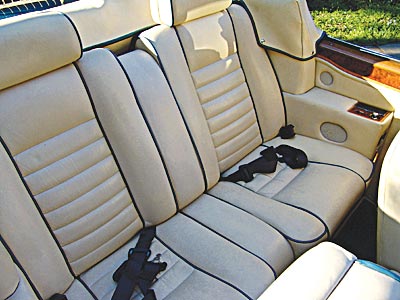
Drivers’ seats must cope with very heavy use and hard conditions. Not only the covering fabric, but also the underlaying nonwovens and foams have to undergo severe testing. Often, differently structured and/or coloured fabrics will be combined. Perforated real and/or imitation leather and strongly structured velvets will be used in the middle seat and back areas in order to enhance air circulation and moisture management. Again, a great field for spacer fabrics.
Car seat specialists offer warming and cooling systems. A common heating system integrates wires to be heated electrically into the seat. In case one wire breaks, the whole heating system will stop functioning. Carbon fibres have recently started to replace wires: The advantage is that the carbon fibres inserted into the fabric are nearly indestructible and will give homogenic heating. Yet another technology integrates a ventilator under the seat to blow cool or warm air through the seat as desired.
Some of the seams must have pre-determined breaking areas for the airbags: headrests, door-side seams of the seats. These parts of seams will be sewn with less thread tension. The beginning and the end of this peculiar part of the seam will be marked during the cutting process. This change of tension requires an automatic sewing machines with at least two tension variants stored in its memory.
Special requirements exist for public transportation seats: They must resist even vandals, who attempt to cut or destroy the seat upholstery. Knitted wire sheats bonded under the covering fabric will resist the attacks. Alternatively, fibres like Aramid could be used.
Fabrics for Upholstery
All kinds of fabrics could work for upholstery, if their abrasion resistance, elasticity, light fastness, etc. meets the demands. Woven, warp knitted, even flat knitted structures, leather and imitation leather can be used. From the fibre side, we find silk and pure wool at the high end, together with leather. All sorts of blends of natural and man-made fibres provide quality and natural appeal. Of course, pure synthetics have their place at all levels; especially microfibres that will create a soft velvety touch. Protection against stains is an important criterion: Scotch Guard, a trademark of 3M, is widely known. Finishings with nano-particles, which allow soil and stains to be removed easily are fairly new.
The quality of the leather governs the price: experts prefer large bull hides, tanned without chrome and with a minimum of coating. The more you see the natural skin structure and the thicker the leather, the better. Leather at its best is fairly elastic and lets moisture through. For mass markets, cars and aeroplanes, the natural defects of the skins will be covered by a thick layer of fillers. These leathers lose a lot of the natural look and moisture transportation. Stain resistant finishings also exist for leather. One of the latest developments is Aquaderm X-Shield, a water-based polymer dispersion that is applied as a top coat on the leather. Unlike conventional systems, whose soil-repellent substances gradually wear off, the binder system, developed by LANXESS/ Germany and the Japanese chemical company Daikin Industries Ltd., with PTFE (polytetrafluoroethylene) segments incorporated by polymerisation is firmly anchored on the surface of the leather. Aquaderm X-Shield protects leather surfaces not only from ‘standard soiling’, but also from stains caused, for example, by mustard, ketchup, marker pen inks or engine oil. It also makes cleaning with leather-care products considerably simpler.
Imitation leathers are either microfibre velvets with a suede leather look or coated fabrics with a nappa leather look. Microfibres will create a cosy feeling and a good moisture management, while coated fabrics could feel cold, plastic-like and may not let any moisture pass through. If choosing a coated fabric, take care to check the moisture management and the elasticity.