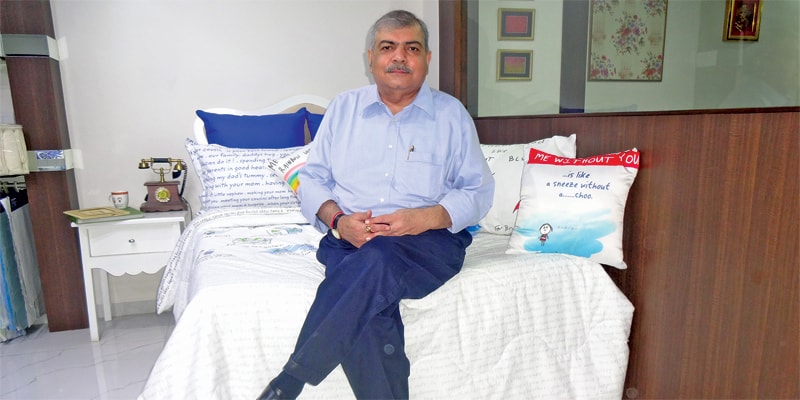
Home segment in India is growing at various levels, nationally and internationally, despite various challenges. In conversation with Apparel Online, Amit Ruparelia, Partner, Trendsetter, Mumbai and ex-President of TEXPROCIL, gives a fair perspective on the current scenario of home furnishings industry in our country and how best it can be improved both from the industry and employment point of view.
Running business over the last 4 decades and with a current annual turnover of Rs. 55 crore, Amit believes that it definitely requires strong business acumen and a careful scrutinization of the market trends in the native country to be successful. With a significant change in product categories and a focus on institutional demands in the US, Europe and Scandinavian countries and indirectly supplying to many big retailers also, the company has been providing both finished products as well as converted (value-added) raw materials (45 per cent of total business of the company) to the overseas market. In fact, the company has the privilege to be the first in India to manufacture and export 1,000 thread count bedsheets.
India’s home textile export (cotton based) is of nearly US $ 5 billion and if one includes synthetic, it would be even more than US $ 6 billion. Simultaneously, India needs to brand its cotton by improving its quality and overall process.
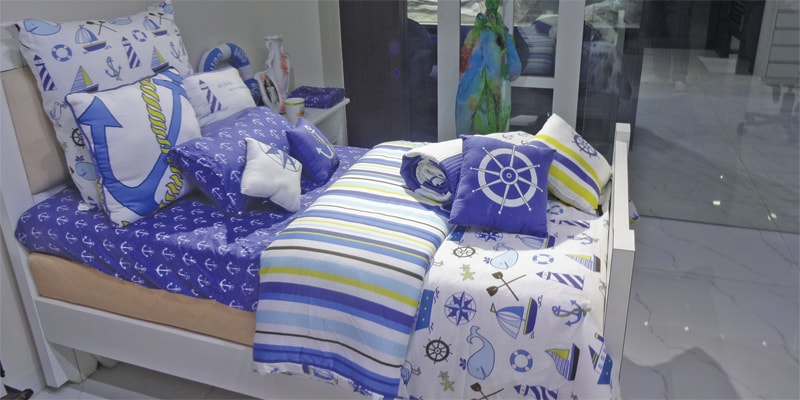
Some of the company’s already existing products include luxury sheets and linen and it is further aiming to expand in sheet sets and raw materials segment as there is endless scope in both of these areas. Elaborating on their exclusive product development strategy, Amit shares, “Visiting customers, investigating the market for newer products is what helps us frame products for all time. We do have designers but most of the creative work is suggested by the buyers.” Speaking about his plans for future prospects, he states that the company has acquired the licence to sell the US based brand ‘Happiness Is’ in the US. Through this brand, they would be able to manufacture and do retailing in the US, further sub-license to a big company in India.
Amit desires to have a faster growth in India as the Indian Government has started valuing its home textile industry as much as it values its apparel industry. One of its units is reorganizing and once it gets completed in the next few months, the company will have a multi-fold increase in production capacity. Comparing his position to that of the companies in neighbouring countries, Amit feels that they have to pay heavily for duties which other countries are not paying. Similarly, the market for blended polyester cotton is huge in the world, as much as 60 per cent, but India is still very expensive in matters of such blends. Amit avers, “We can get far more opportunities compared to Pakistan and Bangladesh if prices of blended fabrics come down. There are so many made-up articles in home furnishings that India is not even manufacturing apart from processing which is again a setback for our country.” He gives example of quilts (not Jaipur-based) where India has good scope, but is not really big in the category. This is all the more unfortunate, as the country is a major manufacturer of raw materials like cotton and synthetic fibre. “This advantage can make us easily win over our competitors if we work upon the above-mentioned potholes,” he adds.
“I must appreciate that most of the home furnishing industry (even smaller companies) are moving towards improvisation.”
The company has the experience of working with renowned names like Ikea, Walmart etc. and is also working on 100 per cent linen, linen blend fabrics. It has two manufacturing units in Kutch, besides a good management team which independently handles production and claims to have details of all workers’ bank accounts, and transfers payment through banks for past many years.
Amit feels that there is a probability of a significant hike in the price of branded fabric in India. He shares, “I personally feel that once GST is introduced, we will come up to somewhere closer in pricing in comparison to other countries. Then it would become a fibre neutral GST. The advantage that cotton has will go away and polyester will have the same duties.” At present, domestic manufacturers in India are facing a tough time being pressurised by duty charges and a very high price from the few fibre manufacturers in India. There is lack of a larger vision on the part of these fibre manufacturers who actually will benefit greatly if polyester starts moving within the country. Simultaneously, customers in India need to be more educated about the home textile business which is just limited to bedsheets for them. They are yet to understand, unlike the international customers, that bedsheets are now passé. In fact, home industry is now primarily into duvet spreads, fitted sheets and embroidery which are all being significantly targeted at, by Trendsetter.
Amit appreciates the recent decision of the Government in which home textile industry too got benefits like the apparel industry but he insists that as apparel industry and home industry are into stitching, home business gets segregated everywhere as compared to apparel which is just known by its name. For example, TEXPROCIL takes care of cotton only; textile exports look after polyester cotton; handloom exports look after handloom made-ups; and silk exports look after silk made-ups. This leaves a home textile manufacturer with no option except to run to different councils for different representations. “India should work on duty disadvantage too, so that we can use our strength of raw material,” he concludes.