A company which asserted Maruti Suzuki as one of its first clients for threads required to manufacture automotive seat covers and upholstery, Kanpur based thread manufacturing giant Threads India Ltd. has strategically exerted an entirely different approach to the business of thread manufacturing and servicing the apparel industry. With R&D at the core of its operations in technical collaboration with Cousin Frere France, this three-decade old company has evolved into a complete sewing thread solution provider for not just automotive and footwear, but for all sewn products with its most recent foray into apparels in a bigger way. Apparel Online recently visited the company’s state-of-the-art facility & R&D Centre in Kanpur and interacted with Threads India’s ‘leadership team’, on the company’s activities in the apparel segment and plans to take the company to the next level of growth.
Twenty-five years ago, Threads India was incorporated to cater to the Indian sewn product manufacturers, who were seeking not just quality threads but rather a unique service experience from a thread manufacturer. “Our first innovation Quartz was inspired from the fishnets used for fishing and the thread was modified to suit footwear due to its stretchability and strength, the two vital properties in a thread which were missing from the products back then,” recalls Ajay Lohia, Director, Threads India Ltd., whose vision has made Threads India a multinational with presence in 36 countries and 14 offices in India. “Every segment or brand that we have developed is as per the needs of our customers,” adds Lohia, an approach which has set them apart from other thread manufacturers according to him.
“What we do is difficult for bigger international companies to elucidate, since we have our head office in India, we are much more swift in the decision making process, approvals come fast and then the ideas take shape even faster.” – Girish Batra, Executive Director, Threads India
With an ability to cater to the diverse demands of the sewn product industry, Threads India attributes this flexibility to its style of functioning, which has evolved, in particular with the proper understanding of the thread business. “What we do is difficult for bigger international companies to elucidate, since we have our head office in India, we are much more swift in the decision making process, approvals come fast and then the ideas take shape even faster,” explains Girish Batra, Executive Director, Threads India, who has been spearheading the company’s operations both nationally and internationally. The company claims that a completely new and custom made thread can be made available to a manufacturer in less than three months. Threads India believes that the technical expertise of a company is measured by the experience of its technical people and the time they have invested in developing customized solutions for various companies. The company has created such a niche in R&D by having a continuous dialogue not only with agents, apparel manufacturers, needle suppliers and sewing machine manufacturers, but also with institutes like IIT Kanpur, FDDI Noida and FIT New York. “Sewing is a relationship between the fabric, needle and thread. Hence we have also worked with needle manufacturers like Groz-Beckert, for such developments and done combined testing of our products, to be able to suggest our customers the correct needle and thread combinations,” shares Girish.
The apparel industry is not something new for Threads India, but previously the company was very selective in working with apparel manufacturers due to the price-sensitive nature of the industry. “In the recent times, we have just broadened our product range to cater to the apparel industry and in a short span of time have become the 2nd largest supplier of sewing threads for denim in India with our Sapphire brand,” says Girish.
The company’s flagship product for the apparel segment is EDDEN, a poly-poly core spun soft thread with patented lubrication for industry-best gliding, which has been developed keeping in mind the high thread breakage at the time of high-speed sewing that increases the machine downtime while reducing the quality of the product and efficiency of the sewing operators.
The DUOFIL range of sewing threads has been made from high tenacity polyester filament covered with cotton sheath during spinning, after which it is further dyed and twisted. The thread reduces breakages due to cotton coating on the outside, which enables it to withstand high temperature and heat generated while working on high-speed sewing machines and also due to the especially formulated micro molecular lubrication, which enables the thread to pass through the needle and fabrics with ease. The smoothness of the thread has been tested by third party agencies and rated as the smoothest in comparison with other threads of similar type. Another ‘value-add’ to its threads for denim jeans manufacturers has been the development of a ‘lustrous’ sewing thread with high resistance to strong washes.
EDDEN, a poly-poly core spun soft thread with patented lubrication for industry-best gliding, increases the machine downtime while reducing the quality of the product and efficiency of the sewing operators.
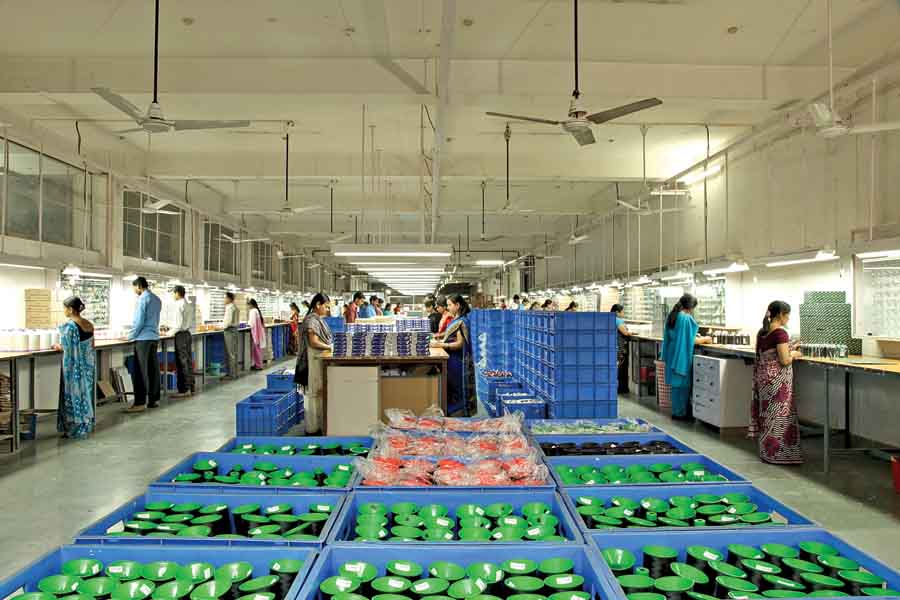
Having realized the specific needs of the apparel industry, Threads India has positioned its products in the mid to high price bracket and has also started working on streamlining the process of order booking, sampling and production, by implementing a custom-made ERP solution throughout the company, which will in the future enable the customers to track their orders online and even place order through the internet. Moreover, Threads India has already tightened its supply chain for supplying previously produced and non-speciality sewing threads within a few days. The company’s manufacturing unit in Bangalore specifically caters to the apparel segment in South India.
In the recent times, the company has just broadened its product range to cater to the apparel industry and in a short span of time has become the 2nd largest supplier of sewing threads for denim in India with its Sapphire brand.
“With our wide product and market reach, we have been bang on at all times… three years back export’s market was bad, but the domestic market was doing well; a year ago the domestic market was not doing as well as the export market and today both the segments, in apparel and non-apparel sectors are seeing a positive movement,” shares Lohia, who sees the rising wages in China as a golden opportunity for the company. Having dominated all the major hubs for leather and footwear, namely Kanpur, Agra, Ambur, Kolkata, Chennai and Delhi-NCR, Threads India would be expanding the thread manufacturing capacities of its plant in Bangalore to gain from the shifting business from China. For the same, the company is adding an ETP plant, which is mandatory for a thread manufacturing unit and is already under construction.
The next big step for the company is to establish its own thread manufacturing plant in Bangladesh, as the country has been witnessing tremendous growth. Threads India is already an established player in the leather and footwear industry of Bangladesh for the past two decades and has been working with companies like Apex, Adelchi, and Jennys. “For the manufacturing facility in Bangladesh we are looking at a joint venture partner who can help us with infrastructure and active management along with the finances and we will share our technical expertise as a thread manufacturer,” elaborates Lohia. Due to its already established name in the leather and footwear industry, Threads India is optimistic of success in the apparel sector of Bangladesh also.
Another big initiative being undertaken by the company is formation of a management team comprising of Ajay Lohia, Shradha Lohia, Girish Batra, RK Sharma, C.J. Mathew, Gagan Marwah, Manish Balani, Srinivas Rao, Charu Chaturvedi as the senior management team, which will take important decision related to the business on a ‘majority basis’. “This will introduce a new aspect of professionalism in our decision making, increase the accountability of our decisions and also help us become an organisation which is run by ‘stakeholders’ and not ‘a stakeholder’,” concludes Lohia.