Southern India Mills Association (SIMA) has put the onus for the textile industry’s failure to achieve the expected growth rate on the higher duty regime in the man-made fibre (MMF) textiles and its clothing segment.
In a statement issued by the Association on Friday, SIMA Chairman Senthil Kumar said that the MMF textiles and clothing exports accounted for 80 per cent and cotton textiles for 20 per cent in China, while in case of India it was totally the opposite. According to him, the reason behind this is that the basic raw materials — MMF and filaments — were costlier by 23 to 30 per cent due to 5 per cent import duty, 4 per cent special additional duty, 12.5 per cent central excise duty and anti-dumping duty on certain fibres and filaments.
He said that indigenous fibre manufacturers, taking advantage of the tariff protection, are adopting import parity pricing policy. Even white cotton is available in the country at international price.
Also Read – Ahead of Union Budget, textile industry eyes incentives
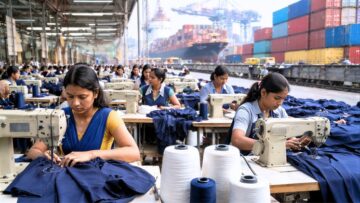
The textiles and clothing industry in India provides jobs to over 105 million people, especially in rural areas and for women folk. It is expected that the Indian textile sector has the potential to become a $350 billion industry from the current level of $110 billion, creating jobs for about 35 million more people by 2023.
In accordance to that, the industry has sought several incentives like halving excise duty on man-made fibre and filament, besides bringing changes in labour laws in the budget for the next fiscal. The industry has also demanded better market access to big markets like the US and EU by means of a trade pacts to help realise its untapped potential.