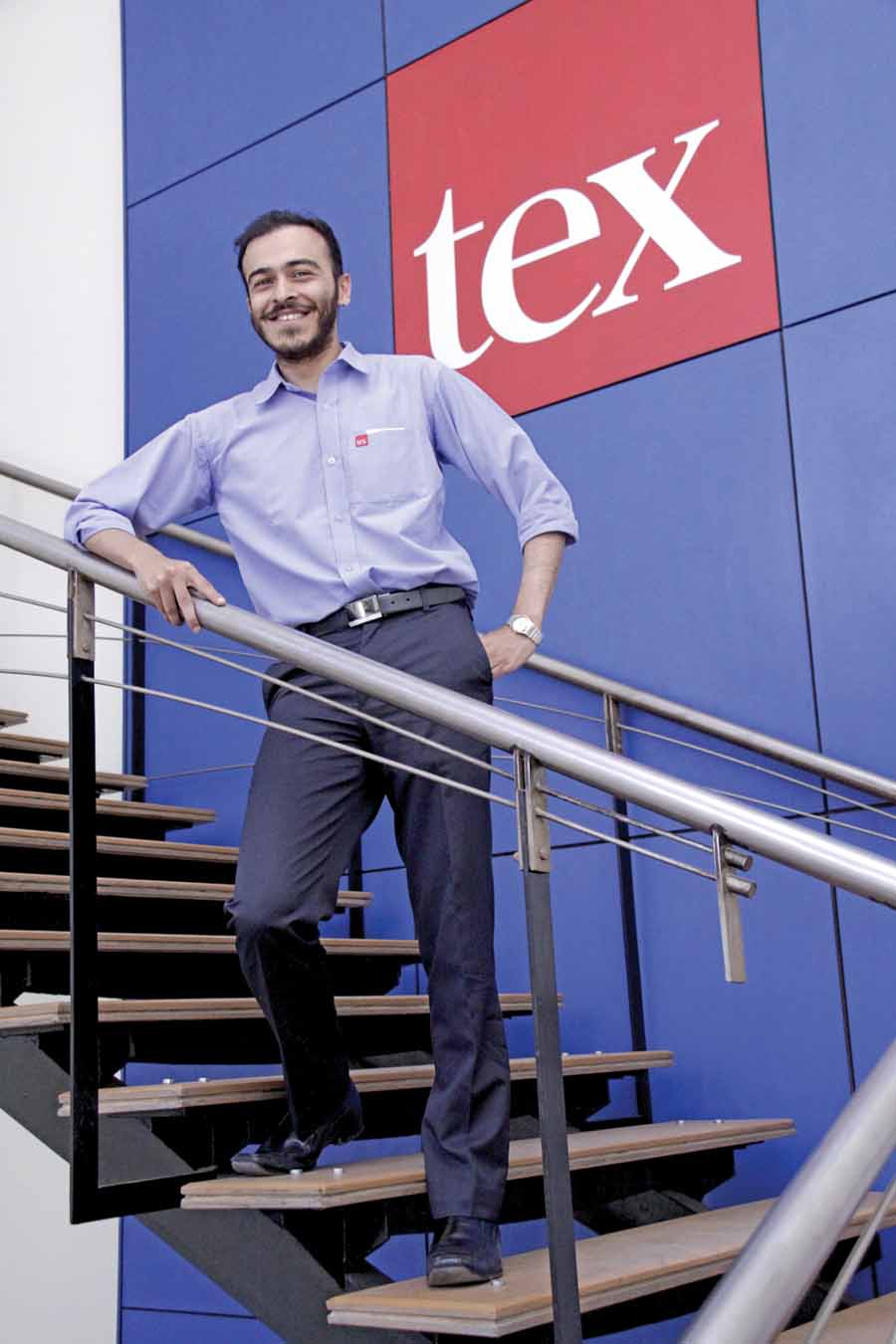
 ‘Power to the youth’ is becoming a national anthem with companies and even political parties opting to put their future in the hands of the young and restless… Our industry is no different and increasingly we are seeing the next generation seize challenges to take their companies forward with new vigour, building on collective vision, but with renewed passion and deep understanding of what needs to be done. “I didn’t actually bring in new thoughts and ideas, but started focusing on harnessing our existing core strengths, and make them more visible, so now more then selling a product we are trying to sell strength. It became clear to me very quickly, that we are unmatched in service, delivery, product development and premium high fashion zippers,” says Mudit Tandon, Vice President, Tex Corp Limited, son of the Managing Director Anil Tandon in conversation with Team Apparel Online recently.
Sitting at the Tex Zipper factory in Khandsa in Gurgaon, Mudit comes across as a very focused and strategic thinker who has spent the past 10 years acquiring experience and knowledge that could help him in ultimately shaping the future growth path of his company, which is today India’s only multinational trim company.
“What I am looking at is what can I do to solve somebody’s problem to enable him to charge a higher FOB, reduce his cost and make his supply chain more lean, and then take a portion of that value and pay for initiatives to support these custom solutions.” Mudit Tandon, Vice President, Tex Corp Limited
Mudit has an MBA from the Indian School of Business in Hyderabad, and has worked in a private equity firm in Bombay. Leveraging on skills he has picked up from his education and experience, he talks about the role of Tex Zippers in the vibrant and often confusing apparel supply chain. “What I am looking at is what can I do to solve somebody’s problem to enable him to charge a higher FOB, reduce his cost and make his supply chain more lean, and then take a portion of that value and pay for initiatives to support these custom solutions,” says Mudit.
One of the biggest gap areas which Mudit identified when working in merchandising for three years before he joined Tex, was the criticality of zippers on PCD (planned cut date). Whenever there is a zipper in a garment, more often than not, the first operation in the stitching of the garment is zipper. You cannot start cutting a fabric until you have zippers. “That is what I have been driving at, that I will get you your zippers in-between fabric arrival and PCD, which enables you to dye your zipper, as per your fabric arrival. That means you have better colour matching, meaning better garments and fewer rejections,” argues Mudit. The key to this is committing to deliver as quickly as 10 days. “We don’t promise – we actually deliver. Last quarter, we delivered at an average of 8-9 days and no other zipper manufacturer including global giants can even promise such short deliveries,” says Mudit confidently.
With two factories in India, local manufacturing in Bangladesh and 15-day delivery in Pakistan, Vietnam and Indonesia, Tex has captured the sharp delivery market, which comprises of high-fashion customers, and sophisticated customers who wish to keep a lean supply chain.
Besides building on the company’s service-oriented strength, which was already in the DNA, Mudit has also strengthened product capabilities. “What I have done is created the design lab and an R&D cell. Now we have two parallel cells working, while the R&D cell is now being put in place for technical issues like, how can you make zippers smoother, how can you make it last longer in washes, etc. while our design team is working directly with design teams of end buyers to add life to what has been perceived as a ‘trim’. We are the first to the market with new developments like shining zippers, super smooth zippers and chunky jacket zippers,” shares Mudit.
Tex’s in-house design cell works on design innovations where the zipper is the centrepiece, and prepares garment design collections of every season. This proactive design-driven approach enables Indian garment exporters to bag more orders from other countries, in-turn improving Tex’s business.
He points out that the in-house R&D team works not only on Tex’s internal R&D, but also works to solve customer problems. One of the biggest challenges in India is that customers don’t often know how to stitch or wash zippers, their tailors or washing teams don’t understand that it’s a machine. “Zippers are the only machine you are putting onto a garment. So if you are going to abuse the machine, it will seize to work, it’s a highly engineering product. So, you have to be very careful during attachment and during washes,” reasons Mudit. Giving an example of Bangalore, where a lot of washing takes place, Mudit informs that a person from Tex keeps on taking rounds at customer factories to see what all new washing chemicals are coming, so that R&D can be done in advance. “Because unfortunately by the time you realize there’s a problem with your zipper in washing, your shipment is coming and because your goods have already been stitched, so nothing can be done. Our R&D team is in place to pre-empt this to the extent possible” argues Mudit.
Tex’s in-house design cell now works on design innovations on garments where the zipper is the centrepiece, and prepares garment design collections of every season. This proactive design-driven approach enables Indian garment exporters to bag more orders from other countries, in-turn improving Tex’s business.
Very clear on what direction the company must take, Mudit has strategically placed the company on four pillars which he considers as the core strength of Tex – unmatched delivery, design cell, R&D and capability to provide customised pullers, products and finishes – all of which he is confident will automatically result in growth, because they enable the customer to either charge more, make a better product or reduce complexity.
“During my time in Private Equity, I learned the trick of identifying strengths of a company, honing them and projecting them to create value. All I have done is made visible what the industry accepts as our strength and also the reason for our international growth despite tough competition from other world leaders,” concludes Mudit.