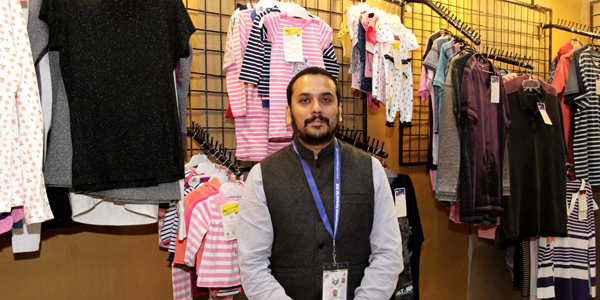
 The collection of N C John & Sons, displayed at the India International Garment Fair, revealed a clear evolution from their earlier focus theme of 100 per cent organic garments to more non-organic offerings. In the evolution, the company has brought about a score of changes in their production process.
“Over time, organic has gone from being a niche segment to a mass segment, so the niche appeal is gone and the customers too have become more aware about organic products. Now the wow factor is no longer a catch to get a premium price. For a company of my size, we need to have that additional 15 per cent more, while initially customers were willing, but today they are not. So for me, it doesn’t make much commercial sense to work exclusively on organic,” reasoned N C John & Sons, CEO John Mathai, on why expansions are happening in the non-organic segment.
However, he did add that they do still have a loyal customer base that is still looking for organic garments. So while the production percentage of organic compared to others has reduced to around 10 to 15 per cent, the quantity of organic products has seen a rise.
Speaking to Apparel Resources about their current specialization, Mathai stated: “We do anything in knitwear, men’s, ladies and kids — all three; and as this is a dynamic industry, the styling keeps changing. We are into more value-added fabrics, like there are a lot of burnouts, which are coming into the market right now. So, we keep evolving depending on where the market is going.”
He also shared that their regular buyers also keep changing their styles. Their style has changed from the more basic to the value-added, which is the trend now. “While some of the inputs come from the buyers, others come when we go to fairs and pick up the market trends from there,” adds Mathai.
The Tirupur-based company has in-house facilities for embroidery and printing, and works with its nominated knitters and dyers for manufacturing. The reason why we are based in Tirupur is because it is a cluster, and there is ease of working without the need to be fully integrated in knits,” avers Mathai.
He also mentioned that this year, they are not looking to get into knitting and dyeing, as it is a complicated process, but are reviewing options to expand on their sewing capacities.
Talking about Bangladesh that is coming up as a serious competitor for exporters in India, Mathai said, “We can’t beat Bangladesh in terms of pricing, as they have duty-free advantage. But we are not too bothered. We have 150 machines working exclusively for value-added items. The kind of products we are making won’t be possible for them to manufacture. Buyers who need our kind of products will definitely come to us.”
However, he admitted that about three years ago, when Bangladesh was expanding, the neighbouring country definitely posed a big threat. But now, they have settled in their own market, and so has India, each in their own niche market.
On their expansion plans, Mathai stated, “We saw 10-15 per cent growth in 2015, and we would like to grow 20 per cent in 2016, with or without expansions.”
The company, which already has about 150 machines, is also looking to expand and buy more machines for their in-house facility.