Ministry of Textiles (MoT) is expecting a strong and healthy growth in textile and apparel exports to Japan in the next few years and efforts for the same are also being made with the help of Japanese experts. A senior minister of the Textile Ministry said the efforts that both the countries are making shall reap positive results for Indian exporters doing business with Japan. Out of India’s total textile and apparel exports of nearly US $ 40 billion, only US $ 0.5 billion (or less) goes to Japan, which imports nearly US $ 35 billion worth textile apparel annually.
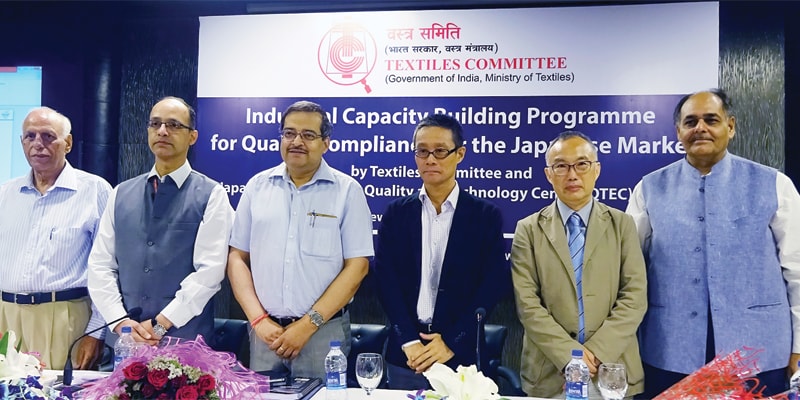
Textiles Committee under MoT is geared up to enhance exports to Japan and is working for the same with the help of experts from Japan Textile Products Quality and Technology Centre (QTEC). The Government of India last year signed a MoU with QTEC through the Textiles Committee with a view to jointly establish and encourage quality compliance activities in the industry. The MoU is expected to usher in a new beginning in the International Trade of Textile and Clothing from India to Japan as Indian industry is marching ahead. Under this MoU, Textiles Committee recently organized an Industry Capacity Building Programme on Quality Compliance of Indian Textiles & Clothing for Japanese Market in 9 cities across the country. The programme was well-attended by the leading textile industry and trade personnel.
Addressing the event in Delhi, Subrata Gupta, Joint Secretary, Ministry of Textiles said, “Japan is one of our closest strategic and business partner, so we required immediate corrective action to increase our textile and apparel exports to the country. Of the total apparel imports by Japan, only 1.2% is from India. We should increase it to at least 5% in the next three years. Our quality is not that poor, and even technically, we are superior to countries like Bangladesh and Vietnam, yet our export is less. Issues lie elsewhere; we need to go deeper for their solutions.”
Ajit B Chavan, Secretary, Textiles Committee, is also positive about this target as he said, “Though our efforts have just begun, we are quite optimistic about this target. We are creating awareness and disseminating all specification, quality requirements, among the Indian apparel exporters.” Apparel Export Promotion Council (AEPC) is also enthusiastic as far as apparel export to Japan is concerned. Vijay Mathur, Additional General Secretary, AEPC added, “Neetee Clothing, a Gurgaon-based apparel exporter, has done few required improvements in its working, like creating worker manual, visual display of machine working etc., and now the company is also doing good business with a Japanese brand Muji. Other Indian apparel exporters too should come forward.” He further added that the apparel exporters willing to work with good Japanese buyers, should have their own environment policies and also should ask their workers about their future aspirations from their job.
Japan revises labelling norms
Consumer Affairs Agency of the Government of Japan has reportedly announced the partial revision of the quality labelling system for textile and apparel products, with effect from 1st April 2017.
In the new enforcement regulation provision, the garment care symbols have been increased by 22 to 41 in terms of numerical digits, and some new care tags such as washing care labelling for mufflers, scarves and shawls have been added, while fibre composition of interlining for trousers has been made mandatory.
Apart from this, care symbols will be attached according to JIS L0001-2014 (care labelling code using symbols), and fibre name and percentage will be required to be mentioned as per the “Textile Goods Quality Labelling Regulation”. Additionally, the manufacturers have to provide the expanded information to the consumers on awareness of the method of cost of caring of the textile product. Also, this has strictly been included in the recently introduced laws that all the new labels should be permanently attached to the textile products, either printed directly on the product or sewn. The label must be visible, indelible and easily accessible to the consumer.
Toshiki Tasaka, Director, Overseas Coordination Department of QTEC; and Kei Funaki, ASEAN and South Asia Regional Manager, Overseas Coordination Department, QTEC deliberated in depth on the subjects: ‘Difference of quality requirements between Western buyers; ‘Quality and Compliance in Japan and JIS Overview’; and ‘The Banned Substance in Japanese Market’ at the event. The Japanese delegates also discussed their country’s market requirements in terms of quality, make-up, benchmarking tools, Japanese industrial standards and various other compliances.
In discussion with Apparel Online, Japanese experts shared that some of the Indian factories are working quite good as per the requirement of Japanese retailers/buyers, and that Japan needs to explore these units. However, more and more information sharing is required at both the ends.
“In majority of the cases, buyers are testing at their end because the JIS standard being followed here by various labs have differences. The same fabric which is passed here by these labs does not pass in Japan. The best way to safeguard for a manufacturer is that whenever he develops a fabric which then gets selected, he should send it to the buyers so that they (the buyers) can test at their own end and meet their requirements. Only then an exporter should go ahead, because most of the times when buyers test the fabric in their Japan-based labs, certain tests fail, but buyers give you some exemptions… Buyers also see from the user/customer point of view whether this ‘failing standard’ is affecting the consumers or not… For example, if tear strength in sheer fabric is not affecting as in a loose garment like in a ladies-top, then the buyer will accept this fabric. So in such cases, one (supplier/exporter) can get exemption.” – Animesh Saxena, MD, Neetee Clothing, Gurgaon
“For JIS rules regarding physical property of textiles, the material should be tested under atmospheric conditions of 20°C. For a tropical country like India, bringing down lab’s temperature is not cost-effective, that is why we test at 27°C. As per my experience of NTC, when I deal with Japanese market, my discussion with worldwide experts, textile scientists made me find out that they accepted the 7°C variation as it doesn’t make any significant difference in the characteristics of the fibres and in case of dispute, Japan should not take advantage of this. Though it may be well established there, till date there is no formal agreement on this point, the sooner it gets resolved, it is better.” – RL Kapoor, Ex. CGM (Tech.), NTC Ltd., New Delhi
“There are few successful Japanese trading companies in Japan and they are working effectively among machine manufacturers. I suggest that being a Government and an independent organization, the Textiles Committee should take similar responsibility and work as an Indian trading company with focus on Japan. It will help the industry right from testing to overall sourcing as every exporter does not have capabilities, resources etc. to further explore Japan. Through this, Japanese companies will have confidence to work with new companies in India.” – KK Agarwal, Textile Sourcing System/Relio Marketing Company, Delhi