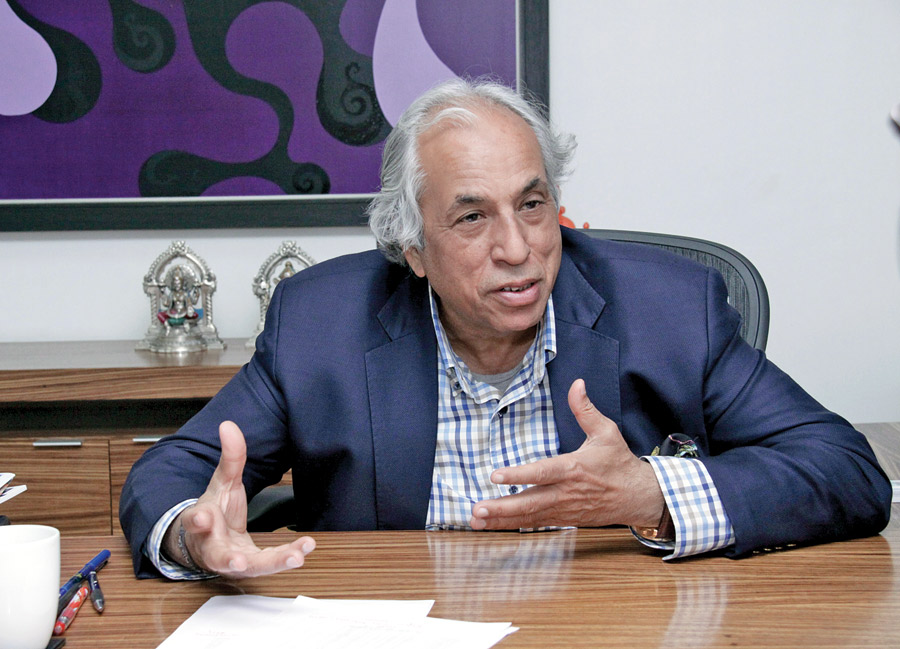
The spacious and tastefully done-up office of Richa Global Exports in Udyog Vihar, Gurgaon, somehow reflects the welcoming personality of its Chairman, Virender Uppal, who today also wears the hat of Chairman AEPC. Uppal, who has taken over the hot seat at a time when things are looking positive for the industry with exports of apparel expected to touch US $ 15 billion this year, is ready to embrace difficult questions with openness, concede shortcomings and take immediate corrective measures. In an exclusive interaction with Team AO, Uppal gets candid on the problems that nag the industry and also how his company has managed to see growth even in difficult times…
[bleft]“Richa Global has been upfront in making investments in technology and also investing in people for growth.” – Virender Uppal[/bleft]
Though optimistic of the opportunities that are coming India’s way at this point of time, Uppal agrees that the industry is still far from being out of the woods. “It has been a difficult three years for the industry and finally we see most of the units running to capacity, with many doing overtime. However, this does not mean that we have miraculously improved as a sourcing destination; it only means we are now more appealing to the buyers, mostly for two reasons – weakened currency and reducing attractiveness of competing countries like Bangladesh and China, due to their internal issues,” reasons Uppal. He frankly admits that as long as the dollar rate remains at around Rs. 60, Indian exporters will remain competitive and the industry will be brimming with business.
Sharing his interaction with numerous buyers that he has interacted with over the last few months, Uppal is confident that buyers are looking at India for bigger share in their sourcing. “The stability of the Indian democracy and the industry’s grip on the fast moving fashion business have attracted many buyers, but we are not able to hold on because of lack of scales and low productivity,” avers Uppal. Going forward he feels that it can be achieved only through trained manpower and technology. At his own company, 7 Sri Lankans are responsible for production efficiencies and quality. “Richa Global has also been upfront in making investments in technology and also investing in people who have the expertise to ensure that technology is used optimally and also systems are in place, which enhance productivity that is why we have seen continuous growth, despite market conditions,” says Uppal.
[bleft]Accepting that the industry is on slippery ground and to assume that the crises is over, would be immature. Uppal urges the industry to take a long view and rethink strategy for individual companies, so that the industry at large can benefit, while contributing more to strengthen the AEPC.[/bleft]
Also important, according to him, is moving out of our comfort zones to newer production bases. “It is not easy and many will resist but eventually it is the only viable solution,” he argues. He urges the industry to take advantage of fresh crop of trained workers coming up near ATDC centres, to establish base in remote areas. “Recently, ATDC opened a training centre at Hindpur, on the border of Andhra Pradesh and already Texport has setup a unit for manufacturing, this is the type of determination that we need,” says Uppal. He, however, admits that though Richa Global has 10 factories spread out in diverse locations in Delhi, Gurgaon, Manesar, Noida and Bangalore, no real effort has yet been made to move into the interiors, though it is something that is on his priority list.
In the meanwhile, over the next one year there are plans to invest around Rs. 25 crore for expansion to strengthen the current capacities in existing categories, as the same has continued to show growth. The garment export division, which registered a turnover of Rs. 285 crore in FY 2012-13, is expected to touch Rs. 360 crore by the end of FY 2013-14. Ready to take initiatives to contribute to society, Richa Global is undertaking education and training modules in their factories in Gurgaon and Bangalore to empower women workers to control their earnings and finances through a welfare project in collaboration with one of their buyers.
According to Uppal, one of the biggest reasons due to which the Indian apparel industry suffers set-backs very easily, is because the industry doesn’t have anything to present to the buyer for fall and winter and even regular customers are forced to get those collections from other manufacturing centres. And it is no secret that the biggest reason for this is that the textile industry in the country, primarily being cotton based, has little fabric to offer which is suitable for winter collections. That is one of the reasons that he is taking the demand of his predecessor at AEPC for 5% script for imported fabric forward with the same enthusiasm.
Even importing fabric to meet any such demand is a herculean task and the complexity of the procedure has been a deterrent to even attempting to import primarily synthetic fabric which is the base for many winter collections. “Even for a company like mine which has a strong logistics department, we avoid importing fabric and only import those which are nominated to suppliers in Taiwan and China. Years back when we started the Ann Taylor business, we collaborated with Vardhman and Nahar to develop a fabric that the brand was sourcing from China and once we could show them quality we stopped sourcing the same,” recalls Uppal.
In fact, the cumbersome procedures associated with the trade including custom clearance are on the priority list for Uppal, now that he is steering the AEPC for the next two years. “I truly feel that if import and export procedures are simplified every exporter can easily add another 3-5% to its turnover,” says Uppal. He bemoans the fact that product classification is still based on what was prevalent during the quota regime, making it an unnecessary time consuming and frustrating experience when applying for drawback. “How does it matter if I have added a button to a T-shirt or made a V-neck instead of a U-neck, the idea is to compensate for duties paid, but still the classifications are multi-layered requiring lot of paper work and many times confusion on where the product should be placed,” adds Uppal. All we are asking for is a simple single window for clearance which is easy to negotiate.
Crushing the perception that AEPC is serving the interest of a few exporters, Uppal strongly feels that it is only a few who take interest and that is why the same faces reappear again and again. “My company is going through a restructuring where the family has amicably decided to divide the business with effect from October 2013 and a lot of my time and effort is going into getting the new structure in place, yet I took up the challenge as no one else was coming forward to take responsibility. Whatever we fight with the Government for, be it duty drawback, market access scheme, wage rates or service tax issues, is in the interest of the industry and the benefit also goes to everyone; so how can I serve my own purpose?” he questions.
Accepting that the industry is on slippery ground and to assume that the crises is over would be immature, Uppal urges the industry to take a long view and rethink strategy for individual companies, so that the industry at large can benefit, while contributing more to strengthen the AEPC. “The industry needs to come forward and use the AEPC more gainfully, instead of criticizing the association, people need to come forward in support, so that the Government which at open forums admits that the industry is critical to the economy is compelled to make critical changes in its policy to give the industry a ‘special status’ befitting its national importance,” concludes Uppal, who feels that a change is coming in and the Government corridors are now more receptive to the industry needs.