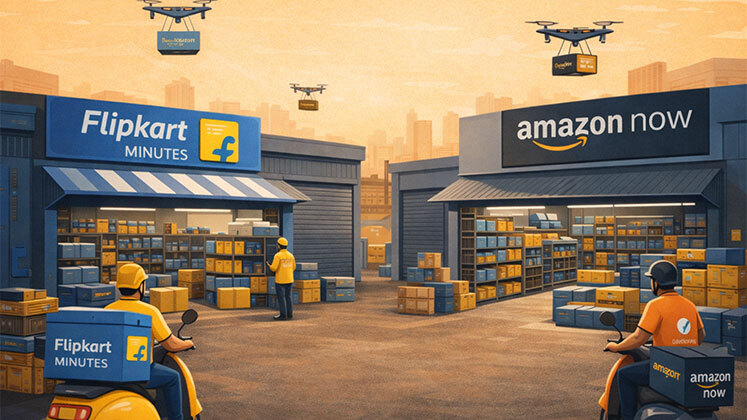
E-commerce giants Flipkart and Amazon are rapidly expanding their quick-commerce operations in India, even as some early pioneers in the 10-minute delivery segment slow expansion to prioritise profitability.
The aggressive scale-up by the two companies comes amid a broader reassessment of the economics of ultra-fast delivery by established players such as Swiggy and Zepto, as well as an ongoing debate over labour conditions in last-mile delivery networks.
Flipkart, owned by Walmart, entered the quick-commerce market with the launch of its Minutes service in August 2024. According to people familiar with the company’s plans, the platform has been adding around 100 dark stores every month during 2026, a pace expected to continue until June. If maintained, the expansion would increase Flipkart’s dark store network to roughly 1,200 locations, up from about 750–800 at present, placing it broadly in line with the networks operated by Zepto and Swiggy’s Instamart.
A person familiar with the development indicated that Minutes currently operates in around 70 cities and is expected to expand to approximately 250 cities by June. The individual added that the service is recording month-on-month order growth of 16–18 per cent, with an average of 1,000 to 1,100 orders per day per dark store, while more mature facilities are handling higher volumes.
The same source noted that Flipkart is pursuing aggressive expansion into Tier-2 and Tier-3 towns, while also strengthening its presence among urban consumers in major cities where market leader Blinkit remains dominant.
The expansion coincides with Flipkart’s preparations for a potential initial public offering, which could take place as early as this year. Industry analysts note that quick commerce is increasingly encroaching on traditional e-commerce growth, particularly in high-frequency categories such as groceries and fast-moving consumer goods.
Amazon is also scaling up its quick-commerce offering through the Amazon Now service. According to another person familiar with the company’s plans, the firm has accelerated its rollout since December, adding around two dark stores per day, and is expected to reach approximately 500 facilities in the near future. The same individual stated that the network is currently processing between 300,000 and 350,000 orders per day.
An Amazon spokesperson stated that the company intends to continue expanding the service aggressively, adding that the rapid scaling reflects Amazon’s commitment to serving more neighbourhoods with faster delivery options. The spokesperson explained that the service allows customers to receive essential items within minutes while maintaining broader delivery options ranging from a few hours to next-day fulfilment.
Earlier, Amit Agarwal had observed that the company had experienced strong customer traction in cities where its quick-commerce service has been introduced, intensifying competition with Blinkit, Instamart and Zepto in major urban markets.
At present, Zepto and Instamart each operate around 1,100–1,150 dark stores, while Blinkit remains the market leader with approximately 2,100 locations. The Gurugram-based company has announced plans to expand its network to 3,000 dark stores by March 2027, representing one of the most ambitious scale-up programmes in the sector.
A senior quick-commerce executive noted that late entrants face challenges in securing suitable real estate and labour because several companies are already active in most large urban markets. However, the executive indicated that both Flipkart and Amazon continue to invest heavily because achieving leadership in the quick-commerce segment is strategically important for their long-term growth.
Meanwhile, Swiggy stated in its October–December earnings update that its earlier expansion of the Instamart network had focused primarily on geographical coverage and network densification, as well as expanding hyperlocal product selection. The company added that future store additions would increasingly depend on local demand growth and network utilisation, rather than capital availability.
According to a recent research note by brokerage firm Bernstein, the performance gap between market leaders—Blinkit, Instamart and Zepto—and challengers such as Flipkart, Amazon, BigBasket and JioMart widened significantly in 2025. The note suggested that competitive intensity is likely to increase further in 2026, with leading companies focusing on strengthening unit economics while challengers attempt to establish a meaningful market presence.
The brokerage also expects aggressive discounting and continued dark-store expansion during the first half of 2026, as companies compete for customer loyalty in India’s fast-growing quick-commerce market.