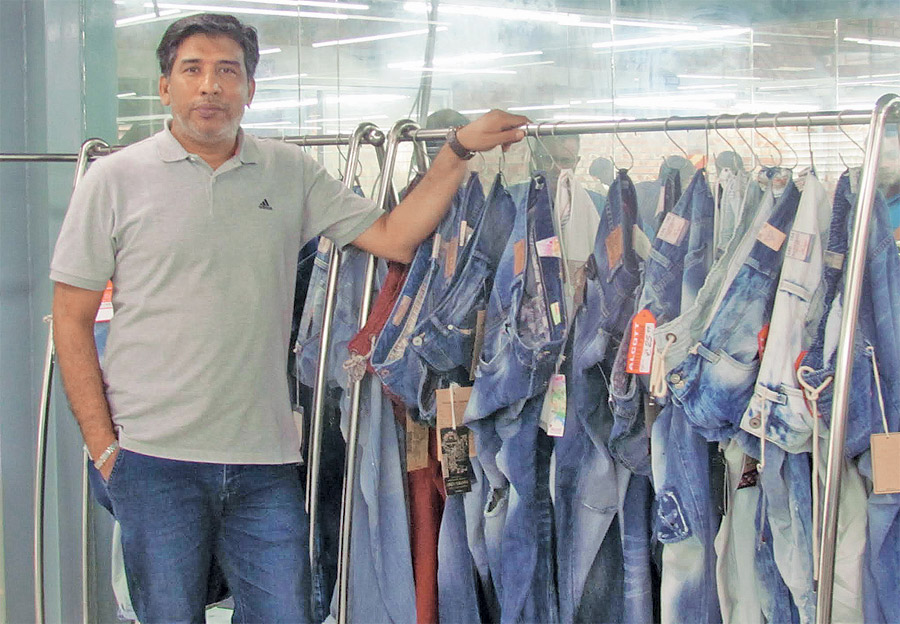
Denim is an ordinary fabric without a wash. It comes to life only when it undergoes different washes. Driven by his passion for denim, Md Nazmul Kabir, Managing Director, Fashion Globe, recently inaugurated his state-of-the-art denim washing unit at Ashuliya which is indeed one of the finest in Bangladesh with all latest versions of washing and finishing technology from Turkey, China and Bangladesh. Kabir says, “I cannot stop myself getting involved with my finishing experts and workers when denim is being transformed through various processes at my washing plant,” says Kabir who started his initial career by joining a knitted garment manufacturer and then switched over to Ha-meem which exposed him to the world of denim.
The journey continued working with big groups, and the turn came in 2006 when Kabir started his own buying operations by the name of Fashion Globe. Within a year, he started his own factory by the name of FGS Knitwear, producing half a million pieces per month. Driven by his experience and passion for denim, Kabir ventured into basic denim bottom manufacturing after stabilising his knitwear business. “Alcott was our first buyer who placed an order of 10,000 pieces and since then my entire focus has been on denim,” says Kabir who has now shaped himself as a value-added denim specialist catering to medium to high-end brands.
Fashion denim is all about the play in washing and finishing and with new techniques and technology there is no limit to creativity. Besides fashion element, the buyers are now asking for green/sustainable denim which is produced with minimum usage of water and chemicals. “In our new laundry we have new ozone machine which needs minimal water and chemicals; we have espresso machine with which we can do acid wash, tubular wash with very less water and chemicals. This plant is going to produce environmentalfriendly denims,” avers Kabir who has judiciously picked machines for washing and dry processes. The drying and washing section has local machines. The dry process machines which handle critical products are from Turkey and China. “The espresso machines which we have, no one has in Bangladesh as of now. With this machine you can avoid different shades, maintain the elasticity strength of the denim and also use less chemicals and water. These machines are though expensive, you can use them for 1520 years,” adds Kabir.
This new washing plant has attracted many new buyers for Fashion Globe. “We are the only supplier in Bangladesh for Pepe Jeans; now we are starting with Mango Man. We are also in talks with Calvin Klein,” informs Kabir according to whom even Spanish brand Cortefiel which is presently sourcing denim from Turkey is in talks with him.
The added advantage of the new washing plant is much lesser human intervention. “The latest version of laser machine from Vav which we have installed gives the output of 50 people producing 5,000 pieces a day. It is replacement of dry processes like hand sanding, whiskering, and destroyed look,” informs Kabir who bought the machine for US $ 200,000 and expects ROI in about 3 years. With a total investment of US $ 3 million, this washing unit of Fashion Globe is a medium sized washing plant; it would be running to its full capacity in 3 to 4 months with product capacity to produce 2,000 pieces in a day.
“By July 2016 we are going to double our capacity; right now we are doing about 300,000 pieces per month, we would make it to 600,000 pieces. So the capacity by the end of 2016 would be 900,000 to one million pieces per month,” adds Kabir who is looking at touching US $ 50 to 55 million by next year and is very confident that by 2017, the company would be standing at US $ 80 to 85 million turnovers.
Expansion in sewing unit is also on cards. Presently the company has 10 lines in its denim unit and now it is putting up a green factory which is very near to its existing unit in Ashuliya. “The project is under construction and would have 18 lines with per day output of 30,000 units. The kind of space we have, we can put more lines in future,” informs Kabir, who has already applied for ‘Green’ unit certification and the product which would come out of this unit, would not use much of electricity and water.





 Bharat Tex Special Report 2026