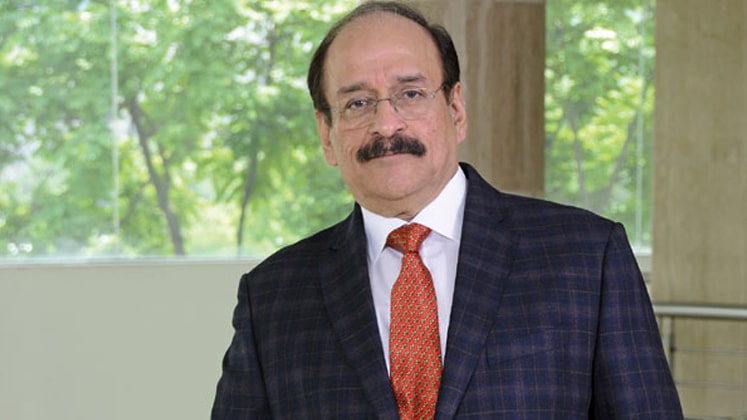
AEPC has been in news for all the wrong reasons in the last one year, from corruption charges to elitist agenda…, besides its executive members being at the receiving end. As Ashok Rajani takes over the coveted position of AEPC Chairman, it becomes imperative to understand his line of action to not only undo some of the damages, but also change the image of the council from a self-centered organization, working in the interest of the bigger exporters and a ‘privileged’ few, to a vibrant export promotion council in the true sense. In an exclusive interaction with Apparel Online, the new Chairman expressed confidence of a productive tenure, though he is carrying forward an old game plan that has not reaped success in the past, and he challenges those who question his sincerity of intent to offer an alternative action plan!
Right at the beginning of the interaction, Rajani sets the record straight… “Export Promotion is my passion as well as top priority,” he says vehemently. This is one of the reasons that besides holding the post of Chairman, Rajani has also retained the portfolio of export promotion for direct action and deliberation. He accepts that the perception of AEPC needs to change and having served many top positions in AEPC for over a decade, he has the knowledge and confidence to take upfront measures to ensure that exports from India not only grow, but that the small and medium level exporters also get better opportunities for wider market access. A glimpse of his passion and efforts find reflection in the outcome of his recent visit of Iran, an unexplored market for Indian exporters. Though Rajani agrees that Iran is a small market as of now and may not really add to the export figures, he feels that the retailers there are looking for collaborations post removal of sanctions and a first entry advantage could mean a head start to a fruitful relationship
ESSENTIALS
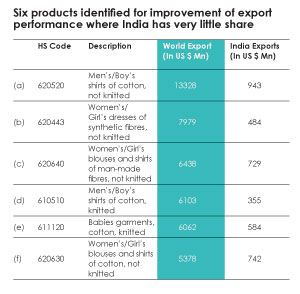
The council has identified six products, 3 of which – men’s and boys’ shirts of MMF, underpants & briefs of cotton, and babies garments of cotton are products where China has offloaded its exports in 2015 over 2014, creating opportunities.
The council is also planning workshops in clusters to understand the existing status/utilization and the problems in availing the FTA benefits, if any, and advise on how to utilize them better in terms of product advisories.
In the meanwhile, the Ministry of Textiles has proposed a target of US $ 20 billion for the financial year 2016-17 to the AEPC, which was looking to achieve around US $ 18 billion during the period, considering the global conditions. This proposed growth of 18.34 per cent is admittedly a difficult task as 14 of India’s top 20 export destinations this year have shown decline, with the EU; India’s largest destination showing a decline of 7.6 per cent. The most worrying part is that even the last quarter has shown a decline, in spite of being a traditionally good season. “Our export last year has not grown as per our expectations, 1 per cent or 0.9 per cent growth is nothing. However, we are not giving up and there are many things, which AEPC is planning on doing in the coming days, which I believe will benefit the medium-level exporters and accelerate growth,” says Rajani with full conviction. Now that Rajani is at the helm of both the AEPC and export promotion, it has to be seen if he can get the growth story rolling on with already established agendas of product, market and capacity building.
Identifying potential product categories…
Emphasis has been laid on improving export performance in top 20 garment products in the world trade basket. In addition, the strategy is to specially focus on exports in those products wherein India’s share is low, for which the council has identified six products, 3 of which – men’s and boys’ shirts of MMF, underpants & briefs of cotton, and babies garments of cotton are products where China has offloaded its exports in 2015 over 2014, creating opportunities. To increase presence in these categories, buyers of above products will be strategically invited to the IIGF and other BSM events. Exporters shall be advised to prepare dedicated collection for the same and B2B meetings of the buyers and exhibitors who are well prepared to deal in the category will be arranged at the event.
Alongside, the AEPC will continue to push for 2 per cent duty-free import of fabrics, which are not being manufactured in India. “Currently, we are not into the exports of top 10 product categories just because we don’t have the fabrics. If we want to increase our apparel export by US $ 1 billion, fabric requirement will be of around 36 crore metres to produce 21 crore additional pieces and create millions of job opportunities. For this we don’t need anything else like drawback or any other facility, just the 2 per cent concession is enough,” stresses Rajani passionately. Though past Chairmen have also been emphasizing on the same, Rajani feels that the changed market scenario could do the trick this time, as Government is now keen to see growth in this sector.
Development of new markets…
the focus will be on the Middle East, CIS and Latin America, Argentina, Cuba, and also to reinforce garment exports to Denmark. “Though these are very small markets, but market diversification process has to go on, and it has to include interest of smaller exporters also,” he says. AEPC will hold workshops on utilizing market access of RMG in countries that India has FTA arrangements like Japan. The council is also planning workshops in clusters to understand the existing status/utilization and the problems in availing the FTA benefits if any, and advise on how to utilize them better in terms of product advisories. There will also be targeted seminars on potential for doing business in Latin America, Africa and Russia. The industry has already heard these initiatives, what is required, is market studies with clearly defined strategies to get into these markets. Holding a few seminars or even organizing BSMs is not going to help, some fresh perspective needs to be built on just how India could conquer newer markets; it needs lot of deliberations and image-building exercises.
 Capacity building to strengthen the internal systems…
Capacity building in garment factories is another area which Rajani is concentrating on. “We are planning more workshops on lean management, preparatory support for the development of fabrics, styles, shapes and colour for next fashion season through forecast seminars,” he shares. To motivate exporters to do better, AEPC will recognize exporters under many new categories, beyond just turnovers. Some interesting categories are: Award for women empowerment for those having women workforce of more than 60 per cent of total employed in a year; award for skill India on the basis of highest number of workers trained and absorbed through planned training; award for “Rurbanisation’ on the basis of setting up of garment manufacturing units in Rural/New Areas, which are away from traditional garment clusters and also an award for sustainability initiatives. How the AEPC will strategically support exporters that take up these challenges is something the industry would certainly like to know.
Synergy between handcraft and exports…
Handwork, which is the strength of India will also be focused by projects that will connect Indian artisans with the international brands and designers, directly or through some NGO’s who are working for the betterment of such artisans manufacturing Indian art and craft textiles and embroideries. The emphasis will be on pushing Indian artisans to work on Indian art work and to upgrade the standard of living of artisans through direct self-employment. Further, they will be provided the new age designs and motifs through innovative textiles besides the traditional motifs used. Creating such synergies is good for craftsmen, but AEPC is about export promotion and such initiatives, as seen in the past do not really support export growth, though funding in this area is worth the effort!
Ground realities from AEPC’s perspective…
On the anomalies for which the AEPC has been on the receiving end, Rajani strongly clarifies: “AEPC is not working for a selected people or group. Whatever BSMs or fairs we do is mainly for small and medium level exporters. All our recent BSMs, whether it is the one in Dubai, Uruguay or Chile – have been very successful. I immediately notice and instruct my team to look into the details of all the emails I get from exporters sitting anywhere or from any foreign buyer, and reply accordingly.” He however added that most of the participants exhibiting at the various BSMs/fairs do not take to product and design advice positively and insist on showcasing their best selling products rather than focusing on new ones, suggested by fashion forecasting agencies or even experts invited by AEPC to guide the exporters. “There are many repeat companies at various BSMs and events like Magic, because they have created a small buyer list from these events that they follow-up on each visit, the focus is rarely on finding new buyers with differential products.” Highlighting an irony in contradiction, Rajani adds, “There are always some complaints about IIGF, but already 293 stalls have been sold for the upcoming event and as there is a long waiting list, we have decided to add 60 more booths. Maybe creating a dedicated cell to work throughout the year with exporters would be more impactful than just talking to them before an event.”
Essentials
There will be a total of 13 main events over the year for export promotion activities under various strategies, and India Market Days – bringing buyers for direct marketing.
On the objections raised by the Apparel House Exporters Association, Rajani is vocal in the defence of AEPC’s line of action. “When I was elected Chairman, I asked the Group to work with us to find an amicable solution, but they did not support me. They should make up their minds on how to move forward with Apparel House showrooms. Many of them have not paid their maintenance charges, and some even want to open their retail store or use the same for office purpose. Rajani also claims that he approved Rs. 25 lakh fund to promote Apparel House showrooms and asked the AHEA to do as they want with this fund to get desired results, but they did not come back with any plan and the amount remained unutilized. It must be remembered that policy making is an art and people who are not experts in the same cannot come up with feasible ideas, it is for the AEPC to take everyone along and create a proposal for the inclusive benefit of all, expecting laymen to chalk out and execute a long-term strategy is unreasonable.
There have been voices against the IAM located at the Apparel House, but Rajani stresses that one has to understand that the institute is an extension of export promotion as whoever is getting training is going back to the industry, so that is part of our efforts to create new talent. “PM is insisting on skill India and we are doing the same while the group wants to shut it down. I don’t understand how and why it has become ‘illegal’ today when all the past and present secretaries and various ministers have come, attended events like convocations here. It was not as if the ministry is unaware of the activity!” he says.
On the recent case filed with the Company Law Board (CLB), Rajani feels that a matter getting a hearing at CLB is not as big a thing as the group is making out to be. “We have already replied to all the points raised at the CLB, there is nothing to hide. Those who are blaming us for inactivity and malpractices should fight elections, now that the EVS system is in place, and become a part of the council. The Commerce Ministry has expressed happiness with the way e-voting was conducted in the recent elections at AEPC; there is no scope for manipulation. I request exporters not to damage the image of the institute which has taken so much time, energy and resources of the industry,” concludes Rajani.