In the last 16 years of operations, First Steps Babywear has witnessed more than 100 folds increase in its infrastructure, while focusing on single dedicated product category- babywear. The growth has been significant, with the company working with many prestigious clients and not only from UK, as was initially conceived, expanding from 1 factory to 7 factories (all in and around Bangalore), out of which 2 are in process to get green certification. Now, adding one more milestone to its journey, the company is foraying into Sri Lanka. In a discussion with Apparel Resources, Richard Dsouza, Director of Projects and CMD of the company touches upon various aspects of the company’s growth and future plans.
Founded by Manish Pasi in 2002 with a modest strength of only 30 machines, First Step Babywear now has 3700 stitching machines with over 9000 employees. With a total of 7 units, (3 in Bangalore, 4 in Hosur (Tamil Nadu), which are also nearby Bangalore), the company currently produces 54 million pieces per year. Until recently, the company was working with more than 40 buyers, mostly from the UK like M&S, Mothercare, and John Lewis, but it has now entered the US market as well. Richard attributes many reasons that contributed to such an impressive growth of the company. One of them being the fact that babywear is a relatively recession free industry. “From day one, it is a growing product category. The volumes may reduce but stability always comes through”, says Richard.

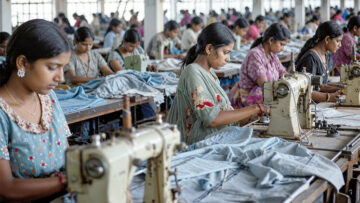
Strong overall knowledge of the founders and core team of the company, be it in the product, market or manufacturing and continuous investment in advanced infrastructure across all departments, has made First Steps Babywear different from others in the category. The company has centralised cutting infrastructure (Lectra, FK Group, and Gerber) and in-house embroidery (30 machines with 28 heads each, all from Barudan). This infrastructure is helmed by properly trained workers. “We are working at 75 per cent efficiency on all our product lines,” added Richard. Significantly, 80 per cent of the products produced are from fashion lines while the balance 20 per cent is basic line. The company hires all kinds of operators be it fresh, semi-skilled, or fully- skilled. They educate and train the workers about its systems with the help of two in-house skill training centres. Various levels of support to the workers, is also a strength of the company like it provides doorstep transportation, free to its workers who come from nearby 30 to 40 villages. The company is also paying an average of 13 per cent annual bonus to them.
Strong focus on sustainability is another advantage to the company as well as its workers, as two factories are in the process of receiving green certification. Experience with these two factories are being implemented in the other factories and in the long run, all the factories of the company will be green. The company has installed a 750 KW solar power rooftop plant, all machines are fitted with servo motors, complete LED system, and eco-friendly equipment. Richard shared, “We strongly believe in sustainability and completely curb any kind of wastage, no matter whatever or however it is.”
Why Sri Lanka?
With all such positivity and strength, why the company is moving to Sri Lanka at this point of time when from day one all of its operations have been in and around Bangalore, is a question that Richard answers with logic. He notes,“We chose Sri Lanka as our next manufacturing base, mainly to get the duty drawback benefit. As Sri Lanka is offering 10 per cent duty drawback, this will help us to be competitive. At the initial stage, the target is to produce 0.5 million pieces per month in Sri Lanka while within a year it will be more than double, as the target is to manufacture 12 million per annum.” He further adds that India’s production will not be impacted due to Sri Lankan initiative.
The Sri Lankan initiative is a result of a recently drafted joint venture with Sisalu Fashions, the company will soon be a full fledged unit with all cutting, embroidery, printing, and stitching, all things will be in-house. As a strategy, the production of basic product lines is being shifted there. “Though Sri Lanka is somehow 15 to 20 per cent more expensive than India due to higher labour cost, quality rejection is comparatively less in Sri Lanka as they boast of skilled operators in the country. This is also one of the main advantages of setting up units in Sri Lanka,” concludes Richard.
As UK is the main market for the company, it has an office there which provides support for product development & design; it’s a marketing hub for all UK based clients. It assists India operations with conversions of designs & orders seamlessly.
Dedicated to 100 per cent knitted products, the company sources yarn from Kolhapur and outsources knitting from Tirupur.
6 years ago, the company started its domestic brand ‘Miniklub’ and as of now it has 600+ outlets across India with 14 exclusive EBO. There is a dedicated factory for the domestic production and the company is enjoying good growth in the domestic market, also.
Why only UK so far?
So far, the company was exporting to the UK only as it was getting enough volume from UK buyers. But, with recent developments, as some UK-based brands have faced the heat of the Brexit movement, now the company has entered the US market and is working with brands like Carter. Most of the clients of the company are well-established brands. Huge volumes offered by bigger brands has motivated the company to work mostly with such brands.

 Bharat Tex Special Report 2026