The fast evolving Bangladesh industry has developed a unique endogenous model where factories open buying operations to fill their capacities, or buying houses diversify into manufacturing for faster and more reliable execution of orders. Classic Group is one such example of the latter, which was started as a buying office in 1991 and subsequently integrated with a manufacturing facility in 1998. Starting as a shirt manufacturer as its core strength, Classic got into bottom manufacturing so that it could grow its business with the existing buyers by offering them diverse products. The young and enterprising Mohammed Taief Azmi Irfan, Director, Classic Group, is taking his father’s business in the right direction by being futuristic, taking wise decisions at the right time…
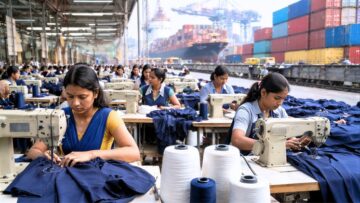
“As a buying office we dealt in jackets, sweaters, sweatshirts, but we saw a drop in orders since buyers were more interested to work directly with factories, which eventually motivated us to start our own production. Initially we faced hiccups in moving to the manufacturing landscape, therefore we shifted our major time and attention in this area,” shares Irfan, who joined his father’s company in 2006 after graduating from UK and working for one year to gain experience. After proving his metal in the company’s other businesses, he finally joined the garment division in 2009. “Soon after we added another factory for better work distribution, and today we are producing 2,00,000 shirts and 1,50,000 pants per month,” adds Irfan.
A major supplier to the US and Europe, Classic has initiated a green project, scheduled to be completed by December 2014.The company has even applied for platinum rating certification for the said project and very soon it is going to be certified by USGBC (United States Green Building Council).” Till about six years back compliance issues were not a big deal, but now it has become of paramount importance and it will not be surprising that the buyer’s next focus would be on opting for just the green factories; this project is a proactive approach towards future and it’s all about waste management,” says Irfan.
 A total investment of US $ 15 million has been marked for the new factory which would have 30 lines with around 1,500 machines. A practical person, Irfan shares that environmental responsibility and future buying trends are not the only motivation for going Green; in fact it was also the realization that as the demand for Green products increases from the consumer’s end, the opportunity to demand higher prices will also increase. “An effective way to create better margins,” says a charged Irfan.
The company which already works with environment-conscious retailers like Kenneth Cole, Roots-Canada and Perry Ellis, is looking to improve bottom lines by also working for niche buyers like Calvin Klein and Zara with its new unit, where expected quantities per style would be lower but price would be higher. “We would start manufacturing high-end shirts like taping shirt, shirts with specialized stitch techniques for which the retail price ranges between US $ 180 and US $ 250 per shirt. Buyers like Walmart give order for 1,00,000 pieces in 1 style, but the margins are too tight and the competition is cut-throat. Value-added products help us build better bottom lines,” reasons Irfan.
Challenges working with a brand like Kenneth Cole are aplenty and Classic works hard and intelligently to equip itself to render the best services. The biggest challenge is sampling, wherein the company makes 1,500 samples in different styles in just 7 days.
Kenneth Cole is one of Classic Group’s chief buyers and the company enjoys the status of being exclusive supplier to the brand in Bangladesh. Earlier the brand was getting its shirts manufactured in Korea, but as the country became dearer as a manufacturing base they came to Bangladesh, where Classic became their preferred choice. Today, out of the total capacity of 1,500 sewing machines at Classic, 50% has been dedicated to Kenneth Cole (KCNY label). The other reason for retaining itself as preferred supplier is that in an order of 60,000 pieces of Kenneth Cole’s (KCNY label), there are 50 different styles which no other company in Bangladesh is apparently equipped to handle, and Classic took the challenge. “This one buyer takes care of the entire salary of my workforce as retail price of one shirt is US $ 150; the balance 50% of my production floor is running to keep the machines occupied as we are running basic garments on them for buyers like Lidl and Aldi, who obviously cannot pay me like Kenneth Coles,” candidly states, Irfan.
However, challenges working with a brand like Kenneth Cole are aplenty and Classic works hard and intelligently to equip itself to render the best services. The biggest challenge is sampling, wherein the company makes 1,500 samples in different styles in just 7 days. To address this, Classic has dedicated one full line for Kenneth’s salesman samples each month. “Though they give us 10 days for the same but I have tuned my sampling team to provide more than what is expected from them,” says motivated Irfan.
The other challenge is merchandising, as the labels have to come from Hong Kong and fabrics from China, all of which makes it very difficult to maintain Kenneth’s stringent deadlines that cannot be missed even by a day, as the products have to be in store on a particular date, even if it means air-lifting.”This stellar performance of the sampling department is complemented by the Classic Group’s strength in maintaining a strong middle management which is well aware of the losses if even one cycle falls short in the value chain,” explains Irfan.
Bangladesh industry has always been a victim of power shortage and political instability. Now adding to the list of internal challenges is the increase in wages, to an extent compromising the USP of Bangladeshi industry. However, Irfan is not affected as he has already cut down dependence on labour by 30% by introducing automatic machines where one operator is handling two machines. “Before wage increase, I was paying Tk 1.5 crore as salary to the entire workforce, but after the wage hike, I am paying Tk. 1.4 crore,” says Irfan.
Irfan is ready for the next big leap and to face bigger challenges which may seem ambitious, but without which companies cannot grow. “I have an ambition of having my own private label in shirts for the international market by the name of Brentwood for high-end customers. I am planning to make a catalogue for which the entire shoot would be in Germany; once it is made I shall approach my buyers to keep the catalogue in their retail stores,” shares Irfan.
With a vision to become a vertically integrated setup by 2018 by putting up own woven fabric manufacturing, Irfan is very upbeat of the future.
“Right now 65% of our fabric is being imported from China, and to earn better margins I have to think in this direction,” concludes Irfan. Expecting to touch a turnover of US $ 50 million this financial year, Irfan is looking at tripling the same once the ‘Green’ factory is fully operational.