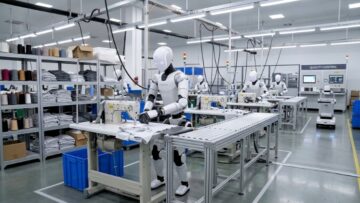
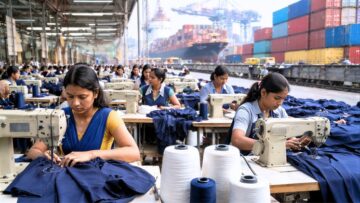
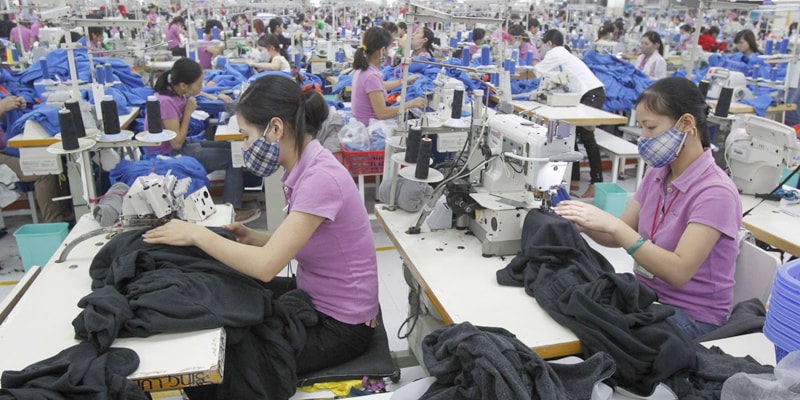
 However, much of the western world may want to refute the significance of China in the current global political and economic situation the fact remains that the country is ‘unstoppable’ today, looming largely both as a market and manufacturing super power. In the last few years China has been consistently losing on both volumes and value of exports to the world market in garments, implying that the country is challenged by cheaper destinations, forcing it to reduce its prices to keep its huge capacities running. No wonder the country is now downsizing its factories in garmenting, mostly basics.
While earlier it was considered ‘the factory of the world’, using its huge human resource to manufacture almost everything under the sun at cheap prices, flooding markets with the ‘Made in China’ label…, it has now strategically changed its positioning to become a huge market for luxury goods and is increasingly moving out of its boundaries to manufacture not only in neighbouring countries like Cambodia and Vietnam, but also in countries and for products hitherto unthinkable…, the recent garment factory in the US is a case in point.
Chinese as consumers…
In a year when many countries were fighting internal crises, China was progressing with Chinese being noticed for their willingness to invest and spend, while others were keeping a tight purse string. There is sufficient data to support the fact that over the past decade, China and moreover the Chinese, have led the world in luxury shopping. Retailers, luxury brands and property developers alike have fallen over one another to cash in on what they perceived as a burgeoning middle-class, their love of all things luxury and a propensity to spend rather than save. As a result, by 2015 China offered more luxury retail selling space than Japan and was fast catching up on the US, and the Chinese accounted for over a third of all global luxury spending. By 2030, China is expected to add in excess of 3.4 million additional individuals to this wealthy population, making it the fifth largest market in the world in terms of HNWI’s (High-net-worth individual).
Chinese as manufacturers…
Supporting their love for luxury is a shift in manufacturing thrust. According to a report recently released by the Economist, over the past 25 years, China’s share of global manufacturing output has risen from 3 per cent to nearly 25 per cent by value, and if the supply chains that Chinese firms drive across other parts of Asia are taken into account, then the figure rises to nearly 50 per cent. But when it comes to the global fashion manufacturing output, China’s share is even greater.
Currently, producing 60 per cent of the world’s shoes and exporting 43 per cent of the world’s clothing, China is indispensable for designers, brands and retailers across the globe from fast fashion to luxury.
Today, luxury brands such as Burberry, Armani, and Prada manufactures in China, not just because it is cheap but also because they are still able to get good workmanship for the price. In fact, a lot of international brands still continue to source from China despite increasing prices due to their experiential labour force.
Chinese as offshore investors to offset internal increase in production cost…
While Chinese as individuals give earlier wealthy nations a run for their money, Chinese companies are making huge investments outside the country making them key targets for nations looking at foreign investments. Of late companies, have been aggressively investing in countries like Cambodia, Vietnam, Indonesia, Myanmar and even the US taking advantage of inherent manufacturing strengths. Investment in the textile mills have also been made in the US, mostly for technical textiles, while investment in Vietnam is focused more on spinning industry, followed by weaving.
Recently, The Savannah Accelerated Development Authority (SADA) of Ghana has signed a Memorandum of Understanding (MoU) with the China National Textile and Apparel Council that will lead to the establishment of a US $ 300 million textile factory in the SADA Zone. Also, as per latest reports, Chinese investor Jiangsu Dongqun Investment Holding Group Co. Ltd. is considering to invest US $ 100 million in the textile industry of Indonesia. In October, this year, Suzhou Tianyuan Garments Company, a Chinese manufacturer of casual apparel and sportswear and a big supplier to Adidas, signed a memorandum of understanding (MoU) with Arkansas in USA.