Lingerie as a product category comprises of briefs, vests, camisoles, bras, panties and corsets. Although majorly imported from China, the category has witnessed a dip of 10% and marginal increase of 7% from the manufacturing giant in the last one year both in terms of the quantity and value, to both EU and US respectively, al l because of the increase in labour wages. This development has shifted the focus on Bangladesh, which registered a growth of 50% and 37% in the same period both in terms of value and quantity to the global markets, respectively. The overall imports of Lingerie products by the US in the same period increased by 17% both in terms of value and quantity and Bangladesh has been a major contributor.
China notwithstanding is still the leader, whereas Bangladesh is but a fraction of China. But with this growth Bangladesh will surely have a greater share in the coming times and a major proof of the same is UK-based retailer Tesco shifting majority of its lingerie sourcing from China to Bangladesh. With this surge of business in the product category, many companies have ventured into lingerie and even the existing companies are nearly doubling their capacities. Apparel Online spoke to leading lingerie manufacturers namely Uni Group, Intimate Apparels and Shore to Shore Textiles, to understand the direction and momentum of growth in lingerie for the country…

“US has always been sourcing good volumes of lingerie products from Bangladesh but in the past few years, European brands like Tesco, H&M and M&S have increased their lingerie sourcing from Bangladesh due to the rising wages in China and the 60% GSP advantage they have,” asserts Asheek Bhuiyan, Managing Director, Uni Group, exporting majorly to American buyers like Walmart, Target, JC Penny, Kmart, Uni Group started working with European buyers like H&M, Tesco and Victoria’s Secret, only a year back. The company is one of the two enterprises in Chittagong which laid the foundation of lingerie manufacturing in Bangladesh, around 1985, the second being Clifton Group and both the companies together were responsible for 55% of the total lingerie exports from Bangladesh in times of the quota system.
Started with manufacturing of briefs, panties and vests, it was later in the early 1990s when both the companies started bra manufacturing. The Uni Group set up its first bra manufacturing facility in 1995, at a time when no one had any kind of knowledge about the product. “Our present monthly production is 3,00,000 dozens of panties and 30,000 dozens of bra per month with a setup of 1,300 sewing machines in four factories and we plan to increase our capacity by 50%, i.e. by 1,00,000 dozens and the aim is to cross the mark of US $ 35 million by 2015, from the present US $ 15 million,” shares Asheek.

This reputation of Bangladesh as a lingerie manufacturing hub is further endorsed, when a three-decade old lingerie manufacturer with its roots in Indonesia, Intimate Apparels established a bra manufacturing facility in Chittagong. Spearheading the operations of Intimate Apparel, Vijay Uttam, CEO states, “As a lingerie manufacturing base, Bangladesh promised the sustenance of business due to the commitment of Bangladesh to apparel trade, even more than Sri Lanka, Thailand, Vietnam and even Indonesia, also there were only two companies manufacturing lingerie in Bangladesh – Apex Lingerie and Hop Lun Group, a 100% Chinese owned company, as competition. The plan was to benefit from the immense opportunities the country has on offer. Manufacturing 6,00,000 bras and 2,00,000 panties per month, the company has a setup of 1,400 sewing machine in the Karnaphuli EPZ, Chittagong and is working with H&M, Walmart, Haines and a few German buyers. “We would be adding 700 more sewing machines in the upcoming facility, which would be operational by June 2014, targeting a turnover of US $ 50 million, from the present US $ 30 million,” says Vijay.
Shore to Shore Textiles is among the recent entrants in the product category along with Epyllion Group and Mondol Group that already has an operational lingerie facility. The foray of Epyllion and Mondol into the product category is well understood because of their background as knit apparel manufacturers, but being a label manufacturer with a turnover of US $ 20 million, Shore to Shore (STS) Bangladesh took a bold step to manufacture lingerie. “We did 3-4 years of market study to select the right business and we zeroed down on warp knitting, synthetics fabrics and bra cup moulding, but then we realized it was too early to be a vendor for Bangladeshi lingerie manufacturer, so instead of being an auxiliary to bra manufacturing, we ventured into the same,” explains Emran Ahmed, Director, Shore to Shore (STS) Textiles, heading the lingerie business unit under the aegis of Yunusco Group.
Shore to Shore Textiles now has a setup of 120 sewing lines spread out in 4,00,000 sq. feet, of which around 65 sewing lines are presently operational, manufacturing bras, boxers and panties. “The reason for starting out with such a big setup is to be a preferred vendor of a certain buyer, who otherwise won’t place orders with us and secondly this has always been my father’s vision, to venture into a business with total devotion and commitment,” explains Emran. The brands that had nominated STS for labels are the ones that started sourcing lingerie from the company.


Foreseeing the influx of business in the product category, many Bangladeshi companies now plan setting up projects with 200, 300 and 500 sewing lines, without realising that the scales do not fetch buyers, they come because of a company’s technical expertise in the product, the economies of scales and its commitment to timely delivery of the product. “Lingerie unlike most apparel products is difficult to make and even margins are also low with more than usual overheads cost ratio and CM to be profitable, because the greater the complexity in the sewn product the greater would be the overheads for the same,” elaborates Vijay. Building on the same, Emran adds, “Our investment in the complete project has been US $ 22 million and before investing such a huge amount we developed a loss plan, which would continue for the initial 3-4 years. Emran further adds, “Since the habit of copying each other is dominant in Bangladesh, people see someone entering a new field they would blindly follow without realising the setbacks.” But do all these investments cut into the business and market share of already established lingerie manufacturers? Vijay says no, “Lingerie factories have closed down in China, Thailand and even Indonesia, so this chunk of business is very large and most of it is coming to Bangladesh, due to this there is no zero-sum game as the pie is getting bigger and bigger.” But he also admits that some people don’t want to work hard, they just would rather poach buyers thandevelop their own.
Product Analysis
[bleft] Foreseeing the influx of business in the product category, many Bangladeshi companies now plan setting up projects with 200, 300 and 500 sewing lines. You can make 4 boxers in the same time taken to make a single bra and even the supply chain is not that complex because both the panty and the boxer require just one type of fabric and elastic. Lingerie factories have closed down in China, Thailand and even Indonesia, so this chunk of business is very large and most of it is coming to Bangladesh, due to this there is no zero-sum game as the pie is getting bigger and bigger. [/bleft]
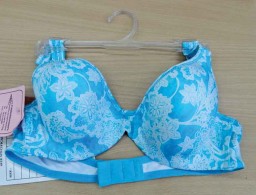
The basic composition of a bra made in Bangladesh is of 95% cotton and 5% spandex with under-bust wire with lace and foam padding, and that is popular in both US and Europe differing only in prints. “While animal prints are very popular in the US, no one likes such prints in Europe,” explains Asheek. The construction of both bras and panties broadly remains the same. “Underwire bras are mostly in demand and comprise 70% of all the bras we make,” adds Asheek. Also sourced in huge volumes from Bangladesh are the plus or excel size bras in DD sizes, which are now manufactured by Uni Group, STS and Intimate Apparels.
It is not that the fashionable lingerie items are not coming to Bangladesh; it is just that the country is not ready for manufacturing such complex bras. “H&M does all types of fashionable bra but as a company we try to avoid it, so the order goes to China, since the country has adapted to do the designs which we still cannot do. For making high fashion bras we require a good proactive supply chain and a strong vendor base. Since the quantities offered are small, Hong Kong has an ideal setup to do such bras as there are factories with just 40-50 sewing machines with a strong supply chain, and ready to ship out high-fashion bras in just 3 weeks’ time,” opines Asheek.
Interestingly all these companies have an added expertise in panties, briefs and camisoles. “Actually to produce 100% bras, it takes time in building the confidence of the customers and moreover if you develop yourself as only a bra manufacturer, you are bound to miss out on the huge business of boxers and panties. Moreover when you have such a big setup, there is a lot of pressure to be profitable, due to which you have to do products other than bras also,” asserted Emran. STS is manufacturing boxers and panties with 35 lines dedicated to boxers and panties, from the total of 65 sewing lines. Companies like Clifton and Four H Group are also very big in boxers, briefs and panties. Adding on further Vijay states, “You can make 4 boxers in the same time taken to make a single bra and even the supply chain is not that complex because both the panty and the boxer require just one type fabric and elastic.” Though Intimate Apparels has historically being a bra manufacturer, since the buyers prefer sourcing sets of bras and panties from a single source in order to maintain the uniformity in colour and raw materials standards, the company has acquired similar levels of manufacturing excellence in panties also.
Supply Chain & Vertical Integration
Bra manufacturing is capital-intensive and the companies should preferably be vertically integrated with both fabric knitting and accessories manufacturing as one of the most basic bras require 30 to 35 different components like a stabilizer fabric (polyester warp knitted non-stretch fabric) for cup seam and centre front, inside cup fabric made of cotton, cup covering fancy fabric, along with various types of elastics for underbust band, underarm region and strap besides that underbust wire, hook & eye, two pairs of ring & slide, bow, label and most importantly foam. Not only the sourcing of all these accessories becomes a big challenge but also managing the lead times and colour harmony is products sourced from distinct vendors is a challenge. Most of the manufacturers are bound to have in-house knitting and dyeing facilities as the quantities are very small which no other vendor can process profitably.
Of the lingerie manufacturers in the country, only Apex Lingerie, Clifton Group, Shore to Shore Textiles and Four H Group are having fabric units and even the accessory manufacturing in case of STS and Four H. STS has recently added 9 circular knitting machines and has also started an elastic manufacturing facility in Chittagong. “Add to that our label manufacturing, we are very close to being vertically integrated,” asserted Emran. However, STS is still dependent on Shenzhen district in China, a city of warp knitters, for polyester warp knitted fabrics used in the centre front of a bra, are only available with Apex Lingerie that too for their captive consumption.
Lingerie demands expertise in all areas of operations and being vertical does not necessarily allow you to develop excellence in all the fields. “We should look at Sri Lanka where specialized fabrics manufacturing companies like Textured Jersey and Hayleys are there, who is excellent support to Bangladesh,” opines Emran. “Lingerie is too complex a product to be produced in a vertically integrated setup,” says Vijay. Agreeing with the same Asheek adds, “We source 70% of our elastics from China through our Hong Kong office as they can offer jacquard elastics and the fabric unit can directly coordinate with the elastic unit to maintain uniformity in the colour of both the items.”
Moulded bra cups, a critical product in bras are essentially scarcely available in Bangladesh. Although both STS and Uni Group have plans to setup an in-house moulding department, the companies are well aware of the challenges in terms of the capital requirement and the scarcity of skilled technicians. “We already have the machineries in-house but we have not got the department running as it takes a lot of time in developing the same and the buyers need to be involved majorly in mould development,” shares Emran. Unibra is also in the process of setting the moulding unit. Intimate Apparels is among the very few companies which has in-house moulding unit in Bangladesh and Vijay owes the success of its in-house facility to the technicians from its parent company, have trained the local people for managing the moulding department.
Role of Expats
Technicians from Sri Lanka, Philippines and China have been playing major role in developing the manufacturing facilities of the country, both in terms of developing the right systems and training people. Intimate Apparels has a team of expats from Philippines, Sri Lanka and India, which the company gives credit to for developing the technical expertise in bra manufacturing. “Since the product is more technical you will find more technicians than production managers in the factory as at times it is not under the skill sets of the supervisor or production manager to handle certain issues and problems. So technicians are needed for handling the same and training people,” shares Vijay. Due to the continuous training efforts of the technicians, the 2nd line of technicians is all local people in Intimate Apparels.
On the similar lines Shore to Shore has gathered a team of experts with experience of working in Sri Lankan companies like MAS Holdings and Brandix.
The reason why Sri Lankan and Filipino technicians are experts is because both the countries were developed as lingerie manufacturing hubs by brands like Victoria’s Secret, Triumph and Honey Lady, and Sri Lankan companies like Brandix, MAS Holding, Hirdaramani and Filipino companies like Bratex and Topform trained a lot of local people. Hence there technical knowledge combined with their English speaking skills made Filipinos and Sri Lankans suitable as lingerie technicians. Even in Indonesia a lot of factories started by Filipino technicians only.
The only exception in this case has been Uni Group, which employed Chinese technicians in 1995 when the company setup its first manufacturing facility and even now the company has 8 Chinese and 6 Sri Lankan technicians.