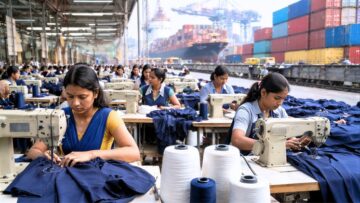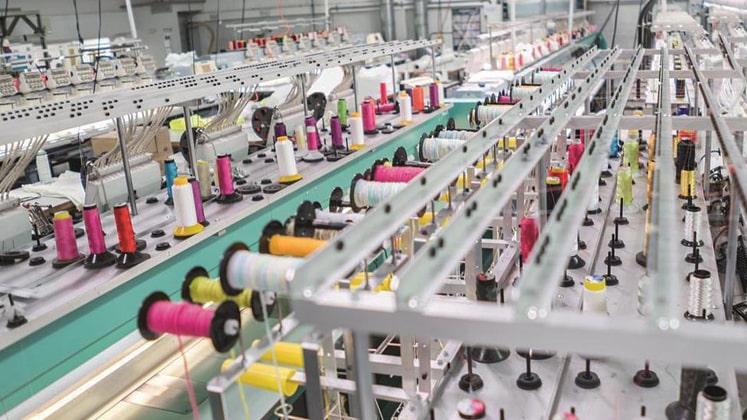
Almost all Indian garment manufacturers have now graduated from CM (cut-to-make) to full package manufacturing. Whatever new development the Indian garment manufacturers present, are related mainly to fabric development or value addition through surface ornamentation (embroidery, printing, embellishment and so on).
New product development through creative pattern making (cut/dart manipulation/silhouette alteration, etc.) and innovative construction is not yet the forte of Indian manufacturers and here is why?
Sumita S. Kapur, Divisional Manager Merchandising, Shahi Exports Pvt. Ltd., Faridabad (India)
New product development through creative pattern making is currently in its initial stage with regard to Indian manufacturers and I can say that this development is picking up at a good pace.
Currently, we are looking backward using traditional methods of pattern making of experienced pattern masters who have better understanding and skills to develop innovative products. The switchover from traditional methods to creative pattern making and innovative constructions will take some time to happen as it involves huge cost and skilled employment.
Ruchi Mehra, Head Designer and Partner, RGB Creations Pvt. Ltd., Delhi (India)
I somehow don’t agree completely with this. It’s true that India is somewhere lacking in product development through creative pattern making as developing products through pattern making creativity needs an upper hand and it’s difficult to surpass their excellence. But at RGB Creations, we are following this creative method for product development. Being the lead designer for our factory, I give full emphasis to creative pattern making, and our team which includes pattern makers too, utilises our skills to ‘technically manipulate’ darts and their positioning; silhouette alteration is also done sometimes.
We also run our own fashion brand named Pour Femme. In all of our SKUs, you will find there are some high-end garments in which we have actually not used traditional darts positioning. We, accordingly, manage our patterns for such garments aimed to be manufactured keeping niche market in our mind.
However, there are still some bottlenecks due to which manufacturers are not opting for creative product development. Cost is one of the main challenges which refrains companies from going for the same.
Sahima Warsi, Designer, Pooja International, Noida (India)
Yes, it’s true that CM concept is getting abolished from India and we truly appreciate full package garment manufacturing. Just little additions can make garments really appealing and that’s what I focus upon while designing garments.
I recently attended a WGSN seminar for S/S ’20, and I witnessed the trends have almost changed. The focus has shifted to fabric as well as the design of the garment with more linen looks in demand. So, I would say it’s fashion which is the leader now and we are the followers. We have to manufacture that only which is going to be sold.
Those who are not following the trend actually don’t want to change their traditional mindset. This issue is primarily in India where despite having immense skilled pattern masters, our designers have not been able to utilise them due to lack of willpower.
Kunal Kataria, Co-founder, KatBro Corporation Pvt. Ltd., Greater Noida (India)
I am too young to comment on Indian traditional ways of running the garment manufacturing industry but I honestly feel it’s the company’s vision which pulls people back from pursuing creative product development. The traditional mentality of garment manufacturers is always towards producing garments in bulk for their buyers and hence they don’t opt for any kind of R&D for new innovative products.
We, at KatBro, always believed in being a designer’s factory, not a sourcing team’s factory. As per our founder C.B. Kataria’s vision, one should always work closely with the designer and never stop himself/herself from developing new products in terms of production technique and fashion collection. It’s the designer who brings the orders, not the sourcing team.
Having said that, we are always up for new challenges especially in flat knits. The kind of products that we cater to and develop is possible only because we never hesitate to do innovative construction in our products.
On the other hand, India is one of the most preferable manufacturing hubs in the world as we have infrastructure, compliance and skilled workforce unlike Bangladesh which has massive compliance issues, or China which has expensive labour and high duty rates of raw material. So, this is the right time for us as Indian manufacturers to make a mark and become the garment manufacturing hub of the world, offering unusual and high quality products with more creativity in designs.
Prabir Jana, Professor, NIFT, Delhi (India)
Product development in Indian context is primarily fabric development (surface ornamentation), because that is what India’s perceived strengths were during early 1980s when India established its mark as an exporting nation. Since then, Indian embroidery and heritage-induced prints have become its strength.
Over the years, India’s exports have grown (and then plateaued), but Indian technical expertise (pattern making and construction) has never improved. Although India has enough educational institutions teaching this subject, it has never been perceived as a respectable career option. That is why pattern making and construction jobs are still held by ‘Masterji’, who has more of inherited knowledge rather than professionally imparted scientific knowledge. Such knowledge is enough to replicate but not enough to create new. Even the coveted job of ‘fit technician’ is still held by expats (as Italian, German, British, Filipinos have strength in this area). These are the reasons why new developments through creative pattern making are elusive even now for Indian garment manufacturers.
Nandana Lodha, Senior Technical Designer, Inmocean, New York (USA)
Dart manipulation was not used in Indian clothing as it evolved in Western countries. In India, pattern making was learnt from generation to generation or at work. Initially there was lack of proper technical training and not many institutes existed for this skill. Even many manufacturing units did not have right-sized mannequins to drape; hence, Indian tech designers determined their garments’ cut and shape based on numbers. Eventually this method got adopted everywhere.
In last few years, some institutes have started teaching pattern making and new technologies like 2D pattern making have been introduced. 2D pattern making doesn’t need draping to start with. In India, the jobs of designers/merchandisers and pattern makers are different from each other. Designers do not make patterns, that is, playing with drapes and dart simulation is rarely done. Pattern makers, on the other hand, just follow instructions and have no dealing with the creative side. This might change with 3D and 4D. I believe now and in future, designer will be more innovative and get involved in pattern making as 3D software gives a chance to design and construct on one platform.