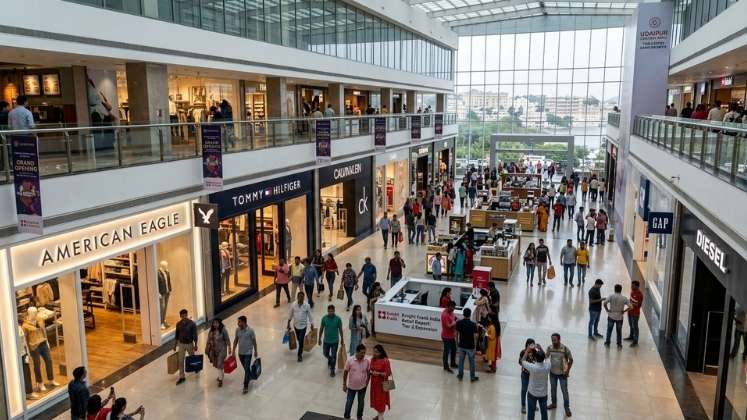
India’s Tier-2 cities are emerging as key centres for international retail expansion, with smaller urban markets increasingly attracting global brands and institutional investment, according to a new report released by Knight Frank India.
The study stated that India is currently witnessing the rise of two parallel retail economies — a mature Tier-1 market constrained by ageing retail infrastructure, and a younger Tier-2 market characterised by newer developments and faster growth.
Chandigarh topped the International Brand Penetration Rankings 2026 despite having a population of only 1.3 million. The city outperformed larger urban centres in terms of consumption strength, Grade A retail quality and density of international brands.
Mangaluru emerged as the most brand-dense Tier-2 city, recording more than 102 international brand stores per million people. Meanwhile, Lucknow hosted the highest number of unique international brands, with 112 brands operating across 5.6 million square feet of shopping centre space.
The report noted that cities such as Surat, Jaipur and Nagpur continue to demonstrate strong population growth and consumption expenditure, but international brand penetration remains restricted due to limited Grade A retail infrastructure.
Tier-2 cities now account for 61% Grade A retail stock, compared with 45% in Tier-1 cities. Since 2020, Tier-2 markets have added 5.9 million square feet of Grade A retail space, more than three times the corresponding addition in Tier-1 cities.
The report further stated that American brands represent 46% of all international retail stores in Tier-2 India. Retail groups based in the United Arab Emirates account for nearly 79% of the department store footprint across Tier-2 cities.
Shishir Baijal, International Partner, Chairman and Managing Director of Knight Frank India, stated that India’s next phase of organised retail expansion would not be driven solely by metropolitan markets. He said the country is witnessing the emergence of a parallel retail economy across Tier-2 India that is younger, increasingly aspirational, digitally connected and capable of supporting international brands at scale.
He further stated that the findings indicate population size is no longer the primary determinant of retail success, with cities such as Chandigarh and Mangaluru outperforming larger urban centres due to stronger consumption patterns, superior retail infrastructure and higher brand absorption capacity.
The report highlighted that while Tier-1 cities account for 98 million square feet of organised retail stock, they continue to face challenges related to ageing Grade C malls and elevated vacancy levels. It noted that nearly 60 “ghost malls” in Tier-1 markets are operating with vacancy levels exceeding 40%.
In contrast, Tier-2 cities currently have 36 million square feet of organised retail stock, much of which has been developed after 2010, resulting in newer retail environments with lower vacancy rates and improved operational efficiency.
According to the report, consumption power is increasingly replacing population size as the key indicator for retail growth. Monthly urban per capita consumption expenditure ranges from Rs. 13,425 (US $140) in Chandigarh to Rs. 5,114 (US $53) in Chhattisgarh.
The study added that rising smartphone penetration, wider adoption of UPI-based digital payments and greater access to digital content have significantly narrowed the brand-awareness gap between metro and non-metro consumers, further accelerating the growth of international retail brands in Tier-2 India.





 Bharat Tex Special Report 2026