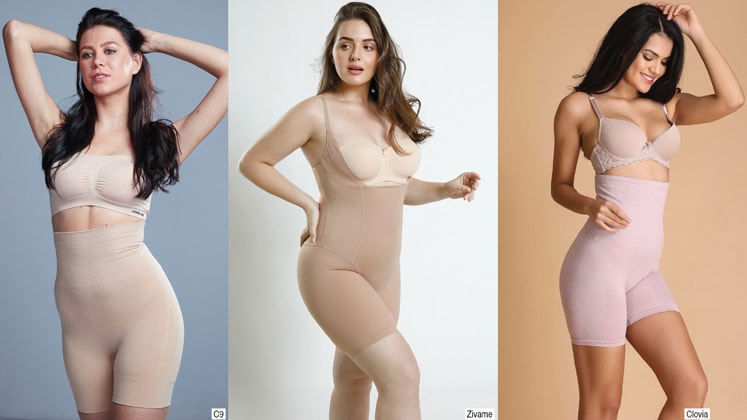
Aesthetic beauty is of utmost importance today, and the fashion-savvy consumers from India and abroad have taken this too seriously, even in terms of their body. Today’s population has become more conscious about conforming to the standards of beauty and to the ideal body shape, which has ultimately skyrocketed the sale of foundation garments over the years. With more and more women wanting to look slim and in shape, new styles of shapewear and compressionwear are becoming a necessary buy and not just the things of luxury. Kiruba Devi, Category Head, Zivame, asserts, “With the emergence of online fashion marketplaces and exposure to global fashion trends, Indian women are going through a lifestyle evolution. Not only has their outerwear style evolved to stay at par with global trends, but women now are also taking a keen interest in educating themselves about the right innerwear to be paired with outerwear for various occasions, moods and needs. Women are also more open to experimenting with new styles and to go beyond their body type conventions. This evolution and the growing awareness have fuelled the need for shapewear in the innerwear category. Shapewear today is a must-have across all body types from slim to curvy for that seamless, smooth look.”

According to Allied Market Research, compressionwear and shapewear market is expected to reach US $ 5,576 million by 2022. Also, a report by Grand View Research has stated that the global shapewear market size was estimated at US $ 2.26 billion in 2018 and is projected to expand at a CAGR of 7.7 per cent from 2019 to 2025, and the growing target population across the globe is augmenting the market growth considerably. Women have been imprisoned in corsets reinforced by whalebone, bound in knickers and laces and garters for years, to conform to the ideal of femininity of the time. While there has been emancipation and evolution of women and their thought process, they have now accepted the types of shapewear willingly in order to make their bodies look slimmer and to resemble the models of today. Delving deeper into what is driving this lucrative industry will further help understand the segment and its potential.
What’s shaping the industry?

The shapewear market is growing, courtesy factors like increase in disposable income of customers, advancements in fabric technology and garment designs, rise in popularity of shapewear among the geriatric population and change in lifestyles, etc. Abhishek Kumar, General Manager-Marketing, C9, agrees, “Shapewear segment has shown good growth in India driven by rise in disposable income of consumers, latest fabric technology and change in lifestyle of people. The segment is growing at a CAGR of around 9-10 per cent in India. Consumers of today are demanding slimmer experience now. Plus, there are health benefits of wearing these as well. In the West, shapewear is more popular as the apparels there are more body-defining. In India, it has not been long since women have started wearing dresses and fitted skirts and this population who have adapted to such clothing mainly comprise the shapewear wearing people, while the older Indian is yet to get comfortable using this garment. For us, the target consumers are in the age group of 18-45 years who are looking to buy value for money products.”
Even as the segment is bifurcated into male and female end-users, the latter rules the category with 94 per cent of the market share, and therefore, there are a wide variety of products dedicated to them. These include control camisoles, corsets, body shapers, singlets, body briefs and sari shapewear. However, the male segment is slated to register a growth of more than 8 per cent from 2019 to 2025. Furthermore, according to National Institute on Aging, an estimated 524 million people were aged 65 years or older in 2010 and this number is expected to triple to about 1.5 billion, representing 16 per cent of the world population, by 2050. A rise in demand from elderly population owing to the usage of compression garments for the treatment of edema, phlebitis and thrombosis has further given impetus to this segment.
Besides a number of factors affecting this segment, one key instrument driving the growth of the shapewear market is the influence of global fashion and lifestyle trends on the women of today. “In this digital era, women have become more open to experimenting with new styles and new look and they not only follow fashion influencers but also desire to be trendsetters themselves. This has led to the evolution of their outerwear wardrobe with women now trying different looks across both Indian and western outfits. Zivame has advanced this conversation by encouraging women to pair their outerwear with the right innerwear – be it lingerie or shapewear. We introduced the iconic ‘Mermaid Saree Shapewear’ which is the perfect replacement for a petticoat as it helps shape the lower belly and thighs and gives a sleeker mermaid look under all types of sarees. We are also the first to innovate the 12-hour shapewear for longer usage with no discomfort, avers Kiruba. Zivame has a wide range of world-class shapewear designed to ensure posture correction and create a beautiful silhouette and the brand puts in a lot of research while developing its shapewear range right from choosing the right fabrics and technology to innovating for longer usage with no discomfort.
Availability and market penetration

Availability of a wide range of products in the category such as control camisoles, corsets, body shapers, singlets, body briefs and sari shapewear is further contributing to the market growth for shapewear. Online channel of distribution is the fastest-growing segment owing to rising penetration of digital media and marketing. “We are witnessing orders coming in from all age groups and channels for this product. Tummy tucker, thigh shaper, sari shapewear, body shaper, tummy tucking belt, tummy tucking skirt are some of the styles we offer. We use state-of-the-art technology to knit Italian imported nylon yarn combined with elastance to manufacture our product. Sari shapewear is one of our product innovations. We started with knee length shapewear in 2013 to wear under a petticoat and went through multiple product iterations to finally arrive at sari shapewear which can now replace a petticoat worn traditionally under saris. Tummy tucker – which is a 4-way effect product impacting tummy, side bulges, back bulges and back area – is one of the fastest selling products at Clovia. We now do 4 colours in tummy tucker and 23 colours in sari shapewear (which is quickly catching up after tummy tuckers),” maintains Soumya Kant, Founding Member, Clovia. While shapewear contributes to approximately 6 per cent towards the overall revenue by Clovia, for C9, the category brings in 20 per cent of the total annual revenue. Even as the brands in the category are offering an array of products for varied target consumers and regions, Zivame categorises its shapewear as per compression levels which is the impact one would want to create visually wherein Level 1 is low compression for gentle smoothening which can be worn for 8-12 hours; Level 2 is medium compression for tighter control for around 6-8 hours; Level 3 gives high compression for super smooth look for around 4-6 hours and Level 4 is more like body-sculpting for a complete trimmed look and can be worn for 2-3 hours.
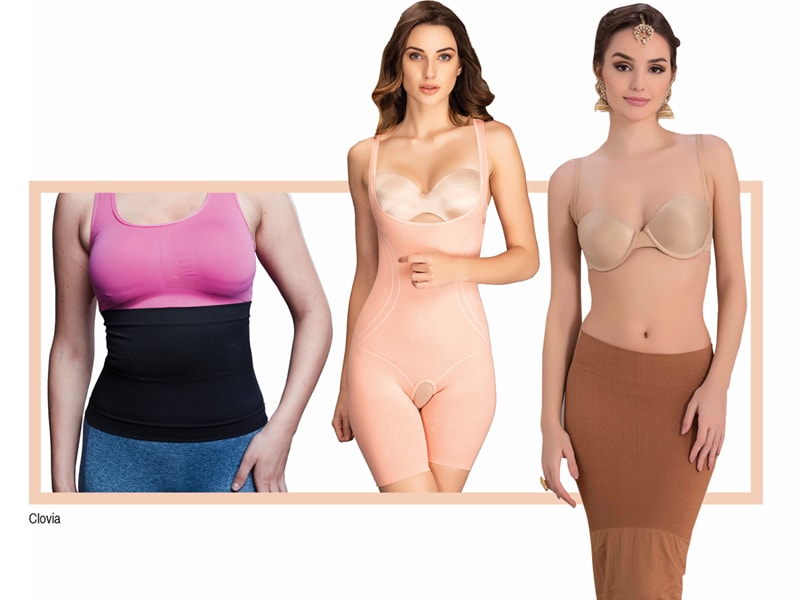
Shapewear has evolved as an everyday essential for women who love to experiment with fashion and break body type taboos. Women are experimenting with shapewear, be it to look slim and toned in party outfits or to look smart in office formals. And this has not been limited to just urban areas but also smaller towns where the women have become equally conscious about their dressing. Soumya avers, “Lingerie as a whole including shapewear as a category had very limited availability in Tier-2 and Tier-3 towns. It is mostly sold via mom and pop stores and is driven by limited variety of product and sizes. Clovia was able to service these areas by giving them both colour and size options. These towns finally had access to the best of lingerie and shapewear solutions. We are now also servicing these towns through bricks-and-mortar stores. While online channel contributes to higher sales as of now since this has been an older sales channel for us. The feedback from offline stores has also been phenomenal and we are adding more colours, variations to our product on the basis of their feedback. We have started to see a lot of repeat customers in case of sari shapewear wherein customers are coming back to buy more colours matching their wardrobe.” For Zivame, online channel contributes to 80 per cent of its revenue even as it is in 20:80 ratio for online and offline channels for C9. “We currently have 40+ stores across 10 cities. The company will continue with its aggressive retail expansion and take store count to 100+ stores in the next 20-24 months. We will also deepen our presence in Tier-1 towns and focus on key Tier-2 and Tier-3 markets,” informs Kiruba.
The foundation of foundationwear
The most recent advancements in fabrics that are used in compressionwear and shapewear have supplemented the growth of this category. Technologies such as bonding and laser cutting have transformed shapewear by eliminating seams, hems and bulky fastenings. In terms of fabrics, lycra, neoprene, spandex and nylon are commonly used by the manufacturers. Improved fabrics are softer, more breathable and have sculpting properties. Ashish Kumar Agarwal, Founder & CEO of SHK Brands Pvt. Ltd. which is a manufacturer of ladies shapewear based in Meerut (UP), conveys, “We have the widest array of shapewear ranging from tummy tuckers to the shapewear leggings. We have shapewear for almost all desired body parts, for various compression levels viz, mild, medium and firm compressions. We also cover several permutations and combinations of targeted body parts like bust and tummy, tummy and thighs, hips and thighs, full body suits, etc. In addition to the conventional shapewear which could be used only as innerwear, we have also recently launched shapewear leggings which are outerwear. The fabrics used in shapewear are very specific and are not available in open markets yet. They are a very precise blend of several components like cotton, spandex, etc. We opted to make cotton-based fabric for our products because of its skin-friendly nature and the comfort it provides. Since the fabric is stretchable, the sizing and design of the products are not straightforward and the styles have to be precisely engineered to give apt compression at the targeted body parts.”
Talking about innovations in the category, Sankom Switzerland has introduced an exclusive line of shapewear infused with aloe vera, which is antibacterial and enables shapewear to cool the body. Skins International launched a series of compression clothing infused with fabric, which is warp knitted using multiple fine quality yarns to give superior performance. Vijay Patel, Managing Director, Omtex Sports, a reputed manufacturing firm producing healthwear and accessories since 1969, says, “The market of shapewear is getting popular day-by-day among women. Keeping in mind the different essentials and requirements of Indian women, we have a wide range of shapewear like seamless range, premium range (called as Gem Series), and last but not the least, our unique hook-up series of shapewear, that focuses on different body parts by giving exceptional body shaping experience. We, at Omtex Sports, use Italian seamless machines and high tech quality Lycra fabric and infuse dry fit treatment in our fabric, making it a total skin-friendly and breathable garment. Our high-end fabrics are from the most well-known and best countries known for their fabric, namely Italy and China.” Designing the perfect shapewear for a comfortable and sleek look depends on making the right choice of material and technology and the Indian market still needs to go a long way in understanding the intricacies of the right kind of technology to be used in manufacturing of this merchandise.
Challenges and road ahead
Shapewear and compressionwear have been worn since the turn of centuries and while it started with women being laced up in their corsets, suffocating themselves to attain the level of ideal beauty of the time, we are in better times wherein technological advancements, creative fabric, stitching techniques and high-quality design, work all together to give us the shape we desire without pain. Also whilst this is the essence of today’s shapewear, majority of players in the segment still lack technical knowledge important for manufacturing this merchandise. To ensure the right amount of compression for the targeted body areas, fabrics used for engineering shapewear need to be high on stretch and recovery.
There are a number of retail brands offering shapewear in India which include the likes of PrettySecrets, Zivame, Clovia, C9, Swee, Dermawear, Myntra, etc. and the prices range from Rs. 300 to Rs. 4,500 depending on the kind and brand of shapewear. While the women’s segment is significantly outstripping that of men, the latter is slated for an impressive growth in the times to come. Talking about the challenges facing this segment, Abhishek asserts, “The industry is facing acceptance challenge; there are reports that continuous wearing of shapewear can cause blood clots, acid reflux and breathing problems. However, experts claimed that if worn the right way, there would be no health implications at all. Factors like technological advancement in garment design, lightweight fabrics, fashion that emphasises body shape, re-branding of panty girdles and celebrities wearing shapewear are contributing to the increased demand of shapewear. Owing to the demand, many new brands are opening to cater to this market and existing retailers and brands are also taking notice of this category which can provide significant sales in coming years. Acceptability of westernwear and changing beauty standards are driving this market.”





 Bharat Tex Special Report 2026