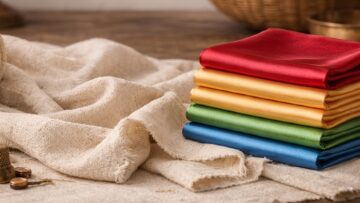
One of the oldest companies in the field, HOSOO, has opened a location in Europe in the hopes of expanding into new markets abroad as domestic demand for Kyoto’s traditional Nishijin textiles has fallen precipitously in recent years.
Masataka Hosoo, 44, the 12th generation owner of a family firm with more than 300 years of history, has established his first abroad base in Milan and opened a store there after investing years in creating cutting-edge modifications of conventional textiles for international tastes.
Hosoo, who has used fabric often designated for high-grade kimono and obi belts to manufacture wallpaper and other interior design furnishings, said, “I wish to introduce the world to the beauty of Nishijin fabrics.”
Early in February, Hosoo discussed the appeal of the very decorative, finely woven textile, known in Japanese as Nishijin-ori, at the Milan shop lined with a variety of items.
“It has been handed down for 1,200 years from generation to generation, made with techniques unparalleled in the world,” Hosoo said.
Thomas Lykke, a Danish designer and longtime business associate of Hosoo who came to the showroom in northern Italy, said, “Milan is a hub for design, and also a sophisticated market. It is a place that has a magnet effect as a global stage for designers and architects. It is a smart place to be.”
The domestic shipments of locally manufactured cloth peaked at over ¥ 270 billion in 1990, but have subsequently decreased and will only reach ¥ 18.1 billion in 2020, according to the Nishijin Textile Industry Association. Diversification is a major goal because kimonos are being worn by fewer and fewer individuals today.
The 14th loom has been added by Hosoo, and the production process is already established. He is currently in discussions with a number of well-known hotels and companies abroad. However, Hosoo noted that the fabric can only be produced in the Nishijin district since it depends on a system of labour division that has been in place there for a very long time.
In the Milan showroom, he has over 200 items on display. The fabric can be touched by guests so they can feel the textures.