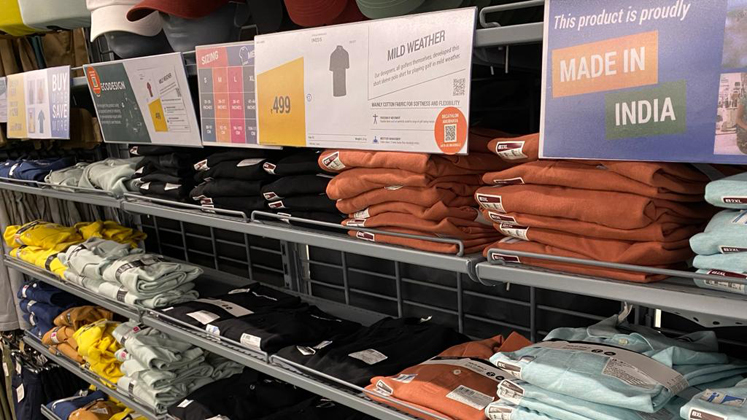
With 103 stores in India and more than 1,600 across the globe, Decathlon, a French sporting goods retailer, is known for its quality products. It has been sourcing in India for more than 20 years and is committed to accelerating its footprints by increasing local sourcing by promoting ‘Make in India’ sustainably for Decathlon’s customers in India and in the world. In India, Decathlon opened its first store in Bengaluru in 2009 and today it has over 100 touch points across 36 Tier-1, Tier-2 and Tier-3 cities. It hopes to continue to reach out to more and more Indians through retail outlets and digital ecosystem.
In discussion with Apparel Resources, Deepak D’souza, Country Production Director and Annie George (Sustainability Leader), Decathlon India share how the company’s approach towards sourcing and sustainability is benefiting the Indian vendors.
With an industry experience of 17 years, Deepak has worked with multiple global brands. His diverse work experience in Sri Lanka, Vietnam and Bangladesh and strong competence in sportswear production and sourcing makes him a commendable industry expert.
He says, “Currently, more than 60 per cent of the overall quantities sold at Decathlon’s Indian stores, as well as online, are ‘Made in India’. In case of textile-based products, it is over 70 per cent. Our 35 vendors (apparel manufacturers) across India have a workforce of more than 60,000. Most of our suppliers and our teams are engaged in capacity management, efficiency/quality improvements, continuous improvements, advanced manufacturing while implementing best practices that could be benchmarked to the global standards.”
Overall the company is sourcing more than 80 million pieces of apparel and textile-based accessories per annum from India for its Indian and overseas stores. Including hard goods, it’s a bit above 110 million per annum.
The brand is committed more towards local manufacturing in order to serve its mission of making sports accessible to many. “Make in India is our focus due to many reasons: India has a strength of vertically integrated companies, accelerating on actions towards sustainability, lower lead time, time to market, state-of-the-art manufacturing capabilities, advanced machinery upgradations and ability to produce and explore more technical fabrics and finished goods,” says Deepak.
As per him, this also creates a connection with Indian consumers when they see the product is ‘Made in India’. By accelerating local sourcing, Decathlon minimises the global supply challenges, lower lead time and can deploy different supply methods based on the local needs.
India also supplies textile products to Decathlon’s other custom zones, mainly to Europe, Canada and Southeast Asian countries.
Most of the Indian vendors of Decathlon produce basic and mid-range of apparel, socks and technical apparels. Deepak says that his team has been able to transform manufacturing excellence with Indian manufacturers by diversifying product ranges, from basic cotton T-shirts to synthetic, nylon, coated and technical fabrics. “We are even accelerating our production towards lower carbon emissions, use of more sustainable, recycled components and as a consequence towards more eco-designed products,” he says.
He strongly believes that with the global demand increasing more for athleisure and outdoor sports in India, Decathlon is also looking for more technical synthetic fabrics (nylon, polyamide stretch) for specific kinds of sportswear, swimwear and outdoor tents so that sourcing of these kind of product ranges could increase in India. And Deepak is hopeful that efforts are being done in this direction with Government initiatives like PLI scheme, technical textile mission and additional efforts being put in by Indian companies.
Decathlon’s teams are engaged very closely with their vendors to deploy the best industrial practices including Kaizen, operational excellence, advanced manufacturing and frugal supply chain management delivering the best quality products.
Global price competitively is becoming more challenging and brands need to find sustainable ways to remain competitive by ensuring the best practices of industrial manufacturing. So Decathlon engages with its vendors for long-term business relations, more transparent ways of manufacturing, sharing expertise on specific technical domains.
“We feel proud to see a lot of transformation as some of our suppliers, who used to do basic products, have upgraded themselves to doing complicated/technical garments for Decathlon and the skill, competency levels of their workforce have also improved. While we continue to expand our manufacturing suppliers across different states in India, a lot of new units are coming up in new zones. All this will help brands and retailers to increase their focus on ‘Make in India’,” says Deepak.
Sustainability is amongst the top priority
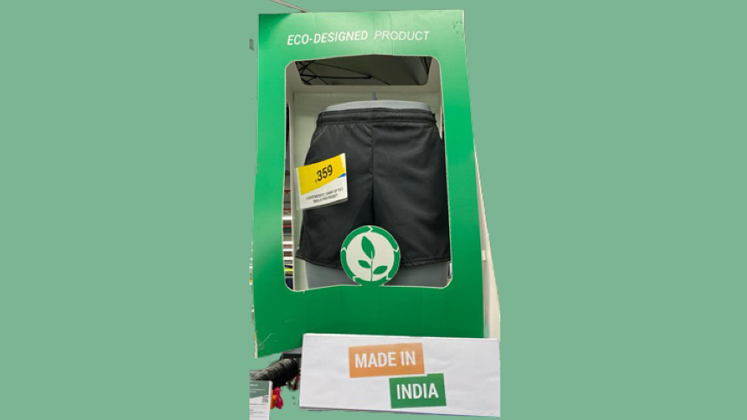
In 2022, over 1,300 of Decathlon’s products will be eco-design of which over 500 are made in India. Eco-design is an approach that aims to reduce the environmental impact of a product over its entire life cycle while preserving its qualities of use. This is achieved by integrating the product’s environmental impact into its design from the very beginning, taking into account the product’s entire life cycle. The company is committed to transform all its products into eco-design by 2026. Sharing this Annie George (Sustainability Leader) – Decathlon India feels proud. With expertise in Marketing, Communication and Sustainability, Annie, a fitness enthusiastic, has been with Decathlon for last 11 years. Sustainability is very close to her heart.

“The use of sustainable components or recycled materials like recycled cotton or recycled polyester is part of the eco-design transformation. One can look for the logo on the product to understand the environment impact reduction action,” she says.
Three of Decathlon stores in Delhi and warehouse in Malur are certified by Indian Green Building Council (IGBC) as Green Buildings. 18 Indian stores have solar rooftops and a few more will have the same by the end of the year. Annie tells, “We continue to work on reducing our emission at our site through building monitoring systems, building optimisation and REC (Renewable Energy Certificates).”
As a company committed to RE 100 (a global initiative bringing together the world’s most influential businesses committed to 100 per cent renewable electricity), by 2026 the brand is engaging with its suppliers to move to renewable forms of energy. All its key suppliers in India are working on reducing their emissions from energy with actions such as onsite energy, PPA (Power Purchase Agreement) or moving to biomass.
“We are striving to reach -53 per cent carbon intensity target by 2026 to move towards a ‘low carbon +1.5°C’ world, and to be able to do that, we need to accelerate the capacity of our ecosystem towards a circular economy. We are proud of Make in India, Made for India, Made for the World!,” she concludes.