As the world enters 2022, hopes to survive and thrive persist, despite Omicron continuing to dismantle the best-laid plans across every business sector, including fashion and apparel segment. The business climate today is much better than what it was at the onset of 2021. Though Covid cases have been on the rise in the US, Europe and Asia, the notable aspect is that several fashion retailers and factories are exuding business optimism – and there’s isn’t any better mantra to success than being optimistic.
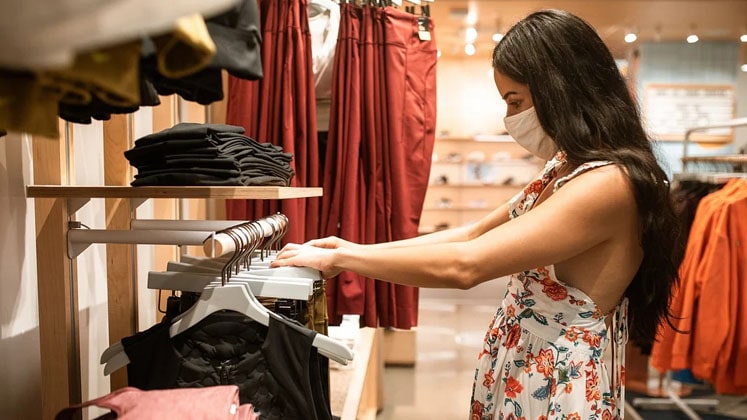
Store closures are not in any retailer’s mind, though some have reduced their working hours; In fact, closures happen at only those places that have been marked containment zones. Many others who have kept their stores open are hopeful that the Omicron variant isn’t here to stay for too long. It is this business optimism that will gradually translate into positive results.
US fashion retailers opt for strategic opening of stores/reducing working hours
A Saks Fifth Avenue employee has, reportedly, told media that the weekend before Christmas witnessed much fewer shoppers coming into the store than usual. The numbers were definitely down, but the good part was that their stores were open and they are still open.
Similarly, Public Rec, a Chicago-based athleticwear firm, has kept two of its stores open in New York and Chicago even as Omicron cases continue to surge across the nation. A good business strategy is the need of the hour and Zach Goldstein, Founder and CEO, Public Rec, substantiates the statement by averring “For our stores currently open, we’ve seen less of an impact in Chicago and more of one in New York City. However, as we assess new locations for 2022, we’ve started to think more seriously about selecting retail locations that may be less affected by what feels like the never-ending ebb and flow of COVID-19.”
While some retailers have adopted careful store-opening strategy to survive the ongoing onslaught, some other US retail stalwarts like Macy’s and Walmart have reduced hours. Reducing the store working hours or sending apology letters to customers for long lines and delayed appointments are some of the unusual measures initiated by the fashion retailers lately to combat the crisis. Lockdown is certainly not on cards – neither for fashion retailers nor for consumers. In fact, as per a recent survey by Coresight Research, shoppers’ craving for spending has remained high despite all pandemic-induced uncertainties – and that’s something to cheer about. According to National Retail Federation (NRF), 2021 holiday season has seen significant increases at clothing and clothing accessory stores. Notably, clothing and clothing accessory store sales, reportedly, went up by 33.1 per cent during the November-December period.

Fashion retailers across the US are no longer perturbed about State and Local Governments closing down companies. Instead, the businesses have started coping with the issue of shortage of workers. In fact, with the threat of supply chain woes too continuing to loom large, US apparel retailers may permanently have to rethink about store hours, besides opting for omnichannel option so as to ensure the business impact isn’t lethal.
The show goes on in the UK as well…
Despite rising cases in the UK, many fashion retailers continued to enjoy record revenues over the festive period. Here too, the Government seems to be clear that there will be no lockdown and has made face coverings compulsory in most indoor public venues, including stores. It’s the same story in England, Wales, Scotland and Northern Ireland.
According to Springboard, footfall slumped during December (from 28 November 2021 to 2 January 2022) to –18.6 per cent below 2019 compared to –14.5 per cent in November. However, Boxing Day sales, in addition to good online performance, distinctly showed that many retailers across the UK witnessed robust sales, with some of the numbers even better than those posted two years back.

British fashion retailer Next saw its full-price sales go up by 20 per cent in the eight weeks to Christmas, compared to what it was in 2019. Now that’s £ 70 million more than what the retailer had forecast earlier for the period. Consequently, Next has now increased this year’s full-year pre-tax profit guidance by £ 22 million to record £ 822 million – a 9.8 per cent rise from 2019.
Renowned lingerie retailer Boux Avenue posted a 50.6 per cent rise in sales in the six weeks to 24 December, compared to the same period two years back. The fashion retailer has attributed the growth to investment in product development….and this is at a time when Omicron cases are on rise. Similarly, British clothing retailer Fat Face also saw its store sales jump by 81 per cent Y-o-Y to £77 million in the five weeks to 1st January 2022, though the numbers fell by 8 per cent compared to the same period in 2019.
Like Fat Face, revenues at Cornish lifestyle brand Seasalt were up 20 per cent Y-o-Y in the five weeks to 1st January 2022, and up by 33 per cent compared with 2019, thanks to record in-store sales. Overall store revenues were up 81 per cent on the same period last year, and up by 23 per cent on the same period in 2019. The clothing and lifestyle brand’s CEO Paul Hayes attributed strong in-store sales to shop locations predominantly based in the market towns and seaside resorts.
Global Industry remains hopeful
With lockdowns not going to happen, the industry is cautiously hopeful of a reasonably good 2022. And there are reasons! Omicron’s retail impact could prove short-lived. In South Africa, where the Omicron wave started several weeks before the US, the new cases have dropped significantly, which could mean the US and the UK too will see a similar drop-off in a few days’ time. That’s good news for all fashion retailers who have shown patience all along.
Patience and business flexibility are the call of the hour! A PVH Corp. spokesperson substantiates “If the pandemic has taught us anything, it is that we need to be flexible and adapt quickly to the changes it brings. We will continue to evaluate our plans as new information becomes available over the next few weeks and will share any updates required as we get closer to our planned, gradual return to the office.” Things are gradually returning to normalcy at PVH.
Technology is another area that retailers have been continuing to invest in last 20 months to combat the challenges and survive the pandemic storm and that isn’t going to change in 2022 too. JD.com, a Chinese online giant, has opened a new physical store concept in The Netherlands – a store that will be staffed by robots. The robots – using all the latest cutting-edge technologies – pick and pack pre-ordered merchandise, which can be ordered via online or through store’s app. Consequently, there will be fewer crowds and more safety.
In the US, consumer sentiments have been on a positive trajectory, while in Europe, 67 per cent of fashion executives expect better trading conditions in 2022. Also, as mentioned earlier, Omicron may be heading for a drop in the US and UK in the days to come. In India too, Omicron is currently at its peak and so it wouldn’t be a surprise if one starts seeing the business scenario change for better from late February onwards, when one can see the cases dip in all probability.
As per Retailers Association of India’s recent survey, the retail sales in India in December 2021 rose by 7 per cent over December 2019 and by 26 per cent Y-o-Y. While the overall figures appear to be positive, the impact of the restrictions is visible at the category level. In fact, segments such as apparel (2 per cent growth) have started losing steam, but there is still hope.
Apparel manufacturers positive as work continues with added caution
The protocols for working in the pandemic have become stringent and all guards that were temporary down are back in place. Wearing a mask and continuously sanitising the factory is mandatory, with many creating mask and sanitisation stations at different parts of the workplace for regular use and also maintaining social distancing guidelines. There’s a feeling that things will be normal soon, and there will be no lockdown.
The apparel manufacturers, who are generally the first section to panic, are very confident this time that business will not be affected in a significant way. “We have seen no impact till now… Business is still booming,” says Sarbajit Ghose, CIEL Textile Board Member and Asia Executive Director Managing Director at Laguna Clothing LLP, Bengaluru. Mumbai-based exporter with factories in Bengaluru and working with some of the biggest brands and retailers in the West, Naren Goenka, MD, Texport Industries, adds, “So far there is almost no Omicron effect on business, retail looks to continue doing good with consumers ready to spend on fashion, and business going forward is also encouraging; now everyone needs to ramp up capacity asap.”
Adding credibility to the claim, Akhilesh Anand, MD, Founder & Managing Director, Carnation Creations, Coimbatore adds in his indomitable style, “I see no reason to panic, I am very upbeat as market is rocking and no orders have been cancelled or delayed.” What is very encouraging is that positivity is not only with the big exporters but even mid-level exporters are seeing no reason to panic; in fact they are more worried about not having enough workers to increase capacity utilisation.

What is adding to the optimism is the long-term vision, which was missing earlier in many difficult situations “Business will surely be impacted in short-term but looks strong and bullish in the longer run. The industry has also become more resilient and has accepted Covid as part of life. I feel the glitch will be only for a month or two, after that we should start seeing the graph going up once again,” avers Sanjeev Mukhija, MD, Goldenseams & CEO Breakbounce streetwear, Bengaluru. In fact, Sanjeev is looking to put up another unit soon nearer to the catchment area of workers off the outskirts of Bengaluru. “The amount of work currently in the market indicates that business will only increase and companies need to bulk up capacities,” he says with confidence.
Giving a supply chain insight, Srihari Balakrishnan, MD, KG Fabriks & President Sri Kannapiran Mills, Coimbatore stresses that all is going to be well. “Omicron is not severe, so it has not dented the business at any stage. Manufacturing in particular is going well, people who service us are slow as someone or the other is affected by Omicron, but that is about it… no closures and certainly no uncertainty for the future, only caution.” Sharing an experts’ viewpoint, Dr. Venkatachalam, Special Adviser, Tamil Nadu Spinning Mills Association (TNSMA), says, “The production levels of spinning mills are at an all-time high. Furthermore, due to higher prices of yarn, all mills are in a better place in terms of financial status, so temporary slowdowns due to the Omicron will not have long-term impact.”
Summing up the mood of the industry, Gautam Nair, MD, Matrix Clothing and Director AEPC says, “After the initial scare of yet another Covid wave, our industry is taking it in its stride. At this stage, it seems that overseas retail has not been impacted so much either. A clearer picture will emerge in the next two weeks but it looks like forecasts and projections continue to be good with our customers.” He points out a few interesting aspects that have emerged which have added to the optimism. “It is affecting workers less and staff/managers more so it is easier to manage; the severity is much less than in the first two waves and none of our employees have had to be hospitalised this time. And the most important mind change is that our people are treating the wave like any other seasonal flu— they are re-joining work in 6-9 days after testing positive, as a result, our own dislocations have been less in this wave.”
Similarly in Bangladesh too, in the first seven days of 2022, apparel shipments registered around 32 per cent in growth, to a little over US $ 869 million Y-o-Y, according to sources at the Bangladesh Garment Manufacturers and Exporters Association(BGMEA), citing data from the National Board of Revenue. However, the Export Promotion Bureau is yet to make an official announcement on the same. Bangladesh apparel exporters have, notably, not faced any cancellation or hold-up of orders yet, and that’s a good sign for the country and the region.
Guards need to be up as challenges persist…
Looking ahead into 2022, most of the fashion retailers across the UK are still worried of the impact Omicron variant will have on staff and sales, but good store-opening plans, reduced working hours, strict precaution measures, including temperature checks and hand sanitising stations, should ensure a good business climate in these challenging times. Also, the peak might just be over soon if the trends are to be true…
There have been talks about how Omicron may worsen the already existing labour shortage, with many apparel workers showing reluctance to work and expose themselves to the virus. Besides, supply chain pressures will be the main challenge this year too, with 67 per cent of businesses, reportedly, expected to raise prices.
All businesses, including apparel retailers and professionals, despite all their optimism and exuberance, are worried that the new variant may put struggling supply chains under more pressure to reverse hard-won growth momentum. In fact, Lululemon, best known for its yoga pants, reportedly, said that it started the 2021 holiday season strongly, but then has since suffered from several effects of Omicron, that also included shortage of staff and reduced operating hours in certain locations.
Notably, apparel manufacturing destinations too are struggling, with China’s textile and garment factories planning to close early due to supply disruptions caused by strict measures taken in view of COVID-19 outbreak. Additionally, the significant increase in international shipping costs, and the appreciation of the Chinese RMB, has also affected the profits of apparel manufacturers, making them reluctant to accept orders abroad.
Here it is important to mention that Manzhouli in China has become the epicentre and if there are more cases there could be mass lockdowns, extensive testing and quarantine mandates – and if that happens then this zero-tolerance approach might lead to widespread factory and port shutdowns. Any further shutdowns will definitely impact production and delay shipments. Numerous nations have imposed travel restrictions in response to Omicron’s outbreak, shutting down open travel corridors and significantly reducing available belly capacity. The industry is well aware of all these challenges and what’s required here is adoption and execution of well-planned strategies.
There is as such no magic wand to mitigate these challenges, but, many experts believe that the supply chain, while still dismantled, has all the potential to grow stronger in 2022.
Though the impact of the Omicron variant remains highly uncertain, future business expectations too remain largely unchanged. There is more exuberance now amongst manufacturers and retailers and there are also efforts to fight and survive the crisis on every front – whichever part of the globe one resides today. Importantly, the industry is hopeful that any disruptions would be modest compared to all prior waves. There is hope that there will be something to cheer for fashion retail this year.





 Bharat Tex Special Report 2026