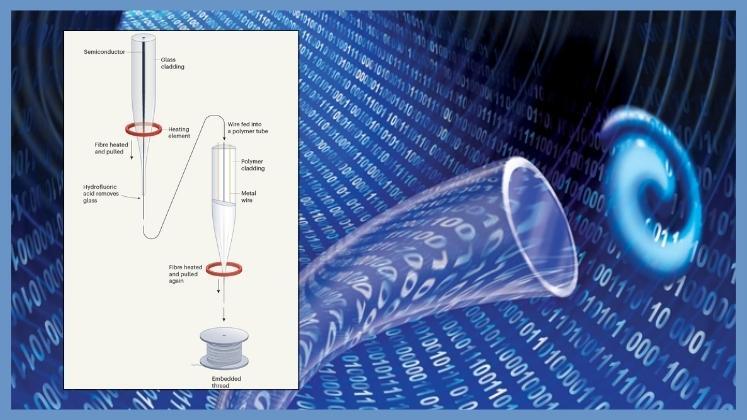
A Singapore-based team of researchers reports some progress in producing microscopic semiconductor components that can be fed into a fibre-pulling machine, resulting in continuous high-performance flexible fibres that can perceive, communicate, and interact with one another.
Nanyang Technological University post-doctoral researcher Zhixun Wang and his team figured out that stresses form on woven semiconductors where the core solidifies and, in a separate, subsequent phase, when the fiber is cooled. The stresses resulted from the different melting points and thermal expansion rates of the chosen materials
“The authors showed that both problems could be alleviated by choosing the right combination of materials: silicon cores worked well with cladding made from ultra-tough silica glass, whereas germanium cores performed better when clad in aluminosilicate glass,” said Virginia Tech researchers Xiaoting Jia and Alex Parrott.
A method of encasing semiconductor materials in fibres by placing them into a glass tube and heating both materials until they are pliable enough to be drawn into a thin thread, which is then cooled was developed. After the glass is removed with acid, the wire is inserted into a polymer tube, alongside metal wires. Following another round of heating, the material may be stretched into a thread hundreds of meters long. It is capable of detecting and analysing signals, the researchers assert.
The team has created a functioning beanie cap that demonstrates an outside use of the technology in aiding the visually impaired. The interface board was included in the hat, and the signal received from the beanie could be processed by a mobile phone application.
As per the research, optoelectronic fibres, fabrics, and functional apparel can be created using semiconductor fibres, indicating a promising path to high-performance functional fibres and fabrics, as semiconductors are the critical components that primarily govern device performance. “Our findings may take functional fibres one step closer to unprecedented sensing, actuation, energy conversion, and computing capabilities,” the researchers said.