Oil lines on circular knitted fabric, is a common problem faced by knitters. This problem of oil stained fabric becomes intense with cotton/elastane plated fabrics, where pre-dye heat setting is essential. Mukesh Gupta, B. Tech (Textile Engineering) from IIT Delhi) and CEO, Cleantech, with over 25 years of work experience in Textiles including yarn, knitted fabrics and garment make-up, has come out with an easy use and low priced solution to eliminate this problem, Team StitchWorld analyses.
The Problem
The needle of a circular knitting machine moves in a wet zone and a dry zone. The part of the needle which is inside the cylinder tricks and the cam boxes is the wet zone of the needle. The wet part is in constant contact with the lubricating oil. The dry zone is the part of the needle which is protruding outside the cylinder tricks and cam boxes and it should be free of any lubricating oil. It is in this dry zone of the needle where the needles make contact with the knitted fabric and the yarn.
The problem begins when the lubricating oil starts to migrate to the dry zone of the needles and then starts to transfer to the knitted fabric, causing oil lines.
Currently there is no solution for removing oil from fabric in the heat setting process, fabrics are heat set and then subjected to scouring process for removing oil. Even the silicone oil used in spinning of elastane/Lycra has to be removed in scouring. The problem is that the oil interferes in the heat setting process and causes yellowing of the fabric, leaving behind oil spots on the fabric.
The Root Cause of this Problem
The question is how does the lubricating oil transfer from the wet zone of the needle to the dry zone of the needle? This oil migration to the dry zone of the needle is due to three major reasons – the wick effect of the trapped lint, surface tension properties of the lubricating oil and the reduced viscosity of the lubricating oil which enhances its flowing ability.
With time, in a running knitting machine, friction in the stitch forming elements causes the temperature of the cylinder and its associated parts to rise and stabilize at about 60-65°C or even higher depending upon the condition of the knitting machine and its cleanliness and the state of its stitch forming elements. Temperature stabilization is achieved by a combination of factors such as lubricating oil, machine RPM, radiation, air flow cooling elements, etc. However, failure of these raises the temperature which causes the viscosity of the lubricating oil to reduce dramatically. This drop in viscosity of the oil makes the oil flow more gently.
Viscosity, a measure of the flow ability of a liquid at 40°C, is approximately 14.3 [mm²/s], where the same oil at 100°C viscosity falls approximately to 3.6 [mm²/s].
Options Available to a Knitter
The knitter has only a handful of options available to cure this problem like reduce the amount of oil that is being injected into the knitting machine. But this solution is dangerous and it may cause the temperature of the knitting machine to rise excessively and may even lead to disastrous consequences including ceasing. The other option available is to stop the knitting machine and to arrange for intensive cleaning of the knitting zone by high pressure compressed air to remove oil and lint that may be trapped in the dry zone of the needle. The last and final option left is to completely strip the knitting machine and clean up all the lint trapped in the needle tricks and the cam boxes.

All the above solutions are temporary and involve considerable cost and stop time for the knitting machine. Irrespective of what is done, the problem recurs and there seems to be no solution in sight.
Probable Solution
A simpler automated solution without involving worker intervention or stopping the machine is required. The trapped lint and oil needs to be removed from the dry zone of the needles either by ‘blowing-it-off’ by compressed air or by ‘sucking-it-off’ by vacuum. Blowing-it-off is not an option since there is a danger of discharging the contaminants on the knitted fabric itself.
A probable solution will lie in extracting by vacuum suction, any oil or lint from the dry zone of the needles, as and when they are generated. Only such a solution will be successful and will not require worker intervention or stopping the machine.
[bleft]A solution to eliminate oil lines on knitted fabric lies in extracting oil or lint from the dry zone of the needles as and when they are generated using vacuum suction. This solution will be successful as it will not require worker’s intervention or stopping the machine[/bleft]
Oil and Lint Extractors from Cleantech
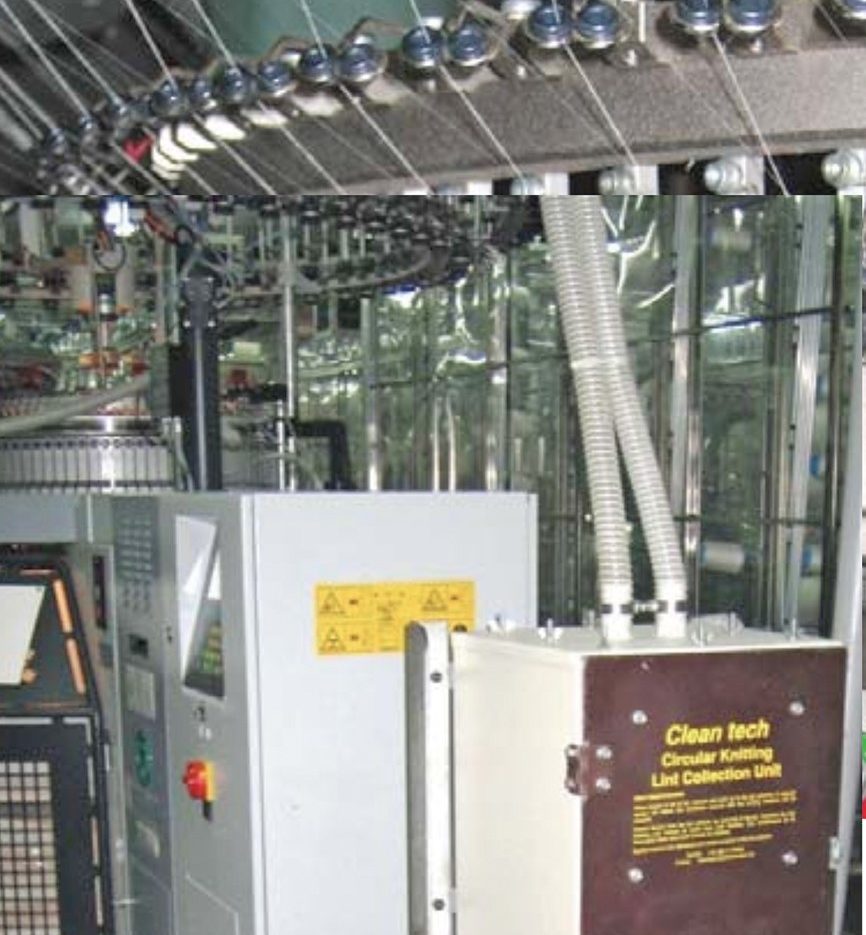
Cleantech has developed an oil and lint extraction system, which consists of two purpose designed oil and lint extracting suction nozzles, which are placed on the dry zone of the needle, just above the cam boxes on the rotating cylinder. The rotating cylinder ensures that each needle is subjected to suction by a nozzle, two times in each revolution of the cylinder. High volume suction air flow is provided by a purpose designed low power vacuum generator based on maintenance and oil free side channel regenerative blower.
Any oil or lint trapped in the dry zone of the needles is sucked out and removed to the waste and oil collector in the extraction system. The filters in the extraction system are designed to separate the lint and oil. Lint is trapped in the filters and the oil is collected and discharged to an external container. The extraction nozzles are designed to act only upon the exposed dry zone of the needle and not to extract any lubricating oil from the needle tricks or cam boxes of the knitting machine.
Outcome of Full Scale Industrial Trials
Full scale industrial trial was done with a knitter, who was frequently plagued by this problem. The following observations over six months were made during the commercial trial.
- The fabric produced was devoid of oil lines and ‘knitted-in-oil-stained lint’.
- There was a 25% reduction in operating temperature of the knitting machine.
- Reduced temperature meant lesser evaporation of oil, which led to reduction in lubricating oil consumption.
- Reduced machine temperature provided the opportunity to increase RPM of machine by 8% (an increase of 2 RPM over 25 RPM of the machine), obtaining a corresponding increase in productivity.
- This increase in productivity was enough to set off all costs for this extractor over a 12 month period.
- There was a marked improvement in the overall quality of fabric and a complete absence of oil soiled fabric.
- No worker intervention or machine down time was required for this oil and lint extracting solution.
- The oil that was extracted to the collector could be reused.
Inference
Consuming moderate power at 0.5 kWh, this simple extraction system has a small footprint of about 300 mm² and was easily accommodated on the floor without any obstruction.
This is truly a simple and an effective solution to eliminate oil lines from knitted fabric with a spin off of reduced oil consumption and reduced machine temperature.