
Making dress shirts with 100% cotton fabrics with finer counts is very different from making casual shirts and invariably poses a challenge for manufacturers. Special precautions need to be taken during the making of collars and cuffs. One is often not aware about the rationale behind this need nor is one clear about related technological possibilities. As cutting operations can be automated to a reasonable extent, selection of right interlining, fusing machine and correct operating procedures is the key to success, as also the selection of appropriate sewing and ancillary equipment. In the last issue we discussed the best practices followed the world over in the area of pattern engineering, interlining and fusing process, the current issue will discuss the sewing technology and processes. While the idea is to provide knowledge and information to our readers, the brand and model numbers are only indicative.
Each specialist will have his own views about the subject, based on his past experiences. Since experiences differ with context, there are bound to be differences in opinion. For example, some of the manufacturers combine hemming with topstitching of cuffs, while in most cases these are two separate operations. For collar run-stitch, some prefer variable top and bottom feed while some prefer jig stitching. As can be surmised, there is no “single best method” of any operation.
Sewing Equipment
In the sewing sector, the profile stitch is one of the pre-requisites for high quality collars and cuffs for which different techniques are available. Semi-automatic workstations with attached jigs to do profiles stitches are very efficient whereas a less expensive option could be a basic sewing machine with needle feed and edge trimmer (PFAFF 2081-731). PFAFF suggest the 3511-series.
In both options it is possible to put a little ease to the collar dips. But there are limitations – physical limits in jig construction and the impact of the operator on material handling using a needle feed machine. This will still leave a risk for quality.
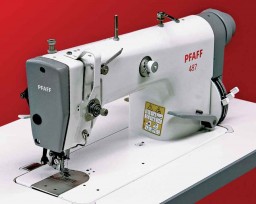
For high expectations of quality and performance PFAFF recommends 487-731 series.
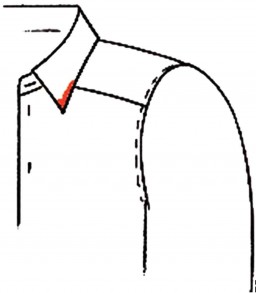
The comfortable feeding system in PFAFF 487 supports the effect, to put ease towards the collar dips, (highlighted in red). The right amount of ease at the upper collar dips prevents the “turning up” of collar points.
Felling
[bleft] Topstitching of collars and cuffs can also be done with a basic high-speed sewing machine. Remember, the higher the manual influence (material handling), the higher is the risk for quality! A better option is to go for needle feed machines with sensor technologies [/bleft]
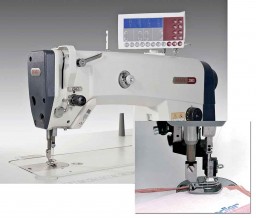
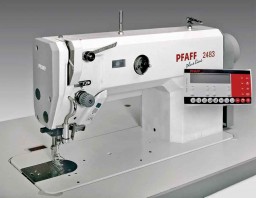
For collar-band hemming and cuff hemming, PFAFF recommends high-speed sewing machines, 2083 series with SRP and an attached hemmer 91-056 211-93. The hemmer is adjustable for different widths. The quality of the sewn products speaks its own language. With this machine an estimated output of 250 pieces collar-band or 200 pairs of cuffs can be achieved.
Some of the manufacturers combine hemming with topstitching of cuffs. Of course, this is an interesting variant. But to be on the safe side, in most of the cases it is recommended to have two separate operations to achieve a high quality. As far as cost is concerned, there is hardly any difference between the two variations of hemming and topstitching the cuffs separately and together.
Topstitching
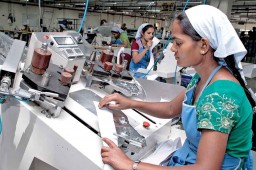
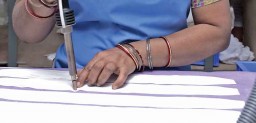


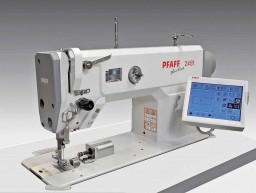
Topstitch for collars and cuffs can be done also with a basic high-speed sewing machine. Remember, the higher the manual influence (material handling), the higher is the risk for quality! A better option is to go for needle feed machines; the best option however, is the use of the unique machine with sensor technique, developed by PFAFF. For topstitch operations on collar, cuffs or other small part, PFAFF recommends the 2481-980/30, a machine out of the so-called plusline-series. That machine is to make the corner stitches automatically in accurate stitch formation. This minimizes manual interference by the operator.
Even if tolerances occurred in preceding operations are too high, the operator can make corrections using a knee switch. Joint seams can be avoided with the help of a bobbin thread indicator. This will improve quality and simultaneously reduce machine down time.
With the support of sensor techniques, it is possible to sew at full speed till the respective corner. Then the electronic edge guide goes off automatically, the operator turns the sewing material (collar) with his right hand to bring it in the required stitch direction and the edge guide comes back in the adjusted position. The next distance is sewn at full speed by giving an impulse through the treadle.
[bleft] A pre-requisite for attaching the collar to the neck is marking of shoulder points and centre back at the collar-band. While trimming the unfused collar-band to reduce seam allowance to 5 mm, semi-automated machines can be used for marking. [/bleft]
Collar to Collar-band: To attach the collar to the collar-band, PFAFF recommends a needle feed machine. This particular feeding system supports operators handling, particularly in curves. An additional edge guide makes it easier for the operator to maintain equal seam allowance. That goes for the topstitch operation too. The use of a compensating presser foot provides relief for the operator and contributes towards higher quality. PFAFF offers the so-called Premium-High-Speed-Series along with an adapted long life hook set.
Collar to neck: Finally, we come to the attachment of the collar to the neck. If it can be assumed that all preceding operations are done within tight tolerances, this operation is going to be the most important for the optical symmetry for the shirt. High quality high-speed machines are recommended. Many manufacturers are using PFAFF 487 with variable top feed combined with drop feed or needle feed machines, depending on collar-band-neckline construction.
A pre-requisite for the operation is marking of shoulder points and centre back at the collar-band. While trimming the unfused collar-band to reduce seam allowance to 5 mm, semi-automated machines can be used for marking. It can be done manually or through separate marking devices.