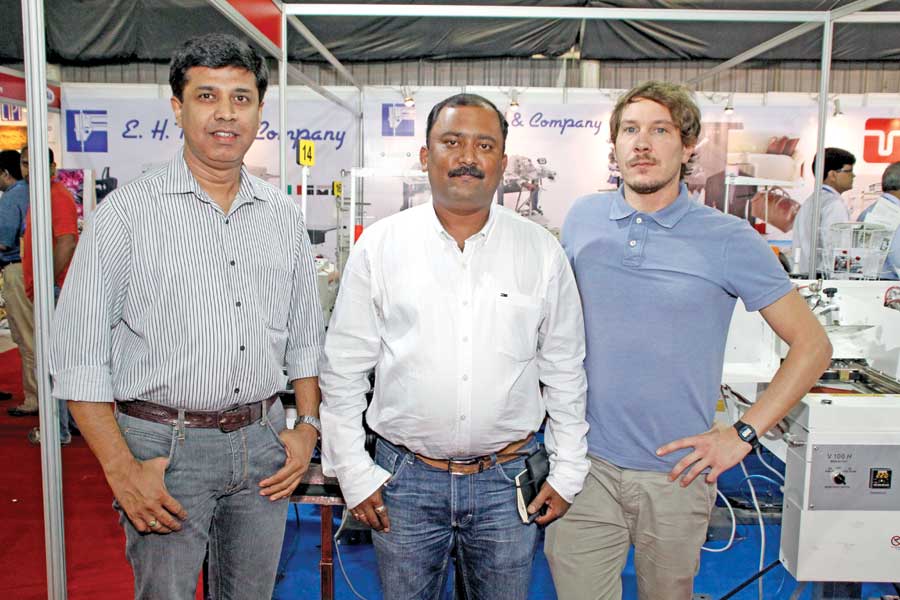
Automation is the mantra at E. H. Turel, and the company is upbeat about the automated technology they offer, positioned to save on manpower and operation time – two critical factors for competitive manufacturing today. “We are always looking to fulfil the needs of the industry where every product segment has different requirements. While on one hand we have high-end automated solutions from Vibemac, Italy, on the other we have dependable and economical sewing options from Typical, China,” says Viraf Turel, Managing Director, E.H. Turel & Co. Among the most sought-after machines at Turel Group’s booth, were the loop setters from Vibemac, X-feed machines from Typical and the automated pocket welting machine from A.S.S. (Automated Sewing Systems).
Loop attaching in jeans has undergone many changes, apart from conventional bar tack, brands labels like Diesel, Woodland, Levi’s and H&M have come up with various combination of tacking (such as cross tacking, etc.) for attaching loops in a distinct manner. “Vibemac responded to their needs with 4650EV8R automatic loop setter. This programmable unit can store from 1 to 999 stitches per bartack with 9 different bartacks styles pre-fed in the memory,” informs Alessandro Signorini, Sales Manager, Vibemac. The production achievable is around 2000 pairs of jeans with 5 loops in 8 hours. The bartacks can be adjusted in both X and Y dimension. The length of the loop can vary from 20 mm to 85 mm, while the width of the loop and bartack can vary from 8 mm to 25 mm. It is easily programmable by PLC (Programmable Logic Controller), and the user can create sequences of loops without even touching the panel. With this unit, it is now possible to personalize bartack’s shape and design to suit brand logo.Moreover, fancy and designed bartacks (Double, Crossed, Square, etc.) are feasible in sewing area of 30 mm X 16 mm by this unit.
The BASS 3200 from A.S.S. is a universal automatic welt pocket unit which can sew all kinds of common welt pockets — straight, slanted, with or without flap pockets, and can stitch pockets of 20 to 200 mm length. Zipper attachments too can be integrated without any problem. BASS 3200 can stitch at a maximum speed 3000 stitches/per minute running on an Efka direct drive motor, with the transfer and trimming system being controlled by an individual drive system. Due to which each and every operation done by the machine can be controlled with the help of the installed microprocessor chip, along with a memory of 40 seams.
The machine also has five separate programmable laser beam marking lights, for precise and easy loading, and an automatic flap sensing by photocell. The needle gauge is available in steps of 2 mm varying from 8 mm to 30 mm. The start and finish of all the seams can be programmed with back tack or condensed stitches. Moreover, the corner cutting mechanism which actually defines the finish of the whole operation can be adjusted up to 10 mm in increments of 0.1 mm.
“Automation is key in today’s time. The focus of a manufacturer should be to invest in automated machinery, right from the cutting room to the finishing floor to increase efficiency, productivity and quality. There are different types of market players with different requirements. But it is vital to identify and understand your needs before making that investment,” concluded Viraf.