Dhaval Colour Chem has been in the business of Screen Printing supplies for over a quarter of a century now and has been a provider of one-stop-solution for all Screen Printing needs servicing the industry with its state-of-the-art printing lab, a training centre and highly motivated service personnel.
DCC displayed the latest oval screen printing machine Alpha 8 from M&R’s stable at the show. “It’s modular and expandable – and can be configured for almost any production requirement,” said Nirav Udani, Sr. Marketing Manager, DCC. M&R’s Plug & Print™ modular design provides for virtually limitless expansion in six-station increments. Other than the end stations, there are no restrictions on printhead placement. All other stations can support printheads – and any station can be left open. The oval shape makes more efficient use of available production area. This also allows the Alpha 8 to fit into spots where no carousel press could.
Available in 3 models: Alpha 8 model machines series offer image areas between 50 x 70 cm to 80 x 110 cm. Double-index mode on alternating printheads can produce images between 99 x 70 cm to phenomenal 150 x 110 cm. The 8-station Base/Drive Module supports up to 4 printheads, while M&R’s Plug & Print™ modular design provides for expansion – in six-station increments – up to 62 stations on Alpha 8 5070 and 6080, and up to 50 stations on Alpha 8 80110. Alpha 8’s digital touch-screen control panel with icon-based controls can display information and commands in numerous languages, simplifying printing operation.
“The advantage that M&R machines enjoy over their other counterparts is that the palette system is coated with insulated rubber providing a cushioning effect when printing pigment prints and it also helps in minimizing heat. This gives a better quality of print,” Kannav Arora, Head Application Support, DCC explained.
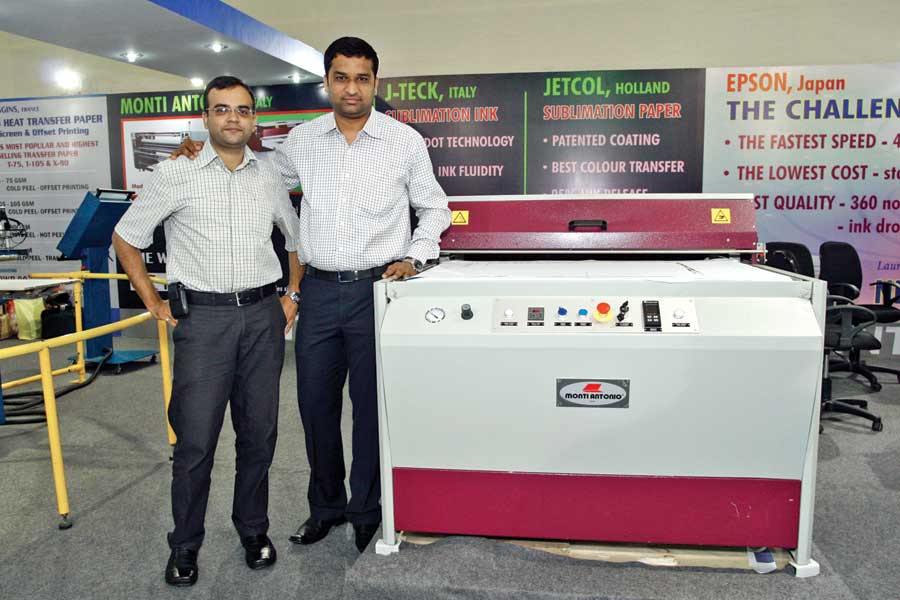
DCC also showcased Monti Antonio’s 108 model heat transfer machine for the first time. This is a digital sublimation printer which carries out the most critical process of transferring the design printed on the paper onto the garment. To achieve a uniform print on the garment, there needs to be a uniform temperature on the heat plate of the machine because any variation in the heat plate temperature will lead to variations across the print as well as across the production line. This flat bed machine has an accuracy of ±1°C and promises to achieve very high quality printing.





 Bharat Tex Special Report 2026