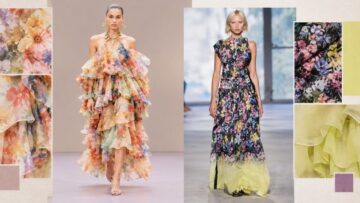
Florals are shedding their spring-summer association and moving into darker, more textured territory for Autumn/Winter 2026. Runway signals from the February fashion month point to a decisive shift: florals rendered in deep, moody palettes, aubergine, forest green, wine, bronze, layered onto jacquards, velvets and quilted textures rather than the airy cottons typically associated with the print.
The moment that crystallised the trend was Valentino’s Spring Couture 2025 collection in Milan, Alessandro Michele’s debut at the house, where ornate florals appeared alongside recycled and upcycled textile treatments, with garments built on labour-intensive handicraft techniques. The tone carried into the A/W 2026 shows proper.
At London Fashion Week, floral prints were among the season’s defining trends, appearing across the schedule even though florals are typically associated with spring rather than winter dressing. Richard Quinn and Patrick McDowell both showed pretty floral motifs on vintage-inspired silhouettes that read as timeless rather than trend-driven. Erdem’s 20th-anniversary show at Tate Britain leaned further into the historical register, building a layered scrapbook of references spanning Queen Elizabeth to Duchess Deborah Devonshire, and moving between Victorian-prim florals and ’90s rave denim.
In New York, market reporting flagged dark florals from labels including Ulla Johnson as one of the season’s defining dress directions, while Paris carried the print into couture, with Chanel Haute Couture pairing scarecrow-esque jacket silhouettes with floral appliqué dresses.
Several markers define the trend for A/W 2026. The palette is shifting from pastel spring tones to saturated, autumnal hues like burgundy, olive, chocolate, bottle green. Execution is becoming more texture-forward, with jacquard, brocade, quilting and velvet replacing the lightweight florals-on-cotton typical of warmer seasons, a broader shift reporters have tied to a season-wide emphasis on texture, with fur, pile, shearling and fringe running alongside the floral story. Craft and upcycling narratives are running alongside the print itself, positioning floral motifs as a vehicle for craftsmanship storytelling rather than pure decoration. And scale is changing too: larger, more painterly floral motifs are replacing small-scale repeat prints, often deployed as a single statement element, a blouse, a scarf, a pair of trousers, rather than head-to-toe application.
India’s textile ecosystem is well positioned to respond to this shift. Hand block printing, Kalamdani and Bagh-style florals, and jamdani-woven floral motifs already work in the darker, richer colour registers this trend calls for, and many domestic ateliers have the jacquard and brocade weaving capability the trend rewards. That capability was on visible display at Hyundai India Couture Week 2026, where designers including Rohit Bal’s label, Rahul Mishra and Tarun Tahiliani worked in silks, velvets and heritage textiles with elaborate hand-embroidery — the same textural vocabulary the global fall floral story is built on, even where florals specifically weren’t the headline motif.
The shift is already visible across ethnic, casual and fusion labels working in both menswear and womenswear. Nicobar has florals running through its kurta and top lines this season, including the Hera Kurta in a soft pink-and-white print, the Uma Top in a watermelon-and-silver floral, and the Astral Kurta in an ivory-and-green botanical print; the label also carries floral and botanical prints through its men’s kurtas. Biba has built entire seasonal collections around the print, including a “Flowers of the World” theme spanning tiny ditsy prints to oversized floral embroidery with thread and sitara work, and a “Love Birds” line centred on bright floral kurtas.
Global Desi works florals into fusion silhouettes with printed tiered dresses, floral co-ord sets and Indo-western kurtis that pair prints with Western cuts, while Bandhej, the heritage Jaipur label, renders florals as small-scale sanganeri-style botanical block prints on cotton and mulmul. House of Masaba treats florals as a signature motif in bold, saturated colourways across sarees and separates, and Injiri works floral motifs into handwoven, hand-embroidered textiles alongside other traditional patterning. W for Woman runs floral-printed kurta sets through its seasonal ethnic-casual range.
On the menswear side, Ethnix by Raymond and Manyavar carry floral motifs on bandhgalas, Nehru jackets and festive kurta sets, typically as woven jacquard or embroidery rather than print, while Rare Rabbit sits within the broader 2026 menswear shift toward darker, more architectural floral prints on shirting, a move away from the classic tropical holiday shirt toward richer, gallery-wall-style florals.
For Indian brands and export houses, this is a season where floral SKUs can be pitched not as a repeat of spring stock but as a genuinely new autumn-winter story, particularly for players already positioning around craft provenance and upcycled textiles, where the trend’s craftsmanship narrative offers a ready-made marketing hook. Buyers sourcing for A/W 2026 collections may want to prioritise floral development in heavier-weight, textured bases over the lighter florals typical of spring ranges