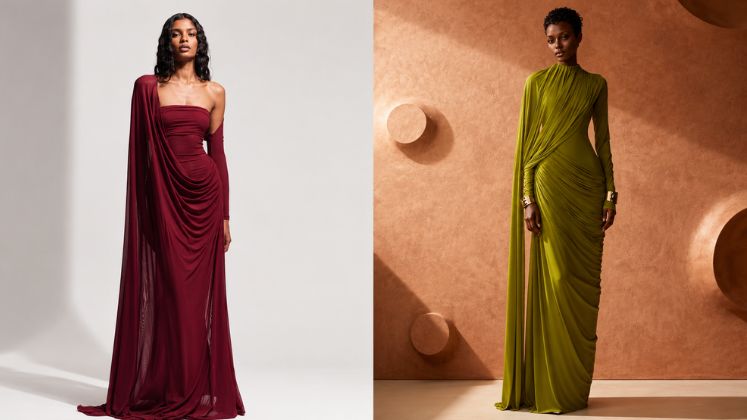
Few silhouettes have proven as durable as the draped dress, and this season’s roundup of runway and retail offerings shows why designers keep returning to it. Where structured tailoring depends on precise seaming, drape works with the body rather than against it,by gathering, twisting or pleating fabric so that fit becomes fluid rather than fixed. That flexibility is part of its commercial appeal too: a well-executed drape dress can move from evening wear to daytime layering piece depending on styling, fabric weight and finish.
Victoria Beckham and Zankov both showed body-skimming, fabric-led silhouettes this season, reworking a familiar drape into something that reads current rather than nostalgic. Fforme leaned into Grecian-style pleating with its Kahlo asymmetrical dress, while JW Anderson’s knot-detail dress used jersey to create a hip-hugging, sculptural drape. At the accessible end of the market, Banana Republic’s hammered dress and Staud’s gathered Davina dress show the trend translating down the price ladder without losing its core silhouette logic, proof that drape scales across price points, from designer pieces retailing upward of $1,000 on platforms like Net-a-Porter to sub-$300 retail versions.
Drape is not a borrowed idea for Indian fashion, it is foundational. The saree, the dhoti and various forms of pre-stitched drape garments have long informed how Indian designers construct silhouettes, which gives the current Western trend cycle a natural point of intersection. Designers such as Amit Aggarwal have built entire design vocabularies around structured drape and fabric manipulation, while others working across couture and prêt lines have used pre-draped sarees, drape gowns and dhoti-style silhouettes as red-carpet and occasion-wear staples for several seasons now.
On the retail side, Indian D2C and contemporary labels have increasingly offered drape dresses and drape-saree hybrids as easy, semi-formal options, positioning the silhouette across couture, occasion wear and everyday semi-casual dressing simultaneously, a versatility that Western retail is only now catching up to with pieces like the Banana Republic and Staud styles above.
For Indian manufacturers and brands, the global draped-dress trend is a validation of existing capability. Domestic ateliers and export units already have deep technical fluency in drape construction, pleating and fabric manipulation; skills built around the saree and other traditional garments. As international demand for draped silhouettes grows across price segments, from couture to mass retail, Indian manufacturing and design talent is well positioned to serve it, provided the DPP and traceability expectations increasingly attached to international orders are met alongside the technical brief. Brands watching this trend should also note how directly it plays into contemporary Indian occasion-wear positioning, where drape-based silhouettes already anchor a large share of semi-formal and festive retail.