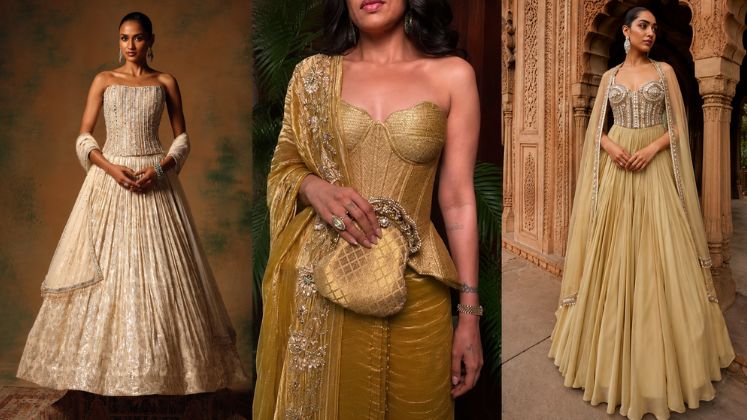
Fashion outlets are calling 2026 the year of the corset dress, an evolution of the “trad-wife” aesthetic that borrows the waist-cinching lines of last year’s milkmaid trend but trades puff sleeves for something sleeker and more polished. Contouring vertical stitching and exaggerated fit-and-flare shapes are doing the work once handled by lace trims.
High street labels have moved fast: Gap has positioned an airy linen corset dress as an office-safe entry point, while Reformation and Omnes have pushed feminine, heatwave-ready versions in gingham and shirred midi cuts.
Celebrity styling has accelerated the trend’s spread from runway to high street. On the red carpet, the silhouette has turned theatrical, from Schiaparelli’s sheer, metallic-textured corset dress at its Fall/Winter 2026 show to structured, bow-backed gowns at the Oscars.
However, in India the structured corset was never a new concept. The cinched bodice has quietly lived inside Indian couture for years, disguised as the choli. What’s changed is its visibility and its vocabulary. Bridal and occasion wear in 2026 is putting blouses at the centre of the outfit, with bold cuts, backless styles, halter necks, corset-inspired blouses and cape overlays reshaping how lehenga choli is bought and worn. Indo-Western lehengas in particular are being reworked with capes, jackets, corset blouses, crop tops and sculpted, asymmetric silhouettes, a clear departure from the traditional choli-dupatta pairing.
Designer India has absorbed the language fastest. Corset-structured blouses and bodices now sit across collections from Amit Aggarwal, Papa Don’t Preach by Shubhika, Falguni Shane Peacock, Gaurav Gupta and Torani; houses already known for architectural silhouettes, for whom boning and lacing are a natural extension rather than a borrowed trend.
The corset saree, pairing a fitted, structured bodice with a pre-draped or pant saree like the ones at Anamika Khanna or Torani, has emerged as a specific occasion-wear category: multi-designer retail platforms now list it as a standalone style, distinct from the classic blouse-and-saree combination. Bridal lehengas are following the same logic, with corset-panel cholis popularized by labels like Mahima Mahajan and Tarun Tahiliani replacing padded, structured blouses as the default for cocktail and reception wear.
Casual wear has been slower but is catching up. Brands like Nishorama and House of Chikankari keep Co-ord sets and kurta dresses that borrow corset detailing, with boned side seams, waist tapes, visible lacing as a styling cue rather than a functional structure, echoing how the West has softened the silhouette for everyday wear. Handmade and made-to-order corset-pattern styles are a steady demand for lehenga and kurta sets aimed at wedding guests and destination functions, suggesting the trend is moving from red carpet to trousseau faster than it’s moving into daily wardrobes.
The corset dress gives Indian labels a rare two-way trend. It’s a Western silhouette that validates a structural technique that Indian couture has used in bridal cholis for years. For brands, that means less reinvention and more repositioning: existing corset-blouse expertise can now be marketed as on-trend rather than traditional, extending its relevance from wedding season into occasion and going-out wear.