-
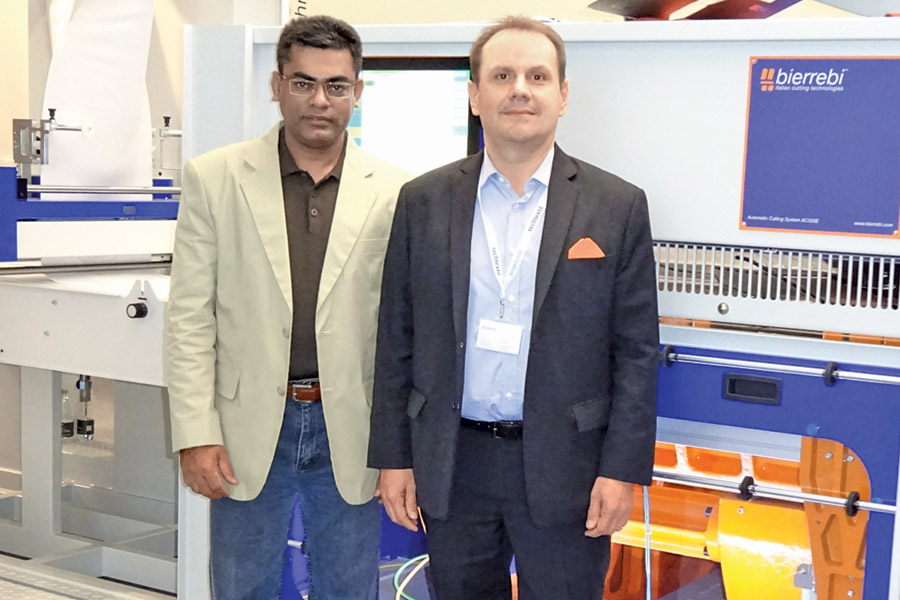
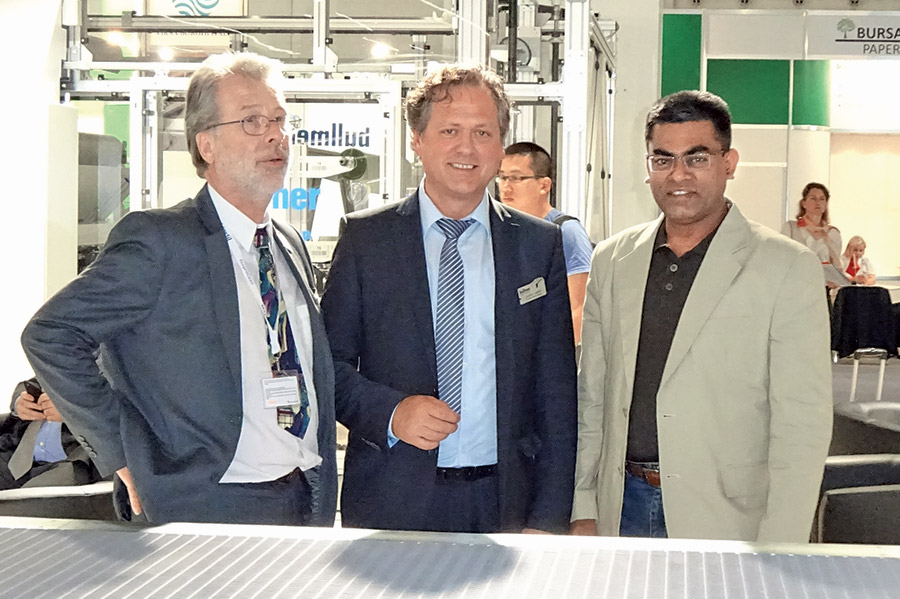
MA Saleque, MD, Uni Asia Associates with Marco Rossi, Sales Manager, bierrebi Sewing innovations aim at reducing labour dependence
- Cutting room solutions focus on difficult to handle knit fabrics
The most-awaited technology show of the sewn product industry, Texprocess is one of the best networking platforms for direct business which enables customers to see a vendor’s portfolio closely, understand the industry pulse better and get updated on technological innovations that are on offer. The recently held 2015 edition of the event in Germany wasn’t an exception. It witnessed massive participation of people who thronged the sprawling exhibition ground of Messe Frankfurt, to attend the four-day tech extravaganza. AOB reviews some of the key innovations showcased by the major suppliers for its esteemed readers in this column.
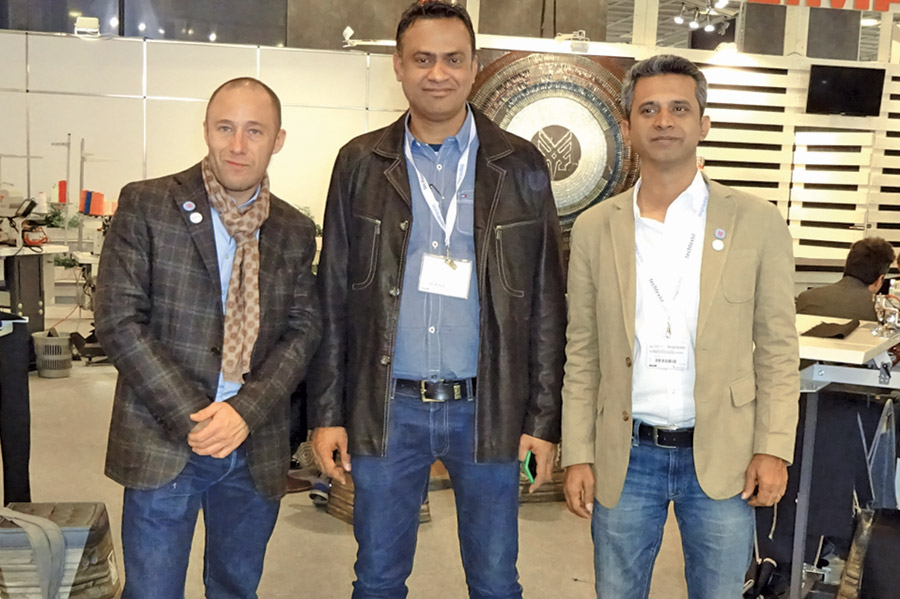
Bearing the theme of simple solutions, bullmer marked its participation with its Compact d 600 fabric spreader, which claims to have eliminated relaxing time for elastane knits. The spreader comes along with a steam spray system, supplied by another german pioneer, veit. Steaming of knitted fabric before spreading ensures dimensional stability of the fabric. This unique intervention helps save up to uS $ 160,000 by getting rid of extra operations, waiting time, additional machines and floor space. International lingerie retailer Triumph, who has purchased over 20 units of this model, gave it positive reviews. The fair also featured Italian cutting specialist bierrebi’s automatic cutting system for tubular knit fabric, AC. The AC line automates steps of handling tubular knit fabric, market placement, fabric cutting and transportation of cut pieces in a single operation, which requires just one operator to take care of the entire process. Claiming to save 10% of fabric compared to conventional methods, the AC system utilizes dye cutting technology for cutting fabrics into panels ready for sewing. bierrebi machines are already in use at the gildan’s facility in the US and Bangladesh; besides Fruit of the loom, la Perla and HBI factories across the world. uni Asia Associates is its sole distributor in Bangladesh.
Indian cutting room software solution specialist, Threadsol’s intelloCut caught the attention of several visitors for its accurate fabric requirement estimating ability. The software generates optimized cutplan and makes use of data related to fabric width, shade and shrinkage in order to ensure minimal wastage and accordingly allocate fabric rolls, in a single click. Another solution from the company, intellobuy, is capable of running unlimited number of cutplans from a consolidated excel sheet (buying sheet) in single click, and has proven average savings of around 10 per cent of raw material and effort reduction by 80 per cent, thereby saving millions of dollars for enterprises, claims the company. Some of the other features of intellobuy include integration with any and every CAD system, exact factory wastage calculations, consolidated marker database, prediction of the quality of incoming fabric and reports for fabric yield/consumption for costing and buying purposes.

Highlighting the importance of customer service, Vibemac, the Italian pioneer of sewing machines for denim bottoms, brought to the event its improved service levels using M2M communication. The company has developed an IT solution to track the machine’s upkeep by documenting its entire history and giving a real time feedback to the mechanic remotely on the fault levels if and when it appears through various sensors in the machine, which will be directly linked to the Vibemac’s head office, via the internet. The other intervention is that of Vibemac’s alliance with VINCO, under which, old machines are conditioned to work as new. They are also customized to perform particular operation in accordance with the customer’s demands and requirements.
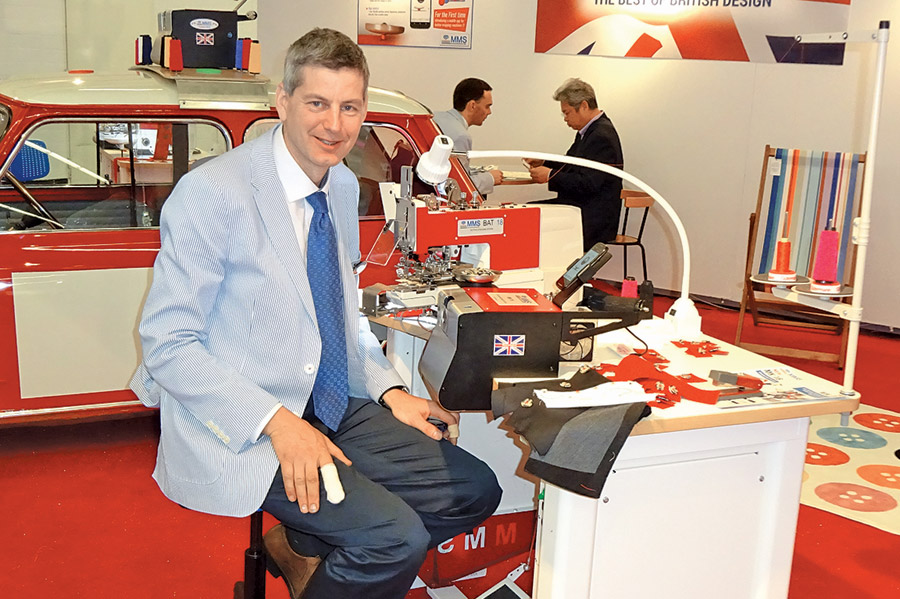
The Japanese pioneer in developing sewing solution, Juki, showcased solutions for bottoms with exhibits like AMS-221EN-TS3020/X90002 for pocket attachment on jeans with 2-colour threads, and APW 896, for sewing welt pockets with flaps. AMS-221EN has maximum sewing speed of 2500 SPM, and sewing area of 110 mm X 110 mm. The machine can store up to 500,000 stitches in the main body memory and 49,950,000 stitches in the external memory. The automatic welting machine can furnish slanted flaps and welts working within a range of 1,000 to 3,000 stitches per minute. The company is proud to have pioneered the world’s first computer-controlled sidewise cutting position of the corner knives for easy adjustment. UK-based button attaching and buttonholing machinery specialist, MMS, presented its mark 11 fully automatic button wrapping machine. The machine only takes about a second for wrapping, sealing and finishing a button shank, thus promising 1,500 buttons per hour. The machine has three pre-set programmes, enabling fast switching from one button shank style to another. Also exhibited at the event were BAT 15, BAT 16 and BAT 18 machines respectively, for flat button attachment, shank button attachment and button attachments through blindstitch.
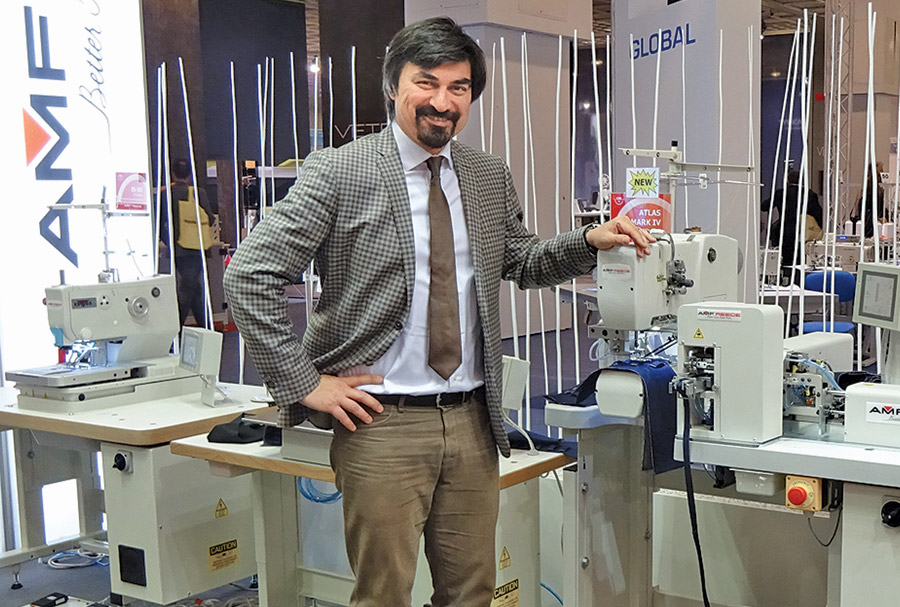
Also of relevance to denim manufacturers is AMF Reece’s automatic belt-loop setter ATLAS mark Iv, which allows sewing of fully customized tack patterns by electronically-driven X-y feeding and twin-needle system. According to the company, the machine takes mere 3.5 seconds to change belt-loop length and 1.2 seconds to stitch a loop. Also exhibited at the show was TH-5500 automat for bottom hemming which can be programmed to match hem joint position accurately with more than two panels. The machine has independently driven top and bottom pullers to ensure puckerfree and even hemming. Capable of running at a maximum sewing speed of 3500 RPM, it can deliver 230-250 pants in an hour.
The Texprocess Innovation Award recipients were Xi’an Typical’s Vetron Autoseamer, Duerkopp Adler’s M-Type Premium sewing machine, Brother’s S-7300A NEXIO lockstitch sewing machine, and Veit’s Fusing 4.0 process control system.
Sewing solution provider, Brother exhibited its newly launched S-7300A, a singleneedle direct-drive lockstitch machine from the brand’s new line of NEXIO industrial sewing machines. A next generation lockstitch machine, which minimizes the remaining short thread length to just 3 mm; made possible through a 2-way trimming mechanism as opposed to an industry average of 7 mm. Further, with this machine, one can sew with varying stitch lengths within the same burst. For instance, 50 stitches can be done with a stitch length of 4 mm and the next 10 stitches can be done with a stitch length of 3 mm, thanks to digital programming. brother has put a pulse motor in addition to a servo motor in it. The machine is also equipped with a LCD colour panel, which is as easy to operate as a smart phone. There is also a USB port to download and feed new data, as per requirements.
One of Texprocess’ Innovation Award winners for 2015, Xi’an Typical’s VetronAutoseam was a hard to miss exhibit for the sheer number of possibilities it offers. The VetronAutoseam can produce 2D and 3D components without an operator as the fabric/ panels are made to move with the help of a rotary device at the needle point. The brand new Vetron machine is able to monitor the edges of two fabrics stitch-by-stitch, thereby automatically sewing the two layers together. The machine is suitable for sewing medium to heavy weight materials found mainly in the automotive, leather or furniture industry. designed keeping in mind the ‘re-shoring’ of apparel manufacturing, it is expected to contribute to the success of production in a high-wage manufacturing locations.
Highlights of the Duerkopp Adler’s exhibit included latest developments for armhole attachment in jacket sewing – class 610-10, 630-10, 670 and 680. The DA 610-10, a doubleneedle chainstitch machine with individually controllable differential top and bottom feeds, finds application in programmed ruffling and taping of armholes. The DA 630-10 is suitable for pre-ruffling the sleeve crown and is equipped with differential top and bottom feeds. It can be programmed per step for a perfect stitch pattern, independent of the material. while the DA 670 is meant for attaching sleeve lining in armholes through the shoulder pad, 680 attaches body lining to the armhole and simultaneously trims the excess length of lining and shoulder pads. both the machines come with an alternating top feed with needle feed and, a post-bed design, for improved handling of the work piece.





 Bharat Tex Special Report 2026