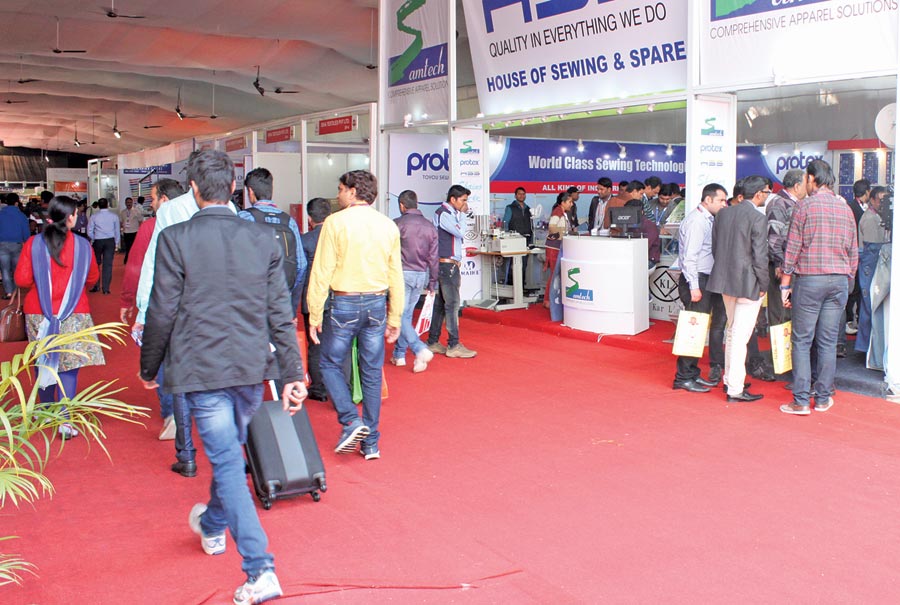
Living up to its reputation for being a meeting ground for industry and technology providers, the latest edition of GTE, New Delhi saw a good visitation from both garment exporters and domestic players. As has been a trend over the last few editions, many companies from smaller manufacturing hubs like Indore, Jaipur, Surat and Kanpur thronged the event to seek out suitable technology and interventions to support better and more efficient operations. Exhibitors shared that while the bigger companies came with the intention to update more on latest technology, it was smaller companies and also domestic players who made larger number of inquiries from the usual embroidery machines to basic spreaders and cutters.
One thing is for sure the garment manufacturing industry, be it for exports or domestic market, are now much more upbeat of business than the last few years. Leading companies from the NCR like Radnik, Richa, Shahi, Orient Fashion, Neetee Clothing, Celestial Knits & Fabs and Paragon rubbed shoulders with many big and small players from other parts of the country. Accompanied by his production team, Sanjay Aggarwal, MD, Shree Bharat International, Noida shared that since business from the US was improving and even Europe looks better this year, they have gone in for expansion. “We have recently added a new factory of 200 machines and now we are looking for energy-saving and productivity enhancing technology to meet the rising demand from the US and Spain,” he said. Also present with his team was Shreyaskar Chaudhary, MD, Pratibha Syntex, Indore who shared that they were looking for machines which can reduce work at the preparatory stage, as also technology to improve finishing. He showed great interest in the new Brother sewing machine, which was launched at the event.
Another big company that confirmed expansion was Richa Global, Gurgaon which is putting up a huge 800-machine factory in Manesar. Nitin Sabharwal, Managing Partner, Sabs Exports, Noida was very upbeat of the market conditions and though they are exporting mainly to Europe, which is still considered to be slow, the company is expecting 20 per cent growth in current fiscal. “We are willing to invest in stitching, printing as well as in embroidery which will make our system easy and will increase our productivity too,” said Nitin. From Jaipur, the team from Singer Global shared that a new factory of 200 machines is under consideration.
Some major companies from the home segment also had some interesting perspectives to share. Pranab Mahajan, Director, Mahajan Overseas, Panipat and owner of the well-established brand Maspar, was very excited about the company’s new green factory in Sonepat, which is a multi-storey building having all operations under one roof for many different product categories. “The home segment is now getting very technology-driven and it is important to be both design-capable and production-capable. Our factory in Sonepat is the reflection of our future which is also going to be sustainable,” said Pranab.

Arguably the only company providing complete ‘cut to pack’ solutions for the home textile industry, Magnum Resources have created a set of technologies and solutions for a niche market segment. Attributing the company’s growth to its team of 30 technicians that provide quick service and support, Akshay Sharma, CEO, Magnum Resources said, “Our company is known for providing value- added technologies and after-sales service to the home industry and we foresee great demand for our solutions.”
Also from the home section, Premier Fine Linens, Coimbatore was represented at the fair by T. Kumaravel, Senior Manager Marketing. The company claims to be the pioneer of double-width bed linen in India and their factory is fully automated with conveyor systems. “The export market for home furnishing is picking up and many orders earlier going to China are now coming to India. So we are looking to expand capacities, though the exact nature of expansion is yet to be decided,” shared Kumaravel. In fact, even Vivek Gupta, MD, Team Krian shared that market was improving as any orders from China are being diverted to the country. “India should have a few good years ahead,” he predicted.

Exhibitors too felt that the years ahead are good for India. “The Indian apparel story is showing strong signs of revival and the basic inputs necessary for success are still strongly prevalent in India. China’s development is forcing it to move up the value chain resulting in a slowdown in garment manufacturing and exports. Bangladesh has fundamental issues in terms of stability, compliance, etc. Vietnam has definitely done well, but there is a limit to what they can do. Hence, India with a large labour-base situated in big pockets around a large country and a raw materials base, becomes an attractive destination for apparel manufacturing and exports,” said Pavan Kapoor, Managing Director, IIGM.

Even players in the domestic market were upbeat. Having a vertical setup (except dyeing), Enfield Apparels, Kolkata (Sonthalia Group) with brands like TSG Breeze and TSG Escape in knits shared that this year they are expecting 100 per cent growth as domestic market is doing very well. “We are looking for something new in machinery or technology intervention which can enhance productivity in any department,” said Udai Agarwal, CEO, Enfield Apparels. Many players from the domestic front were looking for machines relevant for bra manufacturing and interestingly Buddika, Head of Technology and Quality, Brandix Apparel Solutions had come down especially from Sri Lanka looking for advanced machinery for briefs and lingerie. “We are about to start a factory in Vishakhapatnam and we are looking for appropriate technology for the unit as also options for training programmes in India,” he said.

Product diversification is the key growth strategy of all leading apparel manufacturers, and accordingly, leading technology solution providers such as Mehala Machines have expanded their product portfolio. “With our wide portfolio, we not only offer a range of solutions for manufacturing a single product, but also sewing automats for deskilling and improving sewing operations across multiple sewn products,” said Ashim Das, CEO, Mehala Machines. The company introduced for the first time ThreadSol Softwares, which focuses on solutions for fabric saving. Mausmi Ambastha, COO, ThreadSol Softwares felt that with Mehala’s 35 years of industry experience behind them and ThreadSol’s innovations will forge a strong team that will together deal with the challenges that the Indian apparel market is facing today.
The event also saw many manufacturers from Gandhi Nagar, thronging the aisles seeking new technology. Machines for jeans manufacturing were the main focus, but there were also some looking for processing and washing options. As usual, embroidery machines dominated the show and there were around 23 companies presenting computerized embroidery machines, which only goes to reinforce our belief that India’s strength is value addition and will remain to be so. The other machines present in large numbers were sewing machines with many Chinese companies showcasing at different price points. Viraf Turel, Managing Director, Turel Group expects a robust growth of 20% in Indian exports and of 12% in the domestic market. “A good technology with limited automation is going to be the preferred technology by the industry,” reiterated Viraf.
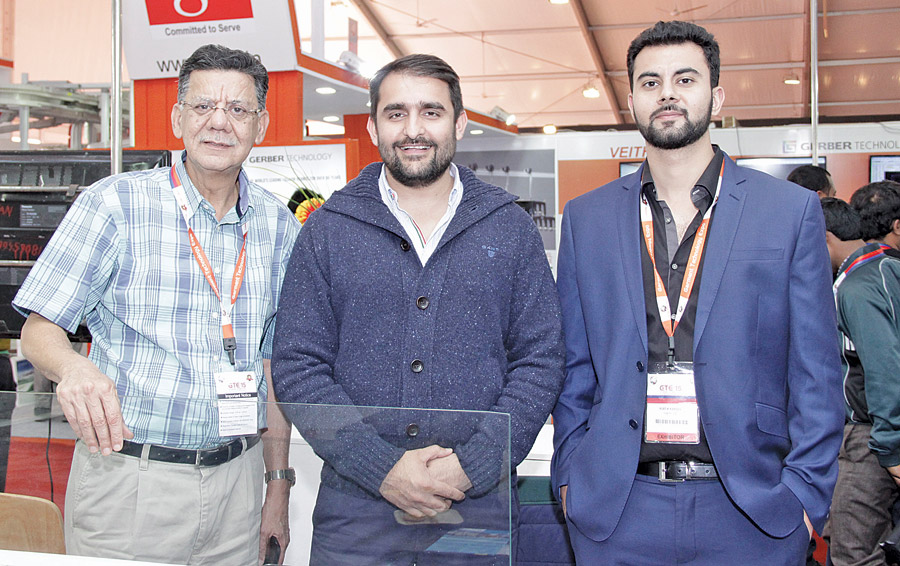
Anil Anand, MD HCA cautioned visitors on selecting automation. “Buying an automat is one thing but maintaining the same is an arduous task because in case of a customized product, all the spare parts and components are available only with the machine manufacturer. This increases the running cost of the machine and the downtime due to delays in shipments of spare parts. But in our case, we are supplying standard machines, whose parts can be purchased from the market and there would be nothing like ‘genuine and exclusive’ HCA parts,” asserted Anil.
Meerut and Kerala emerged as two developing hubs for export manufacturing. While Meerut is emerging as a sportwear base, with many local manufacturers getting into the category, Kerala is picking up for exporters looking at shifting factories from Chennai and Bangalore. Sankara Narayanan K, GM Operations, Kitex Limited shared that the Kerala Government is supporting manufacturers looking to relocate in the state and the resources available in the state are conducive to the industry.