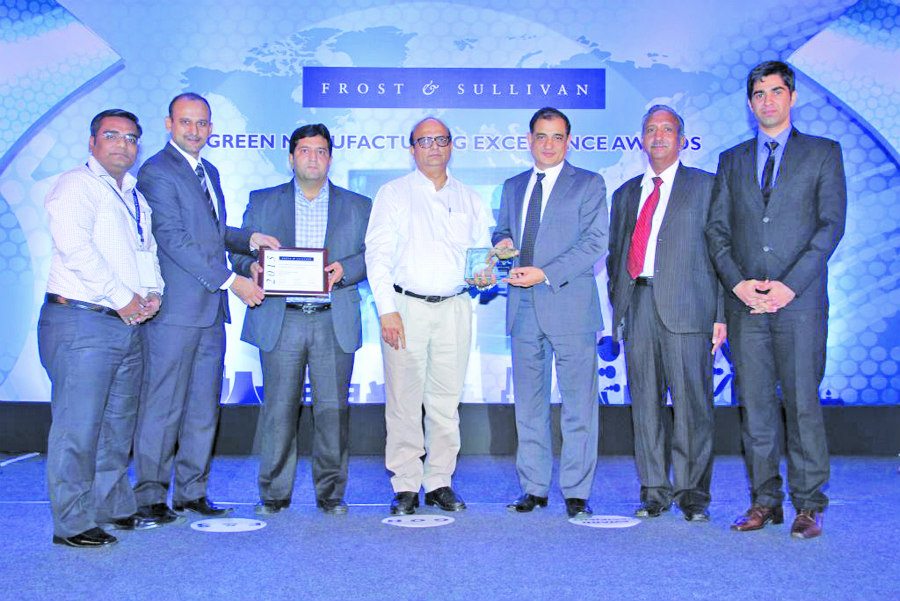
Used often, but rarely understood, ‘sustainability’ actually means changing the way we think about how we use our resources and make small changes that have a big impact on nature and community. To this cause and with a mission ‘to assist the adoption of Green Manufacturing Practices across Indian Manufacturing Companies’, Frost & Sullivan held its 2015 Edition of ‘India Sustainability Summit’ recently at Hyatt Regency, Mumbai. The summit started with a full day of presentations from eminent speakers from across different businesses who spoke about their companies’ initiatives and takes on sustainability. This was followed by an exciting evening of awards where Birla Cellulose was awarded the ‘Challengers Award – Large Business’ in the 2015 Green Manufacturing Excellence Awards category.
Based on the assessments conducted at Birla Cellulose’s Kharach site and subsequently whetted by the Executive Committee of ‘Frost & Sullivan’s Green Manufacturing Excellence Awards 2015, Birla Cellulose was awarded for its excellent rating on pre-determined parameters of sustainability. H.K. Agarwal, COO for Pulp & Fibre Business and Vinay Bhalerao, Unit Head of Kharach unit were present on the stage to receive the prestigious award for Birla Cellulosic.
Delegates at the event were welcomed by Gowtham S of Frost & Sullivan who apprised the guest of the Assessment Model and Methodology of GMEA 2015. He explained that the assessment model is realigned within four major areas and 13 parameters with each having a weightage of 100 points, totalling to 1300 points. The model also took into consideration global sustainability reporting frameworks such as the UN Global Compact. The assessment for Birla Cellulose that concluded had its basis in their GMEA Assessment Model that in turn derived its inputs from the team’s interaction with unit’s personnel, observations in the plant and documents as seen/provided to them. The Kharach unit had a score of 823 for the entire facility. The parameters on which the assessment was done covered Business Strategy, Governance & Ethics, Waste & Emission, Biodiversity, Energy & Water, Materials, Human Capital Sustainability Supply Chain, Society and Customers.
Distinguished leaders spoke on diverse topics on sustainability. The keynote speakers from Birla Cellulose were Ajay Sardana (Vice President & Head – Sustainability) and Rohan Batra (Special Projects) who spoke about Birla Cellulose’s initiatives regarding its commitment towards a sustainable company.
Rohan’s presentation on ‘Product Life Cycle Management’ was highly appreciated wherein he spoke about the company’s efforts regarding sustainability. “By 2017, pulp and fibre business of Aditya Birla Group endeavours to become the industry leader for sustainable business practices across its global operations balancing economic growth with environmental and societal interests,” he shared. He further said that sustainable efforts at Birla Cellulose are tested through Life Cycle Assessment (LCA) as a tool of monitoring and assessing progress.
LCA assesses the environmental impact associated with product, process or service. At Birla Cellulose, it is conducted from cradle to factory. “Birla Spunshades is the most sustainable product in the market that uses a unique dyeing technique. In this dyeing technique, for 100 kg fabric, water savings are up to 70 litres per kg, effluent load is reduced by 70%, power is saved up to 3.5-4.0 KW and time is saved by 6-8 hours per batch, ultimately reducing processing costs with better production quality and profits,” declared Rohan proudly.
On the other hand, Ajay presented an insight on ‘Employee Sustainability Initiatives’ at the Aditya Birla Group. “Employees are key drivers in steering Aditya Birla’s sustainability initiatives. Our company is an exciting world of global opportunities for professional growth with human care. The way we do business is just as important as the business itself,” said Ajay. He further asserted that for a sustainability programme to be credible and successful, the alignment, engagement and enthusiasm of employees – both managers and the workforce – are essential.




 Bharat Tex Special Report 2026