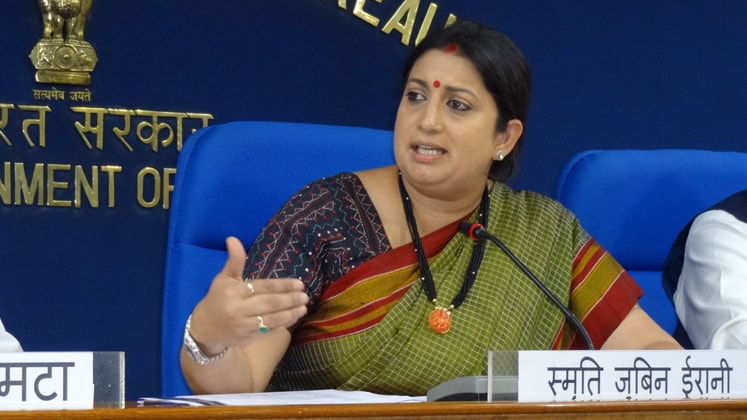
During the ongoing unprecedented times when the industry is passing through its toughest phase and struggling to even pay wages to workers, the only hope was the Government support. But now the industry is again disappointed, as even after 50 days of lockdown, not only any major support has been announced for the textile and apparel industry, but the Textile Minister Smriti Irani has also asked the industry not to expect much from the Government.
As per the mainstream media (Press Trust of India mainly), Smriti Irani said, “It is the time for textile industry to reorient and stop seeking packages from the Government, as its finances are already under strain due to COVID-19. The money you expect is public money, and citizens now demand the details of each penny (spent). The Government’s job is making policies and providing support.”
The issue started with a webinar organised by the Merchants’ Chamber of Commerce & Industry (MCCI), in which Smriti Irani, the Minister of Textiles and Women & Child Development, shared her views on ‘Prospects & Challenges of Textile Industry in Post COVID-19 Era’.
On this entire issue, Sanjay Jain, MD, TT Ltd., who was also present in the webinar, told Apparel Resources, “The minister has been misquoted by the mainstream media. She just advised the industry to reinvest and modernise to improve efficiency and productivity. She said the industry should not just look at the Government for support.”
Irrespective of how the statement has been presented by the mainstream media, the industry has reacted strongly on the same. Apparel Resources received many phone calls and messages in this regard. Several apparel exporters were of the view that industry can’t survive without the Government support, especially during this critical phase.
MCCI mentioned in the press release about its aforementioned webinar, “Smriti Irani said the nation can use the COVID-19 opportunity to redefine its future. The jute and textile industries need help. These sectors are inundated with challenges of technology. The Finance Ministry will shortly announce steps taken to help the industry. The fund that the industry is expecting is money that belongs to the people of India. The industry must be functional and it must not rely on policy support. We can turn the current crisis into an opportunity. Most of the machinery used by the industry is second-hand or imported, which raises productivity issues. The issue is what kind of machinery the industry needs to raise its productivity which can be made in India. IIT Chennai has proposed that machinery can be made indigenously.”
Few industry leaders have also come forward to share their opinions on this issue.
“I completely agree that in the long run, the industry will have to adapt to the new normal; it will have to evolve different strategies and fresh perspectives to meet the challenges of tomorrow. At the same time, it needs some support from the Government in order to survive today’s crisis. Supportive policies to encourage domestic manufacturing would go a long way to encourage the industry to bounce back,” Rahul Mehta, Chief Mentor, The Clothing Manufacturers Association of India (CMAI) told Apparel Resources.
Similarly, Raja M. Shanmugham, President, Tirupur Exporters Association (TEA), shared, “Firstly, we don’t know on which context it has been said. But this statement alone is very disturbing. The entire country has obeyed the lockdown order by the PM, and thereby incurred a huge economic crisis. Because our industry, particularly knitwear sector, is design-driven, catering to the western dynamic market which has 10-12 seasons in a year – which means month on month one new unique collection.”
Raja further underlined that in this situation, all the companies are drained out of liquidity. To revive the industry, a fresh infusion of working capital is urgently required and that too to the extent of 25-30 per cent of the present working capital limit. Further, to reduce the mandatory burden on repayments of term loans, a moratorium of one year with the soft interest-cum-simple interest needs to be devised, and the interest burden can be shared by the Government, banks and the industry, thereby ensuring the well-being of all the stakeholders equally.
“Since this is a labour intensive industry, the Government should not weigh it lightly in extending its support. Else, it would initiate a catastrophic spiralling impact, detrimental to our economy and livelihood of millions of households. Hope our Minister would bat for our industry’s well-being, keeping the above facts in mind. The industry looks forward to her leadership at this crucial hour of crisis,” he added.
Christine E Rai, Chairperson, Buying Agents Association (BAA), also believes that perhaps our Minister has been misquoted here. “Our view at BAA is that it is any Government’s responsibility to provide an enabling environment for industry and businesses to perform. Clear guidelines and simple rules and procedures for doing business are the need of the hour,” she said.
Rajiv Kapoor, MD, Affordable Exports, Delhi, insisted, “Things are very critical at all levels. If the Government doesn’t support, SME exporters will be forced to commit suicide, like farmers of the country. Similarly, there will be the worst impact on the country’s earnings of foreign currency.”
Whatever has been said and done, the Minister is true when she says that it is time for the industry to introspect. It is time for a new direction and new thinking. The industry has the capability. If they reorient themselves, they would not require to depend on others.
It has been reiterated time and again that Indian apparel exporters have to work on their productivity, efficiency, automation and wastage control. They have to adopt a new working culture. Exactly 4 years ago, the Government gave a package of Rs. 6,000 crore, but the situation of the industry has not improved much, be it export or domestic. The Government support is the need of the hour, be it for special packages or policy reforms. But at the same time, the industry should realise that the Government can’t always help with packages.