 “On a visit to the US once I saw branded clothes and found to my surprise that they were made in India. Now, I wish to promote Brand India across the world,” were the words of the newly elected Textile Minister Santosh Gangwar, during his first public address under Narendra Modi’s Government. As the 100 days of Modi Government came to an end with a positive impetus to GDP growing at a rate of 5.7 per cent, concrete steps need to be taken for the much promised sustainability of the garment industry.
The Government has already sprung into action with draft textile policy promising creation of jobs, better credit access and promoting organic production, providing support in terms of economic sustainability not just for the garment industry but also for people working in it. Further, hope comes from the fact that Prime Minister Narendra Modi has already worked wonders in Gujarat, by uplifting the image of Ahmedabad textile mills through his interventions in the sector. Under Modi, Gujarat has recorded exponential growth in raw cotton production boosting it up from 2.3 million bales in 2001 to 12.3 million in 2014, making the state the largest cotton producer in India.
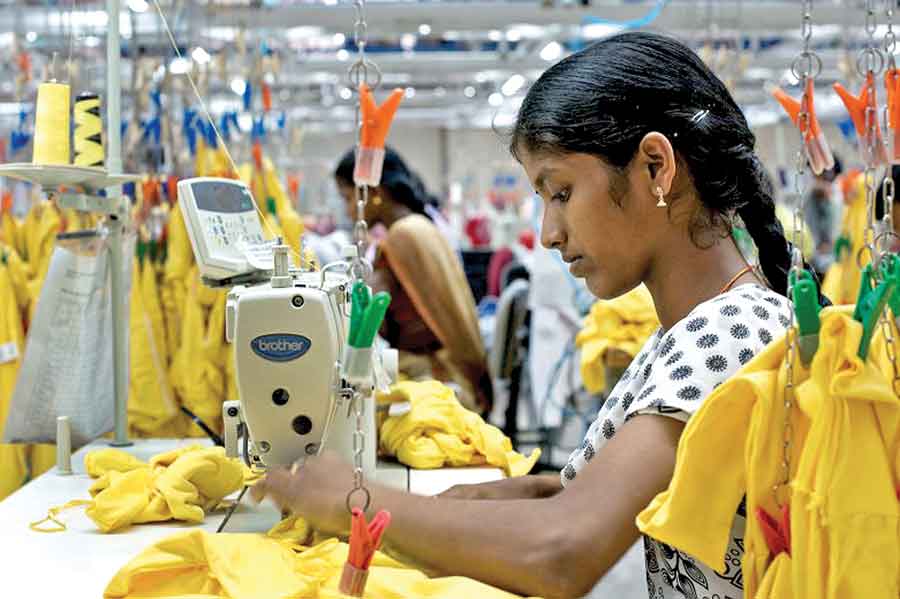
What seems to be of primary importance is Modi’s promise of nearly 10 million jobs a year, a portion of which would come from garment exports. The idea of job creation is vital for the Indian garment industry, which has been continuously grappling with a shortage of labour during the peak demand season. The increased number of jobs would mean stability in availability of skilled and unskilled workforce, greater retention of workforce leading to economic sustainability of the industry in lieu with the economic development of the people. “The textile sector has a huge potential of providing large number of jobs to the vulnerable section of the society. Zari Zardozi (intricate gold embroidery), carpet and many other local crafts… can be a strong source of employment,” says Gangwar in support.
Tackling India’s labour practices is central to Prime Minister’s efforts to revive economic growth and bolster tax revenue. The Government has already started working in this direction. “In order to attract large scale investments, acquire global scale and bring the Indian sector at par with other competing countries, there is an immediate need to review the labour laws to make them investor and labour-friendly,” claims the Textile Minister.
Adding to this, President Pranab Mukherjee has also called for better credit access to weavers and craftsperson’s from banks and financial institutions and to also promote their products in domestic and foreign markets. This would enable the garment factories to take proper advantage of their skills in terms of international competition. India is primarily known for its value-added goods, but today is facing the challenge of skills dying out because of weavers and artisans choosing other professions for their self-sustenance. With Government reforms such as this, it would put India on the world map for value-added goods, retaining the traditional skills and training others in honing theirs. “Products in this sector remain vulnerable to competition from cheaper imports and machine-made substitutes. We must give more attention to development of capacity, skills, designs and infrastructure,” said the President. Better credit access would also enable the economic development of the country boosting the garment industry.
Pushing it further, the Prime Minister has also stressed on the need for developing the whole of Northeast India as ‘organic state’ to enable the region to prosper and capture the global market for organic products. Though Sikkim produces a limited percentage of organic cotton fibre for the garment industry, but the need to promote states, which produce organic cotton, is also vital for the garment industry. Organic clothing is gaining momentum in the international scenario as the source of the clothing fibre is free from pesticides; also organic cotton farming uses less amount of water and produces less CO2 emission. The Government’s measure to promote organic farming will provided sustainable measures for the environment and a greater availability of raw materials.
Apart from various reforms, the Government recently came out with the first draft of a new national textile policy, to replace the one that was formulated in the year 2000 that envisages suitable amendments to several policies including Labour Laws and to encourage industry to boost production and exports. According to the Vision 2024-25 document, if the Government takes the necessary steps, Indian textile exports can jump to US $ 300 billion, up from the present US $ 39 billion, capturing a fifth of the global textile business (up from a mere 5 per cent at present).
To meet the goals of nearly eight-fold jump in exports and doubling of employment, the expert committee on the new textile policy believes the need to attract about US $ 120 billion in investment, including foreign direct investment. For this, the Government has to provide the necessary infrastructure, including creation of new mega textile parks, ensuring easy connectivity to ports and promote innovation and R&D. Till now, the Government has approved two mega textile clusters at Guntur and Prakasam in Andhra Pradesh and Godda in Jharkhand and six more have been proposed in Rae Bareilly, Lucknow, Kutch, Mysore, Bhagalpur and Tamil Nadu. Also the first draft wants India to diversify its export basket, tapping new markets including Japan, China, Brazil and Russia. At present, about 50 per cent of India’s exports are to traditional markets in Europe and the US.
Meanwhile, India has overtaken Germany and Italy to emerge as the world’s second largest textile exporter but lags behind China, whose exports are nearly seven times higher. Though the landslide election win by BJP could be a game changer in the history of Indian politics but it still remains to be seen whether the Government will ensure greater political stability, quicker investment revival, high growth rate and more importantly sustainable development of the Indian garment industry.