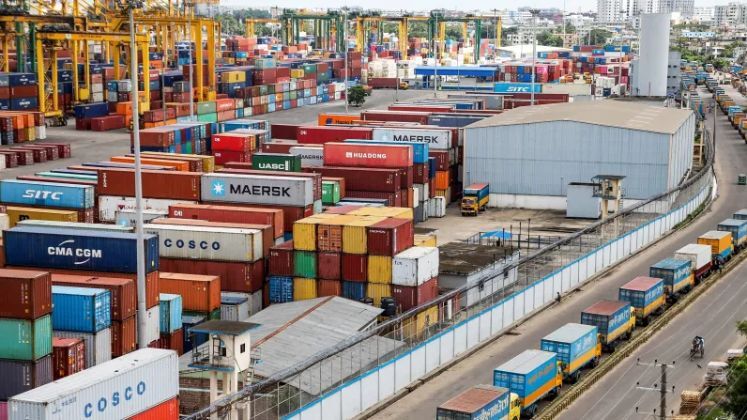
Exports from Bangladesh to India through Chattogram port have soared in recent months as restrictions on shipments through land ports force traders to reroute cargo by sea.
Since May, New Delhi has imposed three separate curbs on Bangladeshi exports, affecting items such as garments, processed foods, plastics, yarn, furniture, and, most recently, raw jute and jute goods. While sea routes remain open, they are slower and more expensive, as shipments must first travel to Colombo before being redirected to Indian ports like Kolkata and Nhava Sheva.
Despite these hurdles, Indian buyers have continued sourcing from Bangladesh, citing limited alternatives. “Businesses always calculate time and cost, and sea shipments from Bangladesh can still be cheaper than importing from elsewhere,” said Abul Bashar, chairman of BSM Group.
Pacific Jeans Managing Director Syed Tanvir Ahmed noted that duty-free access helps offset higher freight charges. “But the problem is that all this trade is now funnelling through Chattogram alone,” he warned.
Data from the National Board of Revenue (NBR) and Chattogram Customs House show exports to India via Chattogram jumped 139% year-on-year in the first eight months of 2025, reaching US $ 338.2 million compared with US $ 141.4 million a year earlier. Export volumes more than doubled to 116,000 tonnes.
Overall, Bangladesh exported goods worth US $ 1.22 billion to India during the January–August period, up 3.3% year-on-year, although volumes fell nearly 11% to 760,000 tonnes.
The surge through Chattogram has been offset by steep declines through other gateways. Exports via land ports, Mongla, and Pangaon dropped by US $ 157.6 million in value and 148,000 tonnes in volume. Benapole—the busiest land port—saw shipments tumble 22% in value and 29% in volume, while Mongla exports shrank to just US $ 91,000 from US $ 5.3 million a year earlier.
The diversion has piled fresh strain on Chattogram port, which already handles 84% of Bangladesh’s external trade. The port’s storage capacity is 53,500 TEUs (twenty-foot equivalent units), but since March container numbers have consistently exceeded 43,000 TEUs, crossing a record 49,131 on August 16.
“Increasing reliance on a single port is not sustainable,” said Khairul Alam Suzon, vice-president of the Bangladesh Freight Forwarders Association. “Unless the government accelerates the modernisation of secondary ports, Chattogram will face chronic congestion that undermines competitiveness.”
Logistics consultant Azhar Uddin Mahmud cautioned that prolonged overcapacity could damage Bangladesh’s image with international buyers. “Missed delivery deadlines may erode hard-earned market trust,” he said.
Port officials also recognise the risks. “If any unforeseen disruption occurs at Chattogram, the national economy could collapse, as no viable alternative seaport exists,” warned Rear Admiral SM Moniruzzaman, chairman of the Chattogram Port Authority, at a seminar last week.
Brigadier General (Retired) M Sakhawat Hussain, shipping adviser, said the government is working on long-term solutions. “The Bay Terminal under construction in Patenga will ease congestion once operational, while efforts are underway to enhance the capacities of Mongla, Pangaon and Payra ports,” he noted.