The European Union (EU) has fallen tremendously in its apparel imports on Y-o-Y basis during the January to April 2017 period. All the major apparel exporting destinations to the EU including China, Bangladesh, Vietnam and India, have noted a decline during the mentioned period.
Moreover, the EU noted a drop of 2.88 per cent as it imported 1410.49 million kg of garments in the first four months of the current year as compared to 1452.25 million kg of garments in the corresponding period of 2016.
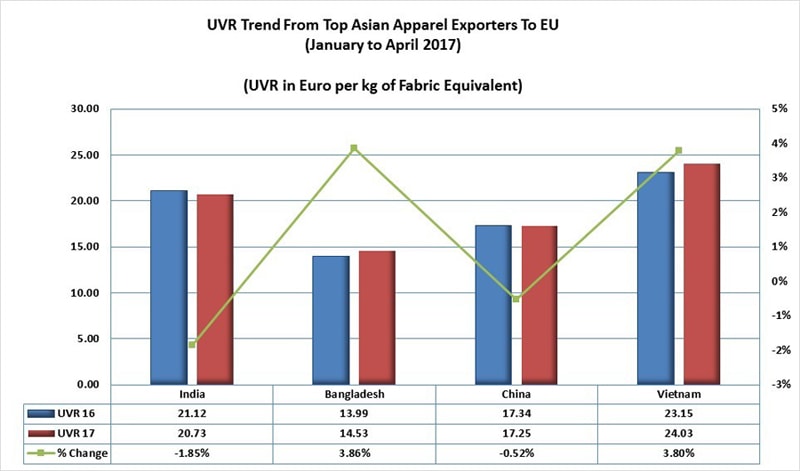
The weak Euro and the fall of Sterling were the main reasons behind the declining apparel imports into the EU. The increase in unit prices also impacted EU imports negatively. As against Euro 18.38 per kg of garments in the January-April period of 2016, the EU rose to Euro 18.69 per kg of garments in 2017 along with a rise of 1.67 per cent in Unit Value Realisation (UVR). The rise in UVR indicated that the EU is importing apparel by paying more values to the exporting countries.
During the period, China dropped by 3.31 per cent in quantity-wise apparel exports to the EU and managed to export 7,898 million kg of garments as against 8,208.12 million kg of garments during the corresponding period of 2016. However, particularly in the April month, the EU’s apparel imports from China surged after the unit prices of the Chinese shipments sharply reduced.
Vietnam, Bangladesh and India too witnessed plunging quantity-wise exports by 0.78 per cent, 1.76 per cent and 2.06 per cent in the period, respectively.
Analysis
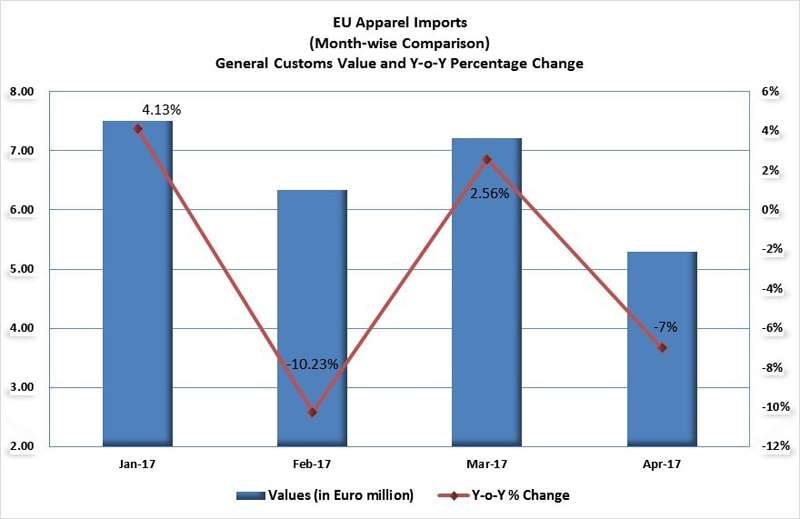
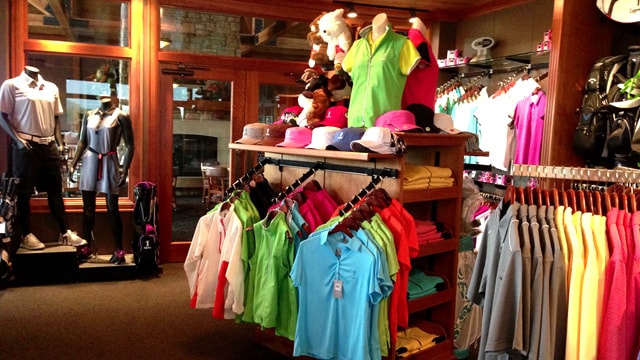
This continuous fall in the EU’s apparel import shows a weak demand in the European market. Since the retail stores are rapidly closing in Europe and the renowned clothing brands are cutting off their apparel quantities, the dismal performance by the EU’s apparel import is obvious. This change in the retail landscape and the consumer behaviour is shifting the demand from in-store shopping to online purchasing, making the EU a tech-driven market.
Apparel Resources’ Take
 Every change is bound to show its positive effects gradually. As the EU is the second largest apparel importer in the world, the transition from retail store to digital shopping might take some time to recreate the demand and thereby increase the import level of the region.
The second half of 2017 has started and it will be interesting to see how EU’s apparel sector would take a turn as the global economic condition is slightly improving as well as more trade policies are being worked upon across the world. The rest of the year is expected to bring cheer in the EU’s apparel sector.





 Bharat Tex Special Report 2026