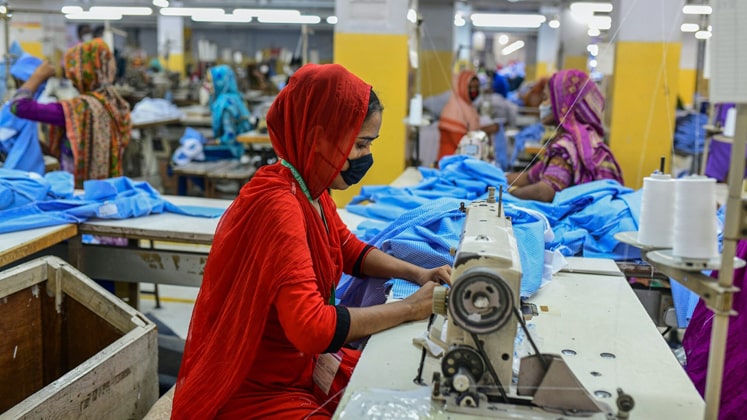
The next national budget in Bangladesh will be presented in June. However, activities are already on as the trade bodies in the country continue to put forth their proposals for the next fiscal year, which gains even more significance considering the havoc the COVID-19 pandemic has wrecked on businesses in last one year or so, especially on apparel manufacturing and exports, which is considered the lifeline of Bangladesh’s economy.
As one would expect, businesses are anticipating support from the Government, to tackle the current scenario and come out of the crisis.
To start with, the apparel exporters have already unveiled their list of budgetary demands, which include exemption of value-added tax (VAT) on all kinds of products and services purchased from domestic sources for the export-oriented clothing industry — the products and services include sub-contracting, printing, courier services, consultancy fees, legal services, engineering services, compliance audits, expenses on corporate social responsibility and the cost of factory establishment — in the next budget.
“We should get the VAT exemption to make exports more competitive in the global market,” said Dr. Rubana Huq, the outgoing President of the Bangladesh Garment Manufacturers and Exporters Association (BGMEA), the apex garment makers’ body in Bangladesh, at a pre-budget meeting with the country’s National Board of Revenue (NBR) even as she demanded the Government should keep the export-oriented apparel factories out of the purview of VAT return submission.
The leaders of the BGMEA and the Bangladesh Knitwear Manufacturers and Exporters Association (BKMEA) also urged the Government to bring down the tax at source to 0.25 per cent from 0.50 per cent and keep it effective for the next five years to help maintain competitiveness in the global export markets while also urging the Government to keep the corporate tax unchanged at 12 per cent and 10 per cent for the certified green factory owners, in fiscal 2021-22.
“Considering the impact of the pandemic on the apparel sector and for the greater interest of investment and exports, the Government should keep the corporate tax unchanged and it should be effective for next five years,” Rubana added.
The garment exporters also demanded withdrawal of the 10 per cent income tax on cash incentives even as the BKMEA demanded zero duty on imported chemicals used in the effluent treatment plants to ensure zero discharge of hazardous chemicals (ZDHC) for the betterment of the environment.It also called for duty-free import of electric-efficient equipment or spare parts such as LED lamps, tube lights and spare parts for fire safety equipment to make factories safe and environment-friendly.
Sometimes, factory owners need to expand factories to increase exports as well as to meet the buyers’ requirements on compliance.To do so, an owner has to import fire equipment or parts of fire equipment for the extension, underlined the outgoing BGMEA President. “So, we are urging the Government to include these types of products under the duty-free import facilities,” she added.
Also Read: COVID-19: Garment makers rework their strategies amidst resurgence of pandemic
On top of that, the apparel exporters have also urged the Government to ensure hassle-free release of goods when returned by the global apparel brands due to the pandemic.
Meanwhile, as per reports, the Bangladesh Textile Mills Association (BTMA) reportedly requested the Government to increase alternative cash incentives from 4 per cent to 7 per cent for the upcoming fiscal year, to fight the economic fallout of the pandemic while also calling for reducing source tax to 0.25 per cent from the existing 0.50 per cent.
Alternative cash incentives came down to 4 per cent due to gradual cuts in the last few years even as with the existing rate and adjustment of some benefits, millers were competitive but the ongoing pandemic has left the sector people in tough competition, said the BTMA President Mohammad Ali Khokon, interacting with the media even as he added that considering the devastating impacts of the Coronavirus pandemic, a 4 per cent alternative cash incentives is not enough for the sector.
After the LDC graduation, there will be new challenges for the sector due to erosion of duty benefits enjoyed as a least developed country, Khokon said, adding, “Considering the benefits of cash incentives for the sector, we are urging the Government to increase it to 7 per cent and withdraw tax on incentives.”
As to the LDC graduation, very recently (on 7 April), experts and business leaders have urged the Government to start an extensive preparation right now to secure GSP Plus scheme in the European market to keep the country’s export unhurt due to the loss of trade benefits following the graduation from least developed country (LDC) status in 2026.
Formulation of a comprehensive transition strategy and starting negotiations are also needed for extension of existing trade benefits and availing special trade benefits in other markets, including China, Japan, Canada and India, they said even as they added that signing free trade agreements with major bilateral and multilateral trading partners is also important for Bangladesh to keep the country’s export unharmed.
Centre for Policy Dialogue (CPD) Distinguished Fellow Debapriya Bhattacharya underlined that it was high time for Bangladesh to prepare itself for securing the GSP Plus scheme in EU market as the European Commission was now working on the issue, and plans to send the proposal related to GSP Plus scheme to the European parliament by June and then it will be a challenging task for Bangladesh to convince the parliament, which does not discuss any technical issues, rather it concentrates on social, labour and governance issues, he said.
“It is time for Bangladesh to have a cohesive, dynamic and inclusive-transition strategy for the GSP Plus scheme as well as link it up with other global initiatives, particularly taken by the World Trade Organisation and the United Nations,” said Debapriya even as Faruque Hassan, the Bangladesh Garment Manufacturers and Exporters Association (BGMEA) poll winning panel leader said that the country needed an immediate and mid-term strategy to remain competitive after graduation when the country would lose many of existing trade benefits, including duty-free export in EU market under everything but arms (EBA) scheme while underlining that a total of 61 per cent of apparel export to EU market may come under new tariff regime after the graduation.
It may be mentioned here that in fiscal 2018-19, the tax at source was set at 0.25 per cent but in fiscal 2019-20,it was increased to 0.50 per cent.
“Export earnings from the apparel sector have witnessed a negative growth due to the pandemic, which also hit the backward linkage industry badly,” Khokon said, adding, “In the given context, we need a cut. The Government should set source tax at 0.25 per cent for the next fiscal year.”
Meanwhile, the textile millers also demanded withdrawal of 2 per cent tax on purchase of cotton from local sources while also calling for withdrawing 5 per cent advance import tax on pet chips, as it will increase the prices of yarn, they felt.On top of that, textile entrepreneurs also reportedly urged the Government to remove 5 per cent value-added tax on all kinds of fabrics made of man-made fibre at production level whereas those using cotton fibres need not.
Such kind of discrimination has been acting as a barrier in product diversification, discouraging man-made fibre importers, said some industry insiders even as they maintained that local yarn and fabrics manufacturers are very much dependent on cotton fibres, using it in a mix where man-made fibres account for just 20 per cent.However, the international scenario is different. In the global fashion industry, 28 per cent of the mix is cotton fibre.
This is why product diversification within the garment sector has not been taking place and Bangladesh was still struggling with basic garment items and lower prices from the international retailers and brands even as China, Vietnam, Cambodia and India have been performing strong with man-made fibre.
We want the Government to fix a uniform rate on sales of all kinds of yarn and fabrics, underlined the BTMA even as the accessory manufacturers have also come up with their own set of suggestions as well, many of which are same as those put forth by the other trade bodies.
The garment accessories and packaging products have urged the Government to set the tax at source at 0.25 per cent and corporate tax at 12 per cent for the next fiscal year even as the apparel accessories makers have to pay 0.5 per cent source tax and 32.5 per cent corporate tax, currently.
The Bangladesh Garment Accessories and Packaging Manufacturers and Exporters Association (BGAPMEA), a platform of backward linkage industries crucial for the apparel industry, made the call in its budget proposal for fiscal 2021-22 to the NBR.
“The pandemic has severely impacted the country’s apparel sector and as a backward linkage industry, we also suffered,” maintained BGAPMEA President Abdul Kader Khan while adding, “We are suffering from fund scarcity in running the factories. Moreover, we did not get the desired funds from the Government’s stimulus package offered for the apparel sector to pay workers’ wages… We are earnestly requesting the Government to set source tax at 0.25 per cent instead of existing 0.50 per cent, as well as to reduce corporate tax to 12 per cent instead of 32.5 per cent for the next fiscal year.”
In line with the country’s export-import policies, direct and deemed exporters are entitled to enjoy equal facilities reportedly.
But our corporate tax rate is higher than others, the BGAPMEA President said even as since the last national budget, garment exporters are reportedly enjoying 12 per cent corporate tax, which is 10 per cent for apparel manufacturers with certified green factories while accessories exporters have to pay 32.5 per cent corporate tax.
According to BGAPMEA data, there are more than 1,700 small and medium accessories and packaging makers, who are capable of providing 95 per cent of the demand for accessories’ products to the country’s apparel industry and other export-oriented packing industries even as in the fiscal 2019-20, the sector contributed over US$5 billion to the exports of the apparel sector, of which nearly US$1 billion came from the direct export of accessories.
It goes without saying that the apparel manufacturers as well as the supporting industries are going through some unprecedented times on account of the pandemic, however, as to which all suggestions will make the cut when it comes to acceptance by the Government, is to be seen.





 Bharat Tex Special Report 2026