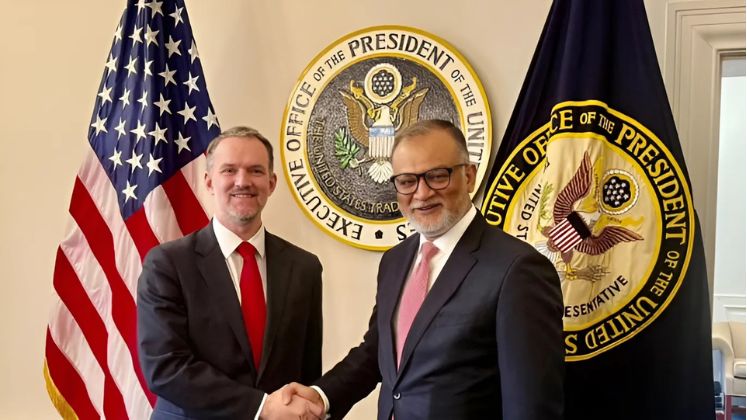
Image Courtesy: https://www.tbsnews.net
Commerce Adviser Sheikh Bashir Uddin has confirmed that Bangladesh is preparing for a third round of negotiations with the United States regarding tariff issues, with discussions likely to take place before the 1st August deadline.
Speaking to reporters at the Secretariat, the adviser noted that preparations are underway for the next phase of talks. However, he refrained from answering certain questions due to a non-disclosure agreement (NDA) in place with the United States.
The adviser recently returned from Washington after leading a negotiation team from 9th to 11th July. According to him, the discussions touched on several matters involving the National Board of Revenue (NBR) and other ministries, requiring further internal consultations.
When asked whether Bangladesh anticipates a reduction in the 35% additional tariff imposed during the Trump administration, Bashir Uddin offered no clear answer.
Although business leaders had earlier expressed interest in meeting the Chief Adviser, no such meeting has yet occurred. A 90-minute session with the Commerce Adviser was held on Monday shortly after his return from the United States.
Multiple exporters and economists who attended the recent meeting shared that while specifics were not disclosed, the negotiations appear to be evolving beyond standard trade matters. Dr Muhammad Abdur Razzaque, Chair of RAPID (Research and Policy Integration for Development), said the US side seems focused on broader geopolitical issues, including national security concerns.
Anwar-ul-Alam Chowdhury Parvez, President of the Bangladesh Chamber of Industries, also expressed cautious optimism.
Razeeb Haider, Director of the Bangladesh Textile Mills Association (BTMA), who was present at the meeting, noted that the government acknowledged their concerns but refrained from sharing details due to the NDA.
Reportedly, the US has raised concerns about Bangladesh’s economic dependence on China and has encouraged alignment with US-led sanctions on third countries. Simultaneously, it is also urging Dhaka to address the trade imbalance between the two nations.
Economist Dr Selim Raihan, Executive Director of SANEM, echoed concerns that the negotiations are increasingly tied to broader strategic interests. He urged the government to proceed carefully, particularly if political demands are introduced into the framework.
Power and Energy Adviser Fouzul Kabir Khan also weighed in, stating that the US initially seeks a framework agreement that encompasses security issues alongside trade matters. “Significant progress has been made in recent days. Detailed discussions on tariff and non-tariff issues will follow,” he said at a press conference on 13th July.
Meanwhile, Commerce Secretary Mahbubur Rahman dismissed rumors that the US had demanded a 40% local value addition requirement for goods labeled “Made in Bangladesh.” “I have never heard of such a condition,” he stated.