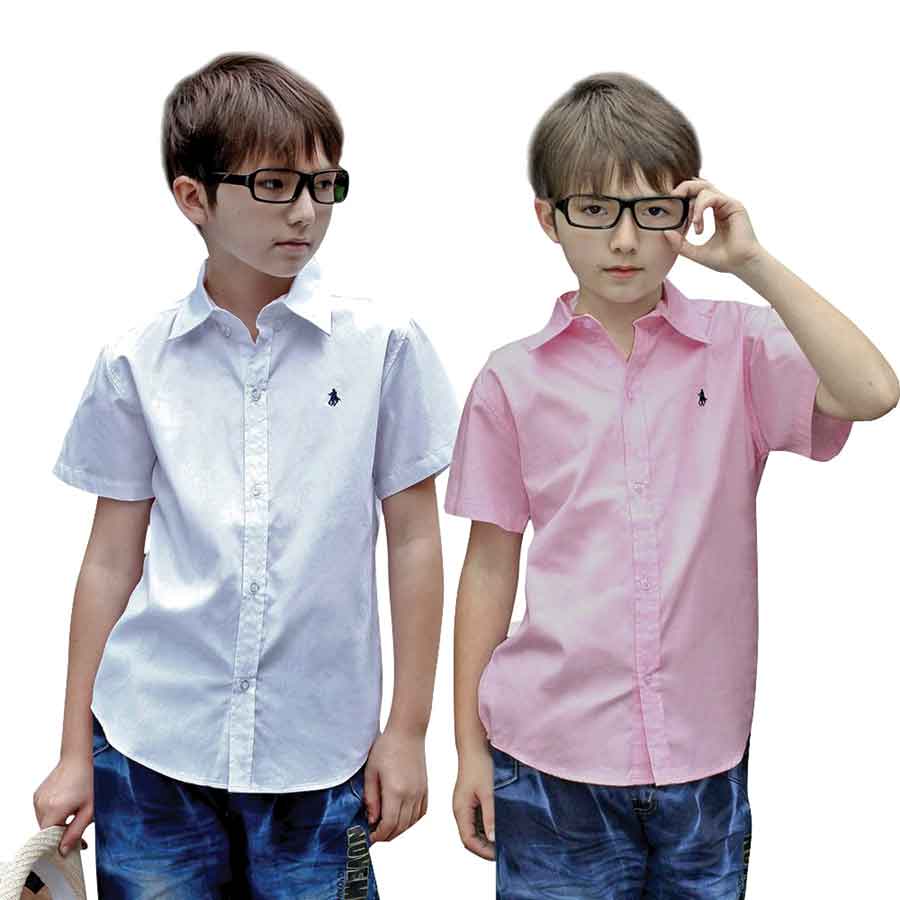
Shipping more than 20,000 school shirts for girls and boys each year to CKL, a Glasgow (UK) based importer, AHL-Export International, a decade old buying agency has expanded its product reach beyond sweaters and knits to include school uniforms. Though uniforms are a big category in Europe, few dare to enter because it has stringent compliance regulations and strict size specifications. “The perquisite for workwear or uniforms is that it has to be tough, durable, functional and also stylish. In school uniforms, it is very important to have good quality fabric and a perfect emblem; even if there is a slight variation, the whole lot is rejected,” shares S.M. Azad Rahman, CEO, AHL-Export. Slowly, but steadily Bangladesh factories are taking to uniforms with some European players besides CKL, like Trutex and Dimensions also sourcing these performance-oriented garments, which were earlier largely sourced out of China.
Though uniforms are a new category and AHL is still finding
its bearing, it has already created expertise in knitwear. “I have been dealing in sweaters since 1992 and understand the product in and out as compared to other items,” says Rahman. The FOB price for sweaters varies from US $ 4.15 to US $ 6 per piece, depending on the weight and design of the product. Further, the price is higher if the product is being made on manual machines. “Now with the increase of automation in Bangladesh and installation of jacquard machines like Stoll and Shima Seiki, the price of the sweaters is expected to come down,” shares Rahman.
AHL-Export caters to markets in UK, Germany, Australia and Spain. In UK, which is the biggest market, all the customers
are retailers, importers as well as brand labels. Finding Australia as a lucrative market, Rahman is looking at penetrating deeper into the market and fetching volume orders. “The Australian market is different than the European market in terms of the buying cycle and while winter orders are received from Australia in the months of October to November the orders from Europe are received in the months of November to December,” says Rahman. The company is also looking at expanding its market to Japan and Latin America in the next few years. At present, the company is not directly sourcing for Japan due to the lack of knowledge about the Japanese market and also because of language constraint. But it hopes to start for the market in the coming months with the collaboration of an Indian company based in Kolkata.
Rahman is deeply concerned with the growing demand of the buyers to seek lower and lower prices, even as the requirement in quality is going upward. “With minimum wages going up, the factories are finding it difficult to manage their business. As a buying agent we keep explaining to the buyers that if they want good quality products, they will have to pay for it,” reasons Rahman. To ensure quality, AHL is sourcing from top level to medium level factories, preferring to execute and procure from larger factories if the price and quantity of the order is acceptable to the factory. “With quality as our utmost priority we avoid working with very small factories as they have a lot of quality and compliance issues,” argues Rahman.
Having added CKL, Rahman is looking to work with huge volumes, which are attractive to larger factories. “CKL is a leading wholesaler, importer and national distributor; it sources garments from key manufacturing destinations, however it is also equipped to produce bespoke garments,” informs Rahman. CKL holds over £ 1.5 million worth of stock in its 50,000 sq. ft. storage facility and carries an extensive range of over 15,000 SKUs across 600 product lines. Having its client base pan-Europe, the importer appoints suppliers with highest ethical and quality standards.