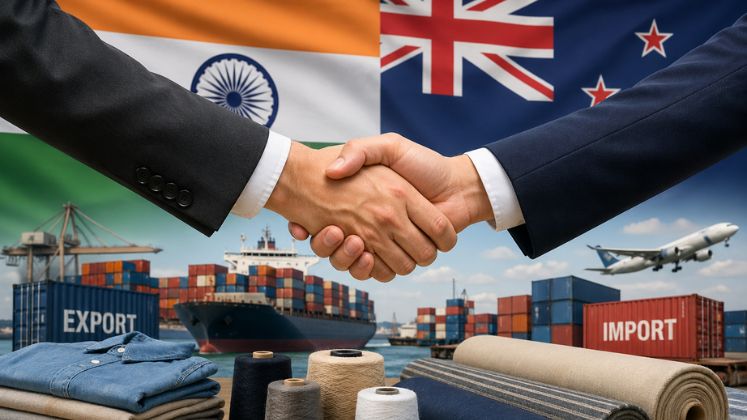
India and New Zealand have signed their long-awaited Free Trade Agreement (FTA), which will remove tariffs on 100% of India’s exports to New Zealand and either eliminate tariffs on 95% of imports from New Zealand, while also granting duty-free access to 8,284 Indian export items.
The pact is also expected to bring a projected US$20 billion investment pipeline, along with an annual quota of 5,000 visas for Indian professionals.
The Commerce Ministry factsheet report noted that India has offered market access on 70.03% of its tariff lines, covering 95% of the total bilateral import value from New Zealand.
According to a report, prior to the pact, New Zealand imposed an average tariff of 2.2% on Indian goods, while around 450 product categories including textiles, ceramics, and automobiles attracted duties of up to 10%.
India’s apparel exports to New Zealand reached US $37.02 million in 2024–25, highlighting the growing presence of Indian garments in the market.
New Zealand imports over US$1.2 billion worth of ready-made garments annually, with India currently holding a share of around 4.4%. The FTA presents a strong opportunity to significantly enhance India’s presence in this market, particularly in key categories such as cotton T-shirts, shirts, knitwear, and garments.
New Zealand’s Ministry of Foreign Affairs and Trade noted that “made-up textile articles” were the fourth-largest category of Indian imports into the country in 2025, with imports to New Zealand valued at NZ$80.22 million (US $47.26 million).
Leather and footwear will also benefit, with tariffs reduced from 5% to zero. Agra’s leather sector is expected to gain directly. According to a Commerce Ministry statement cited in the report, the city accounts for nearly 75% of India’s leather footwear output and holds a Geographical Indication (GI) tag for its leather products.
“The FTA with New Zealand offers upside potential for India’s textile and apparel sector that extends beyond greater market access and an increase in realisations by providing a more level playing field to our exporters vis-à-vis those from other countries. As a high-income, quality-conscious market with a highly discerning, well-informed consumer base, New Zealand’s strong acceptance of higher-value Indian textile products can serve as strong validation of Indian exporters’ ability to compete effectively on both quality and price,” said Ashwin Chandran, Confederation of Indian Textile Industry (CITI) Chairman.
With New Zealand being a major exporter of high-quality wool, the FTA could make it more profitable for Indian companies to import wool for manufacturing and then exporting high end garments.