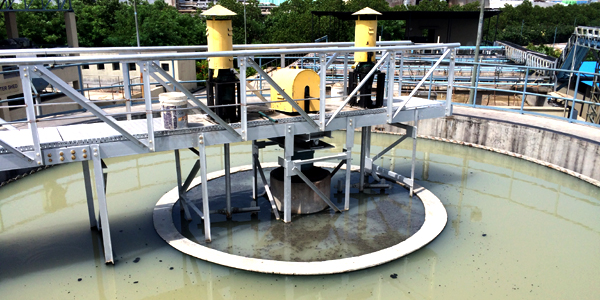
With the assurance that the Centre and the state government will jointly contribute 75 per cent of the funds required for setting up of the Common Effluent Treatment Plants (CETP), the Tamil Nadu Pollution Control Board has urged the textile processing units of Erode, Karur, Salem and Tirupur districts to join the CETP project.
The units will have to provide only 25 per cent of the total funds required for the project.
At a meeting on this issue, the owners of textile units held discussions with State Environment Minister Thoppu N D Venkatachalam on the technicalities of establishing a CETP in Erode. To facilitate the CETP project as well as to reduce the initial burden on the units, the Erode Textile Processors Association has sought interest-free loans. According to the association, they have already allocated a 22-acre site for the purpose, against a target of 6 acres of land. Venkatachalam, meanwhile, stressed on the point that the Rs 700-crore project, which is being set up by the Tamil Nadu Water Investment Corporation, must be effectively utilised by the textile units.
Also Read – CETP being planned in Erode to address environment concerns
However, Association President K S Thennarasu maintained that there is no need to worry at the moment, since the 400-odd dyeing, bleaching and printing units that are currently operating in the region, are already equipped with Effluent Treatment Plants and Reverse Osmosis systems.
Meanwhile, the association has submitted a petition to PMK State Deputy General Secretary P V Arumugam, raising concerns over contamination of groundwater in the area near the Cauvery River as a result of the proposed facility.
The proposed CEPT facility establishment would incur a cost of Rs 300 crore and is slated to be established in two phases. The first phase would see the bigger textile units coming together for the establishment of a CETP plant at the estimated cost of Rs 170 crore. In the second phase, another facility will be set up for the smaller units.
Owing to the scattered location of the units, the industries are advised to transport the sludge to CETP via tanker lorries. The proposals for CEPT sites for the Bhavani, Perundurai and Chennimalai clusters have been sent to the government for approval.






 Bharat Tex Special Report 2026