 Businesses around the world have started to create strategies for growth based on practices of sustainability. The Textile Industry is also taking the sustainable route using products and processors that are sustainable and the latest concentration area is packaging, wherein buyers are asking for shipments in material that comply to sustaibale parameters… Saurabh Kalra, CEO, White Rock International, a Delhi-based Buying Office for Home Fashion, talks about the trends in sustainable packaging and the cost benefits.
Sustainable packaging implies packaging that incorporates the three principles of sustainability – reduce-reuse-recycle. The increased demand of packaged products has resulted in increased packaging waste and consequent disposable problems and unhealthy effects on the environment because of pollution. Moreover, the enhanced consumption of packaging materials has resulted in depletion of natural resources, higher energy consumption and pollution of water and air. There is a need; rather a strong urge for sustainable packaging to be implemented. Switching over to a sustainable package for a product would help reduce, recycle, reuse and recover the packaging waste.
Sustainable Packaging Industry
 Packaging that is reused after it has been recycled is generally known as sustainable packaging. At the end stage of design, it involves increased use of life cycle inventory (LCI) and life cycle assessment (LCA) to help guide the use of packaging which reduces the environmental impact and ecological footprint. According to a Research Report from Pick Research, a Cleantech marketing intelligence group specializing in monitoring green practices, the global packaging market is consistently growing, as there are expectations from the Eco-Friendly Packaging Market to double from $ 88 billion (2009) to $ 170 billion (2014) with the overall packaging industry expected to grow at a slower pace, from $ 429 billion in 2009 to $ 530 billion in 2014.
Sustainable Packaging in Soft Furnishings Export Houses
 Packaging of soft furnishings is segregated into three stages, where firstly the soft goods are primarily packed (primary packaging), followed by the secondary packing, i.e. in corrugated cartons. The effort today is to have sustainable option at both levels. In India, factories in Hathras and Greater Noida in Uttar Pradesh who are into soft furnishings, made-ups, rugs and floor coverings, manufacturing for the international companies are actively using sustainable packaging. Export houses like Bharat Exports and Mariko are committed to the cause even though the buyers are still not stringent on the use.
What is the Impact of COST on Sustainable Packaging?
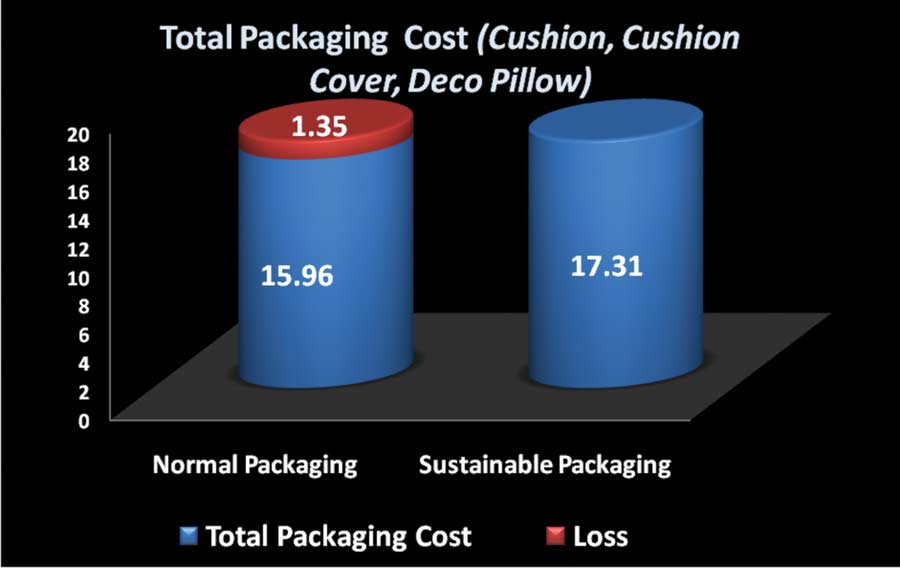
 The general perception is that using sustainable packaging will increase cost, but in reality companies employing sustainable packaging have reported cost savings, which is a contradicting statement to the former. As per Environmental Leader (2009), a publication dedicated to energy and environment news for business, in order to discourage the adoption of sustainable packaging, critics have created the illusion of higher cost.
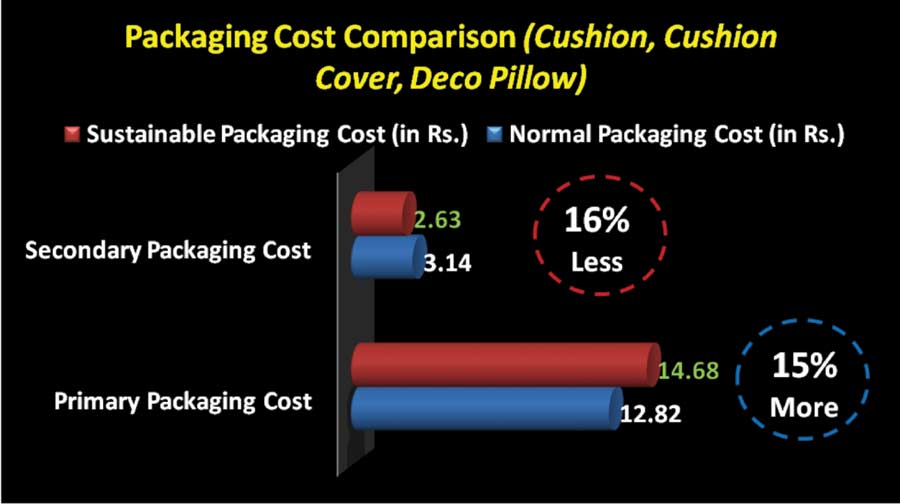
In exports of soft furnishings’ the primary packaging of a soft good (cushions, cushion covers, deco pillows, etc.) on an average account for 85% share of the total packaging cost, while the secondary packing cost is just 15% of the total packaging cost, so there won’t be much effect on the cost, if the sustainable solutions in the secondary packing are expensive, so most of the sustainable initiatives are being taken at the secondary packing level.
Packaging materials used for soft furnishings include poly-bag, paper/tissue paper, hang-tag; kimble, corrugated cartons, carton sheet, and pressure sensitive tape are all easily available in sustainable options or can be replaced by sustainable alternatives. However the question is which of the sustainable options are cost-effective…
[bleft]Saurabh Kalra is CEO of White Rock Group. The company is into Intl. Buying Services of Lifestyle Products, Domestic Retail and Consultancy. Saurabh is also a Fashion Consultant, Mentor, Visiting & Guest Faculty with Pearl Academy of Fashion, IAM, INIFD, JIMS, and FDDI in field of International Trade, Intl. Marketing, Intl. Retailing and Entrepreneurship.[/bleft]
Sustainable poly bags [PE-LD (4)] which are recyclable in nature are costly over the normal poly bag. For the hang tag and kimble, natural alternatives are both available and suitable; such as, handmade paper hang tag, paper hang tag and jute kimble which cost more than the normal packaging options except for the paper hang tag; which is cost-effective over the normal hang tag. If we consider an average price comparison, the sustainable hang tag also turns out to be costly. The sustainable corrugated carton and carton sheet on the other hand are a better option over traditional materials as they are made up of 100% PCW – Post Consumer Waste (normal being 33% PCW) and are also cost-effective over the normal materials. In the case of corrugated carton using sustainable options results in a saving of about 24% and in the case of carton sheets it is more than 7%. Paper tape over the plastic pressure sensitive tape is a good sustainable alternative and is also less expensive than it by around 15%.
While the cost of primary packaging works out to be expensive, sustainable secondary packaging in all cases is more cost-effective. However, in the case where initially expensive normal packaging materials are being used, the resultant cost of sustainable primary and secondary packaging will come out to be less.
As more and more buyers are looking to work with exporters who have etched a sustainable growth path, furnishings manufacturers and exporters should switch over to sustainable secondary packaging as it is cost-effective irrespective of the product to be packaged. It is a good option to convert the secondary packaging into sustainable secondary packaging, as the main materials; corrugated cartons and carton sheet can be made sustainable and are less expensive if turned into sustainable. The choices lie with the companies, but the strong feelers from the global industry clearly indicate that soon it may become a norm, so implementing changes today could support growth in business.