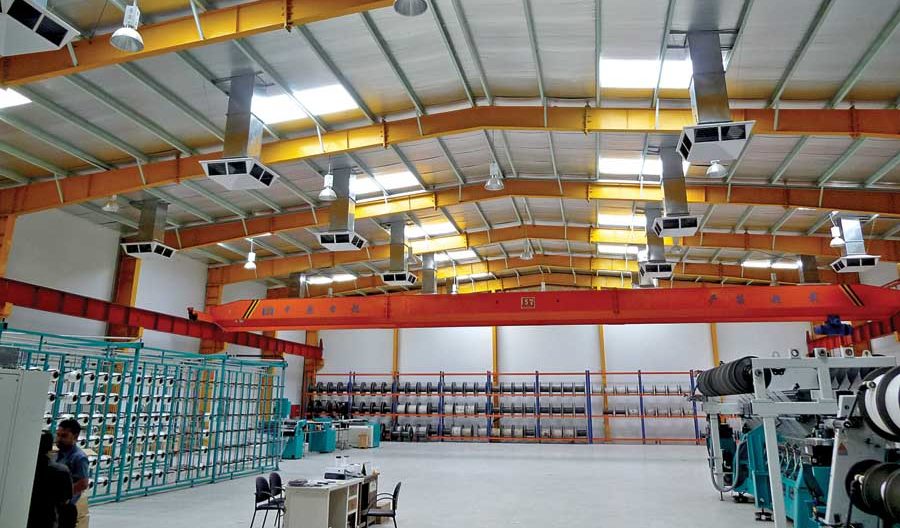
Rising electricity tariffs have compelled apparel and textile manufacturers to adopt measures to cut down their electricity and power consumption. Since the sewing operations require around 1000 lux light at the needle point, manufacturers have adopted LED and CFL, which consume lesser electricity compared to the fluorescent lights. Interestingly, if we can capture and redirect even 1 per cent of the sunlight, the amount of lux produced will be around 700 lux which will be more than enough to sufficiently light an apparel manufacturing facility. Keeping the same in mind, many companies in the world have launched “skylights” – which capture and redirect the sunlight, and when the sunlight dips, they are supported by electric light to fill in the shortages.
Known by the common name Skylights, these light fixtures use the principle of light refraction for redirecting sunlight into the facility through the numerous tiny prisms that make up its surface. The choice of the refracting surface can have an enormous effect on the quality of the light provided and the energy efficiency of the design. The common materials for skylights’ refracting surface include a variety of reinforced plastics and glass. The common plastic materials include acrylics, polycarbonates, and fibreglass. These materials come in a number of colours-from clear and translucent white, to bronze and grey colours. They also come in a variety of thicknesses and number of layers. Often an ample amount of air insulation is provided between two sheets in a single skylight so as to withstand enormous pressures. All these variables affect the performance of the skylight.
Practically, effective skylights take into consideration only impact-resistant white acrylic sheets as the refracting surface, so as to ensure an even distribution of light to prevent any glaring or shadows caused. Polycarbonates or glass fibres are not used as they do not possess enough strength to bear hailstorms and other natural calamities or hazards. Also, these materials transmit heat along with the transmission of light which increases the load on HV systems, unnecessarily adding on to the energy consumption.
The skylights are available in a variety of sizes and shapes that can range from simple rectangles to complex polygons. A dome-shape skylight is more preferable than a flat one as the flat sky lights are non resistive to dust accumulation and scalability. They can be small, to fit between rafters, or large enough to run the length of a building. To cover big spaces, the skylights can be in the form of long barrel vaults or smaller units combined on a space frame. The number and placement of skylights on the roof of the building is the most basic decision to be made about a skylighting system.
Integration with the Electric Lighting System
Since the application of this system is limited till daytime, it is used in combination with LED/CFL ceiling lights, which are triggered as soon as the pre-installed light sensors detect a dip in the sunlight lux levels. However, the cost might be a constraint in integrating the sensors with individual machine lights. These sensors are robust and tamperproof and are placed such that they are not affected by heavy movement on shop floor. Since it works in real time, the light sensing technology is so fast that the operators cannot make out when the switch has happened or the loss in the sunlight is supplemented by the LED lights. Moreover, all the LED lights would not turn on as soon as the lux drops, they would turn on one by one, maintaining the pre-defined lux levels.
Limitation
The only apparent limitation of such lighting system is that it can only be mounted on pre-fabricated structures with tin roofs as ducts for installing skylights, and no installation can be made on concrete roofs. However, there are other products with the typical designs customized for multi-storey applications.
Conclusion
The product claims an ROI period of less than three years and the approximate investment for lighting a 50,000 square feet apparel factory with skylights is less than US $ 34,000. The ROI of the product is further shortened by the fact that the temperature of the facility does not rise even though sunlight is being redirected within the facility, as the technology has a negative coefficient towards heat and is actually called cool light. This property of the product sets it apart from the rest as in most cases what companies would save on the electricity would be reinvested in keeping the place cooler as the solutions would be increasing the temperature of the facility.
Bristolite, a US based company is one such provider of skylights who addresses all these issues and has already found success in China, Vietnam and Bangladesh. With a lifecycle as long as 15 years, Skylights from Bristolite come with a warranty of 4-5 years. There are numerable options in the types of skylights that Bristolite offers which are just as right for their end use.






 Bharat Tex Special Report 2026