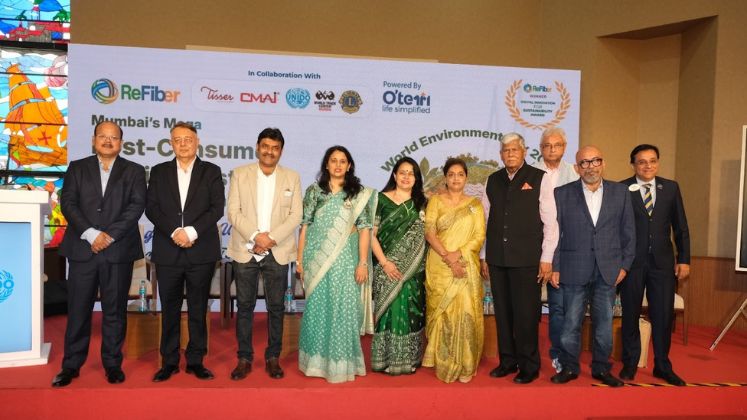
A nationwide initiative aimed at increasing consumer participation in textile waste management and promoting circular fashion was launched in Mumbai on World Environment Day.
The ‘Mega Used Clothes Upcyclon’, a consumer awareness, used-clothing collection and upcycling programme, was unveiled through a collaboration between the Clothing Manufacturers Association of India (CMAI), the United Nations Industrial Development Organization (UNIDO), ReFiber, Oterri, Tisser, World Trade Center Mumbai and Lions International.
The initiative seeks to strengthen India’s post-consumer textile waste management ecosystem, a key component in achieving circularity within the textile and apparel industry. According to industry estimates, more than half of all textile waste is generated after consumer use, while nearly two-thirds of discarded household apparel ends up in landfills or open dumping sites. Stakeholders involved in the programme noted that these figures highlight the need for greater consumer awareness and participation, alongside scalable solutions for collection, recycling, reuse and upcycling.
Textile Commissioner Vrunda Desai stressed the importance of collective action involving industry, government, civil society organisations and consumers to accelerate sustainability and circularity across the textile value chain. She highlighted the growing need for conscious consumption and responsible disposal practices to reduce the environmental impact of fashion and support a more sustainable future.
CMAI President Santosh Katariya stated that the transition towards a circular economy could not be achieved through industry efforts alone and that consumers represented a critical stakeholder in the process. He noted that every garment responsibly donated rather than discarded helped extend its lifecycle, reduce waste, conserve resources and lower environmental impact.
As part of the initiative, organisers aim to collect 20,000 kilograms of used clothing and household textiles for reuse and upcycling. The programme is being supported by Tisser, an organisation that works with more than 20,000 women artisans and workers.
Organisers said the initiative is expected to reduce textile waste while generating sustainable livelihood opportunities for thousands of women engaged in the upcycling value chain, further supporting the development of a circular textile ecosystem in India.