Despite the global economic downturn, ZARA’s extensively appreciated business model has kept its customers happy and fashion forward. Though many believe that fast fashion is contrary to the concept of sustainability, ZARA is today among the 50 most sustainable brands in the world according to the latest Best Global Green Brands report by Interbrand, a brand consultancy firm, witnessing a sharp 18 per cent increase in its brand value.
Fast fashion, which promises consumers rock-bottom prices on runway-look-alike fashion, is demonized as it pushes low quality disposable garments, dubious labour practices, and environmentally irresponsible fabrics. Regardless of this, fast fashion is here to stay as consumers demand lower prices and more fashionably trendier clothes, within a much shorter span of time. During 2010, when many apparel industries suffered due to recession, ZARA, a subsidiary of Spanish parent company, Inditex, reported a 13 per cent increase in sales and a 32 per cent increase in net profits. Though sustainability is questionable when being associated with fast-fashion, the brand has taken major steps towards remaining ‘ethical’ and environment-friendly.
The brand continues to leverage its enviable logistics system, which enables store managers to communicate directly with designers – providing them with valuable information on what is and isn’t selling. This allows ZARA to be remarkably receptive to quickly changing consumer demands as the designers can easily respond to trend shifts which secures their competitive advantage in today’s hoard of fashion-conscious consumers. Most ZARA styles are produced in smaller quantities first, and tested in close-to-home markets before being mass produced and shipped internationally based on their domestic sales result. This is why the garments usually sell completely, or the company has less unsold stock, therefore it wastes less raw materials and energy leading to higher profits.
[bleft]The clothing label has promised to eradicate discharge of hazardous chemicals from its supply chain and product by 2020 following public pressure, in response to the Greenpeace’s Detox campaign.[/bleft]
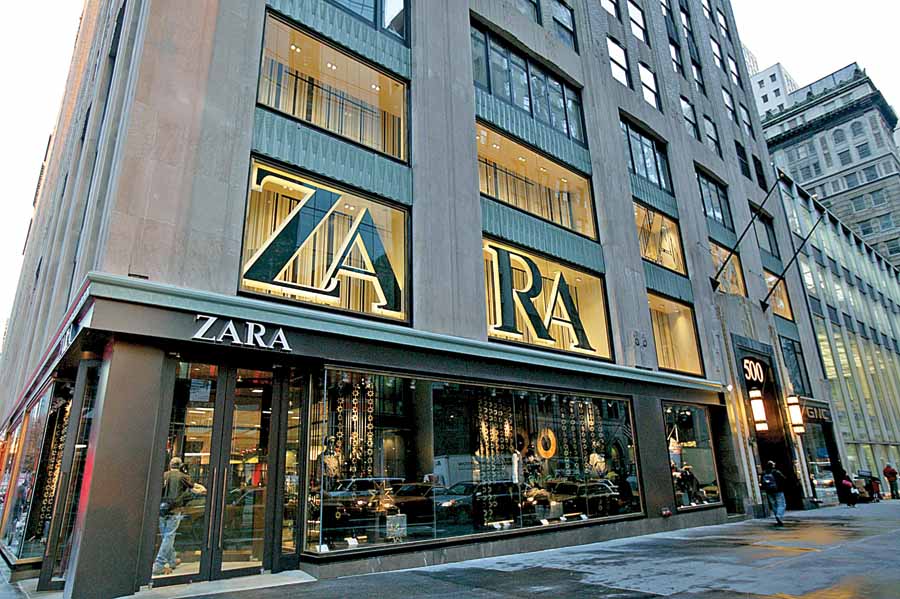
Owing to many sustainable initiatives, one primarily being building an eco-friendly store in New York using various green features has brought ZARA on the helm of being amongst the top global brands working towards a sustainable future. The in-store facility imbibes a host of green elements such as installation of high-performance heating and air conditioning units, and automatic-adjustable thermostats. It has also been equipped with motion detector-controlled lighting fixtures in the store rooms and less-transited spaces, which allows the detectors to dim lights by 80% when not occupied. The property features electronically regulated air curtains at its entrance, which restricts influx of hot or cold outside air. It also consists of energy-intensive systems that are turned on in a sequential pattern to avoid demand spikes and also, the wood incorporated in the building’s store fittings and furnishings, as well as the shopping bags used is PEFC-certified, which uses plastic bags that are biodegradable. Installation of speed-controlled mechanical escalators, and automatically opening double entrance doors add to the sustainability. The use of various green features reaps energy savings of 30 per cent and water savings of 70 per cent per year over a traditional shop while reducing its carbon emission rate by over 150 tonnes annually.
In addition, the clothing label has promised to eradicate discharge of hazardous chemicals from its supply chain and product by 2020 following public pressure, in response to the Greenpeace’s Detox campaign. As part of this radical change in production, ZARA plans to enforce its suppliers to disclose all releases of toxic chemicals from their facilities to surrounding communities. With the target of zero hazardous discharge by 2020, ZARA has already asked 20 suppliers to achieve it by the end of 2013. Meanwhile, in order to improve worker safety, ZARA has also signed the Accord on Fire and Building Safety in Bangladesh, in the wake of the deadly building collapse at Rana Plaza that claimed around 1100 lives. Under the agreement, parties will be committed to the goal of a safe and sustainable Bangladeshi Readymade Garment (RMG) industry that protects workers from fires, building collapses and other accidents that can be prevented with reasonable health and safety measures.
Through implementation of an eco-friendly management model in all the ZARA stores, the clothing label aims to reduce energy consumption by 20 per cent, including the design itself, the lighting, heating, cooling systems and the possibility of recycling furniture and decoration. Recycling hangers and alarms, which are picked up from any of the stores, are processed into other plastic elements, which is an example of the label’s waste management policy. Millions of hangers and alarms are processed each year and both the cardboard and plastic used for packaging are also recycled. Various awareness campaigns and specific multimedia-based training programmes are also organized to educate the staff in sustainable practices, such as limiting energy consumption, using sustainable transport and modifying behaviour patterns. ZARA uses ecological fabrics and supports organic farming by making some of its garments out of organic cotton (100% cotton, completely free of pesticides, chemicals and bleach). Also, ZARA’s fleet of lorries, which transport more than 200 million items of clothing a year, use 5% biodiesel fuel which allows reduction of CO2 emissions by 500 tonnes.
Although, ZARA has expanded its presence globally, the Spanish apparel company has built its strategy around consumer trends, embracing the fast-changing tastes of its customers. To do this successfully, ZARA has developed a highly responsive supply chain that enables delivery of new fashions as soon as a trend emerges. Rather than subcontracting manufacturing to Asia, ZARA has built 14 highly automated Spanish factories, where robots work round-the-clock cutting and dyeing fabrics and creating unfinished “gray goods”, the foundations of their final products. Strategic global expansion, a commitment to sustainability efforts and keeping consumer demands at the forefront, ZARA continues to be a leading global retail brand.