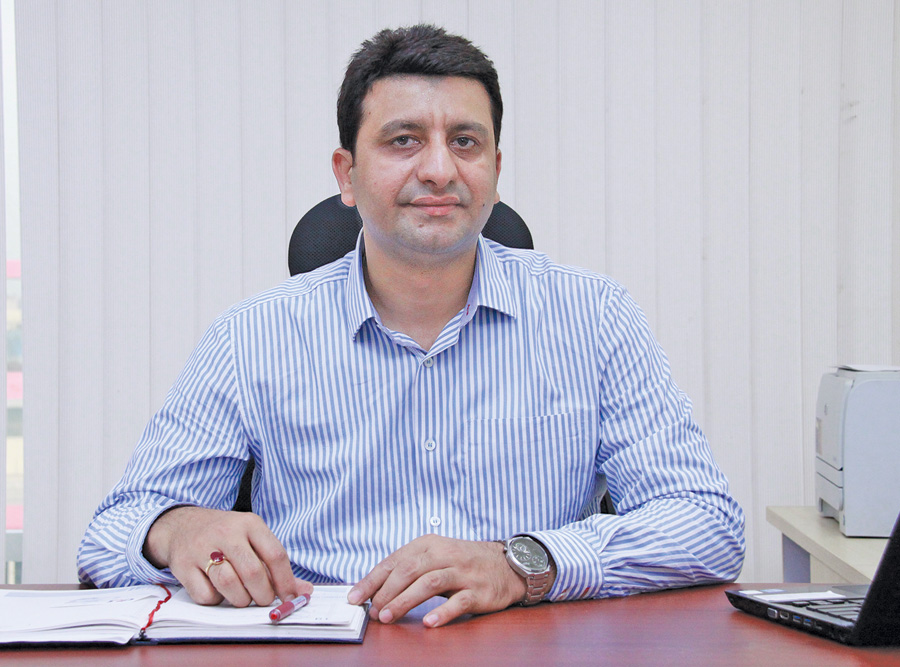
In a short span of time Indo-British Garments (IBG), Faridabad has travelled an impressive sustainable journey, covering and connecting aspects like worker welfare and efficiencies, and material management with workers’ comfort as well as cost-effectiveness. With multi-focused approach to workers’ involvement that include initiatives related to his/her health, motivation levels, work-life balance, ample opportunities for further growth, better education for their children, they have just one aim – happiness – to be on the faces of their workers. Team Apparel Online met Raj Kamboj, Deputy Managing Director of IBG Group, who is passionate about his staff’s welfare to get an update on sustainable efforts at the company.
Defining sustainability as keeping stakeholders in a mutually beneficial positions and an ecosystem where it is functioning fully, IBG claims that it is a 100 per cent safe place to work in with investments in the right infrastructure, ability to evacuate safely, with comfortable work positions and all equipment calibrated timely. Formulating policies for workers, respecting women, and ensuring there is no sexual harassment as a priority; using ample sunlight and having a basic green building design with better energy usage and saving, as also keeping disposables at a minimum, IBG has used the Nike codes of conduct for sustainable growth.
Maximum Efficiency, Minimum Wastage
The company takes special pride in reduced overtime, which is a chronic problem in many factories. “IBG provides 10 hours of wages in 8 hours of work, thus ensuring efficiency in 8 hours. They work at 83 per cent efficiency and have entire focus on efficient production. This is also achieved through better material management, useful research and development; so after 80 per cent, each 1 per cent up gets Rs. 125/- a month extra. It takes a lot to make sure that lines are fixed to product types. This also ensures mastery in product making and workforce is less stressed as it is the same product they are sewing,” shares Raj. This approach has led to IBG sacrificing on the profits as they insist on a product profiling. Minimum changeover brings about greater efficiency and helps workers take back more money home. They ensure discharges are limited and although waste is not measured, the cutting room reports 91-93 per cent cutting efficiencies. IBG also assures that waste is segregated and given for recycling, in turn to be made into rugs with the cut waste in Rajasthan and Eastern UP.
Focus on Workers Engagement
Workers engagement remains a focus and investment into welfare as an integral part of CSR. IBG supports and helps the workforce in obtaining maximum benefits from Government schemes that are available for workmen. Very few organizations participate in such activities.Workers that have sustained more than one year, get a cycle and scholarship for children’s education. “Our group provides up to Rs. 1 lakh per month as scholarship which is availed by 3-4 workers every year. Focus is also on education of girl child; 4-5 employees have their children studying B.Tech; and one of them is in Poland studying in University of Warsaw. It is a matter of pride for us that our employees are largely happy and prosperous,” adds Raj.
Under the leadership of its MD, Chandni Sachdev, IBG, Faridabad is known for workwear and uniform. The company has a workforce of around 700, and its garment export turnover for the fiscal 2014-15 was US $ 5.38 million (Rs. 35 crore). The IBG group has business in India, Jordan, Canada, Netherlands, South Africa and Malaysia.
In a health and safety initiative, IBG ensures full body check-up for its all employees; this check-up includes kidney and liver examination and various blood tests to take advantage of. IBG also speaks regularly on safety at workplace which is further extended into safety on the road too.
The company provides water purifiers and helmets for bikers as Diwali gifts. As a resultant it has 5 per cent attrition and a satisfied and motivated workforce. With career paths well drawn, helpers at the plant have grown into line supervisors, trained computer operators and taught ERP. Some helpers have developed themselves and now take responsibility of packing supervisors and logistics in-charge. Setting up a small computer centre which is for around 50 workers and opened even after work hours, has been highly appreciated by the staff. Free internet is provided and people here learn computers. This centre is open to their children as well on Saturdays and 50-60 people avail this centre out of the total workforce of 640 workers. Apart from these, as long-term steps the company tries to make events a regular affair so that the workers and even the middle-management staff can benefit. Recently a radio jockey was invited to host a talk session on ‘life motivation’ in a lighter tone.
Though the company admits that sustainability is largely buyer-driven, and they give the maximum contribution, most of the problems come from the customer side. But at IBG the initiatives are self-initiatives with no mandate from customer side and the company sees this as their responsibility to give back to society. Because of this approach, IBG claims that it does not lose its employees to competition and does not have its employees work after the working hours, thus keeping them fully charged for the day duties.
“Products are from customers and the choice of sustainable products lies with retailers and brands. Here contract manufacturer cannot take a call. However, a manufacturer can ensure that the value chain it passes through is controlling all necessary factors for sustainable manufacturing,” concludes Raj.





 Bharat Tex Special Report 2026