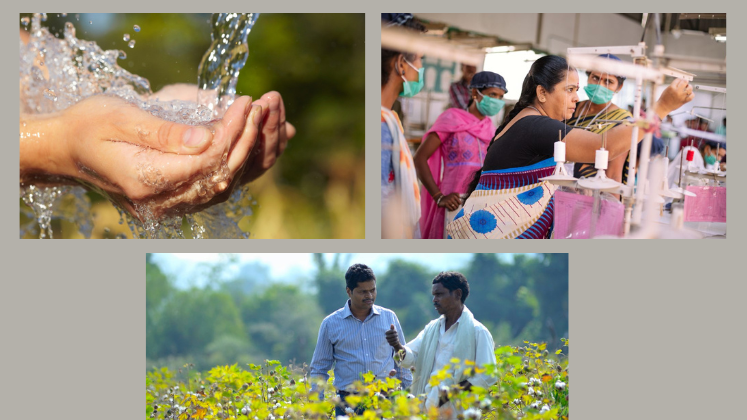
There wasn’t anything more pleasing than seeing the Indian apparel factories and brands’ stores celebrate World Water Day (22nd March), World Health Day (7th April), Menstrual Hygiene Day (28th May), World Bicycle Day (3rd June) and World Environment Day (5th June) recently. There is a growing awareness about sustainability amongst the industry now, but, what’s more fascinating is to see the same vigour and enthusiasm amongst Indian apparel firms that was until now seen mostly in the Western part of the world. The best part, however, is that the collective efforts of stakeholders have been growing by manifold to create a better sustainable fashion textile value chain– and importantly a better sustainable world.
Various initiatives for saving natural resources – water and energy conservation, women empowerment, training programmes, support to farmers, especially those involved in cotton farming and a few other specific areas –have been undertaken by brands in collaboration with their vendors. Importantly, several fashion brands have been supporting their Indian vendors and society as well – consequently having a positive impact on them.
Water conservation is the need of the hour!
Yes, water conservation is indeed the need of the hour!Natural resources are today not only limited, but are also being used massively in the manufacturing of textile-based products. In fact, as per industry estimates, in India alone, the textile industry uses over 425,000,000 gallons of water daily. Isn’t that saying everything?
It’s not that the industry hasn’t been taking initiatives. But, despite initiating measures like zero liquid discharge (ZLD), problems such as water scarcity and water pollution continue to persist. Here one may like to state that almost 163 million people in India do not have access to clean water. That’s appalling – enough to justify why water conservation is such a grave concern and why it needs immediate attention.
Many fashion brands have been actively initiating measures by saving water within the manufacturing units,besides extending full support to various projects pertaining to water conservation – some even with those stakeholders who are not related to the textile industry, but are equally committed to water saving.
Life and Building Safety (LABS) Initiative, a collaboration between global apparel and retailers, is tasked with creating and implementing a shared standard to prevent structural, electrical and fire safety issues in India.
While US clothing bigwig Target is supporting Water.org to enable access to water and sanitation that is directly helping families in India,another American retail stalwart PVH Corp is also supporting Noyyal Bhavani Basin through water stewardship efforts with the World Wildlife Fund (WWF).
Swedish retail giant H&M continues to partner with its suppliers to deploy water efficiency measures. For example, H&M Home has implemented a water efficiency project with Indian suppliers, achieving as much as 35-40 per cent reduction in water use!
Similarly, Gap, Inc. has also been at the forefront in taking initiatives to conserve water. Notably, USAID and Gap have jointly unfurled ‘Women + Water Alliance’ that combines objectives to empower women and improve community water resilience in India. With the support of its partners – CARE, Water.org, WaterAid and the Institute for Sustainable Communities – this programme already has improved access to clean water and sanitation for 1.50 million people in states like Madhya Pradesh and Maharashtra. Notably, women have benefited in good numbers as mostly they are the ones who arrange and manage the water for their families.
It isn’t no less feat that Gap has saved 1.7 billion litres of water since 2019 through a partnership with Arvind Limited’s Naroda denim mill, which uses reclaimed wastewater from Ahmedabad.
The retailer’s efforts involve improving community water resilience in India, a three-year partnership with Ministry of Rural Development, which plans to expand across all Indian states in future.
The US retail giant has also prepared more than 2,100 village action plans for water access in India in collaboration with the Central Government, local governments and organisations such as Arvind Limited with whom GAP is building an 18,000-square-foot Water Innovation Centre. The centre, due to open in the latter half of 2022, will showcase water-management’s best practices and recycling technologies.
Continual focus on strengthening women’s empowerment
We all know that treating women fairly at work, ensuring their overall safety and respect, giving them a non-discriminatory working atmosphere, ensuring their health and well-being, and promoting their education, training and professional development are some of the key focus areas of women empowerment.
But, what’s noteworthy is to see many fashion brands and buyers initiating efforts in these areas. They are working directly with their supply chain, taking the help of NGOs and various foundations to strengthen their goals that talk about empowerment of women.
Prevention of sexual harassment in the factories is one area that holds top priority for everyone in the industry,and several efforts are being initiated in this regard. H&M’s 10 supplier factories in India– for example – participated in one such programme that was run by Swasti (NGO), reaching 13,500 workers. There are many such measures initiated by buyers.
Targettoo has provided a three-year grant to Industree Foundation to help build sustainable livelihoods for underemployed women in the creative manufacturing sector. Notably, Industree aims to ensure these women get higher and regular incomes, decent and equitable working conditions and the ability to cope with life crises. This grant directly supports the development of a new production community, digital and other training materials, and support tools.
Similarly, German sportswear giant PUMA has also partnered with International Center for Research on Women (ICRW) to run a Gender Equity Project in India.
Some of the training initiatives that have done extremely well for women empowerment include the likes of Personal Advancement & Career Enhancement (P.A.C.E.) programme by Gap and M&S’ POWER (Providing Opportunities to Women for Equal Rights).
Since its initial pilot phase in 2016, 36,436 women have benefited through the M&S’s POWER programme in leading Indian apparel manufacturing hubs – Bengaluru, Gurugram and Manesar. The intervention aimed at bringing changes in the demand side by ensuring that the men and women– who constitute the workforce of the targeted factories– are aware and sensitised of their rights and responsibilities.
The training sessions were divided into six modules of one hour each, with focus on understanding gender stereotypes, gender discrimination and violence against women, safe working place, understanding sexual harassment at public and workplace, provisions of the POSH Act and its implementation.
Gap has supported Self-Employed Women’s Association (SEWA), and achieved its goal of training over 271,000 women across Gujarat, Bihar and Rajasthan. Interestingly, women in India have also used their P.A.C.E. training to pursue elections! In January 2021, 167 participants in the programme were elected to the panchayat (regional assembly) in Maharashtra, with 14 elected as ‘Sarpanch’. That’s some achievement!
Brands have been actively supporting farmers
Fashion brands are not behind in actively guiding farmers about best agricultural practices with the aid of all latest technologies. Organic cotton has also been a focus for the brands,with few of these also financially supporting the farmers. For some, training in sustainable farming methods remains the priority.Fashion biggies such as H&M, Inditex, Primark, Target and Gap have been working diligently to support farmers.
The H&M Group’s Circular Innovation Lab is working with technology company Materra to set up an R&D farm in India, with the intent to optimise latter’s hydroponic cotton farming system to local conditions. The project will run for two years and generate valuable information to enable a scale-up of more sustainable cotton supply chains using Materra’s technology.
The brand’s initiatives are already benefiting Indian farmers! H&M Group has been supporting farmers’ projects with the Organic Cotton Accelerator and other organic cotton initiatives in India, during the 2020-2021 crop season,which has resulted in 14,000 farmers getting involved in organic cotton projects. Owing to this,farmers received US $ 1.28 million in premium, supporting investment in organic farming. Interestingly 100 per cent procurement was by H&M Group’s brands of committed volumes.
On the other hand, Zara’s parent company Inditex is supporting more than 2,000 Indian farmers producing organic cotton. For this cause, the apparel giant has joined forces with Asia-based DBS Bank, to provide finance to farmers. DBS has been working with the local network of Farmer Producer Organisations (FPOs) to evaluate the financing needs of farmers in Inditex’s supply chain.
This close coordination between brand and supply chain partner can be seen in the efforts of Target and Arvind also. Target is funding a cotton programme with its apparel supplier Arvind that aims to help 500 cotton farmers in India adopt organic and regenerative farming practices over the next five years.
Then there’s Bestseller that has become official partner of the Organic Cotton Accelerator (OCA) and signed its first direct-to-farm agreement in India. OCA is a multi-stakeholder organisation that’s fully dedicated to organic cotton.
The business for Social Responsibility (BSR) HERproject is also supported by various retailers.
Gap has also been supporting farmers and has made a long-term commitment to source in-conversion and organic cotton from approximately 1,500 partner farmers in Alirajpur, Kundanpur and Udaigarh of Madhya Pradesh. Alongside Arvind Limited, Banana Republic is funding the work of Action for Social Advancement (ASA), an NGO that trains farmers on converting to organic practices.
One has observed from various studies that any support to farmers has multiple effects, as farmers share the knowledge and opportunities with their fellow groups that are spread across different areas.
There are plans and initiatives on the part of both brands and suppliers to make sustainability a part of our work culture; however, more brands and factories need to come together and take the mission forward and help make this world a better place to live.
Specific support
The H&M Foundation partnered with Social Alpha to launch Tech tonic innovations in Waste Management to identify local, disruptive innovations that improve waste management and the livelihoods of waste pickers.
International Justice Mission at the community level empowers job seekers so that they can better protect themselves from potential abuse. Two examples of that work are the safe migration programme and grassroots prevention project in India. Target works with GoodWeave to combat underage labour in the handwoven goods industry in India. GoodWeave-certified rugs are woven by adult artisans and help support the education of thousands of at-risk children that might otherwise need to work.