Around 6 million women operators are working in the Indian apparel manufacturing industry and 60 to 70 per cent of them belong to the age group of 18+ to 40. Women operators are more disciplined, are known for better productivity and also have less turnover rate but at the same time every month, they struggle for 3-4 days due to their menstrual cycle and it impacts them physically as well as mentally. In the research conducted by the University College of London, Menstrual cramps have been described as ‘almost as bad as having a heart attack’. Looking at the seriousness of the issue, a few of the apparel factories have taken note of this and come up with noble initiatives to support women. And they have achieved good results too. These factories have supported women with proper guidance and regular availability of sanitary pads (free/ or on subsidised rates), and period leave but thousands of factories are there which are still missing on this front.
Looking at the entire scenario and diversity, the top priority should be to make menstruation a normal subject, so that anyone can talk about it from the board room to the shopfloor openly without any fear and hesitation. Menstruation should be accepted as a routine fact of life, with easy access to period products and necessary facilities. The issue becomes significant as women’s dignity, health and in many cases livelihood is closely tied to their struggle every month with menstruation.
Providing sanitary products is essential but not a complete solution. Women workers’ approach also needs to change as the majority of women feel that menstrual blood is dirty or impure. Such and other myths and taboos need to change as Humjoli Foundation has a perfect motto Periods – Sharm Nahi, Shamta Hai (Periods are not a matter of shame but are about potential)
Life changing efforts
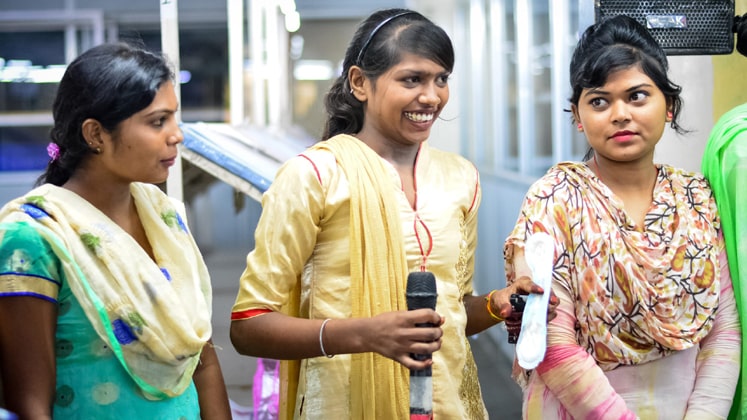
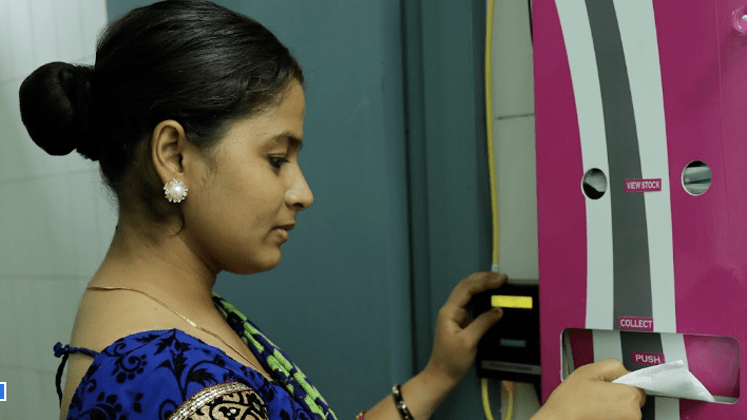
It will not be wrong to say that Shahi Exports has done a remarkable job in this direction. The company is working in this regard for more than four years and has conducted many surveys, discussions and analysis. Its project ‘Pravah focuses on menstrual health and hygiene training and awareness and easy access to low-cost, high-quality sanitary products for its women employees. There are biometric-enabled vending machines in women’s toilets, stocked with highly subsidised sanitary napkins. The safe disposal mechanism has also increased the hygiene level in the toilets. The company also promotes access and acceptance of menstrual cups as safe sanitary products. These and other such efforts not only help women during their menstrual cycle but also change their mindset that menstrual blood is dirty or impure.
Another leading factory of Delhi-NCR, Paramount Products is offering free pads for the last two years and around 1800 women workers of the companies are benefiting from this. Women are now very much using these pads and even guiding their daughters and other women in the family about proper hygiene. The company also has in-house trained staff for creating awareness and guiding women in this regard.
Not only leading exporters, a few of medium-level companies are also coming up with interesting initiatives in this direction. One year ago Nandani Creation Limited (JaipurKurti.com), a Jaipur-based leading domestic player, announced a period leave policy for its women employees. As per this policy, period leave of one day (over and above the regular leaves and holidays) for each month is available to the women workforce. The company took this step as it is moving towards building a culture of acknowledgement for women’s organic necessities.
Gain to the companies
Along with the women workers, factories which put efforts for menstrual hygiene also get benefits as in the baseline survey of the Shahi Exports, it was observed that 47 per cent of women strongly agreed that the provision of cheap pads makes them think that the company cares about the workers’ health and well-being; this percentage shot up to 71 per cent in the endline. The company also asked the respondents if providing high-quality and low-cost pads makes them want to work for more years at this company. The percentage of respondents who strongly agreed with the statement went up from 32 per cent in the baseline to 61 per cent in the end-line survey.
Rupali Agarwal, Head-CSR, Paramount Products informed, “There is a significant reduction in women absenteeism and their overall health and confidence have increased a lot. Women are now more loyal and feel bonding with the company.” She further added that the company manages money for pads from workers’ welfare fund and doesn’t see it as an added cost.
Anuj Mundhra, CMD, Nandani Creation Limited shared his experience, “I was criticised by a few of the fellow apparel manufacturers when I started this initiative but I was firm to continue with this and in one year, we have seen that motivation of the young female workers has increased and they are very happy with this policy.” He also said that women are so enthusiastic about this scheme that they manage their work effectively so that their period leave doesn’t impact the factory’s output.
50% of women aged 15-24 years use clothes during periods, claims National Family Health Survey.
Benchmark in India
Though the labour-oriented, apparel manufacturing industry cannot be compared with any other industry, but there are a few examples that can be said to be the benchmark. Still, there are a few good examples as food delivery service Zomato which has introduced up to ten days of ‘period leaves’ in a year for all women employees to build a more inclusive work culture. Swiggy also has ‘No Questions Asked’ Period Time-off for women delivery partners and a monthly two-day time off policy during periods for them (with a minimum earnings guarantee too). There are also a few more companies in various industries/sectors having similar policies.
What more can be done
In Delhi-NCR or any other apparel manufacturing hub in Tirupur and nearby other hubs also, only few factories are putting in efforts for menstrual hygiene as factory owners don’t have an interest and thrust on this. “This issue is not in the factories owners’ priority list. At our own level, we do have some initiatives focusing on awareness and subsidised sanity pad distribution but the budget constraint is there,” said A. Aloysius, Founder, Social Awareness and Voluntary Education (SAVE) NGO of Tirupur.
NGOs and platforms that can support
- Swasti, The Health Catalyst
- Breakthrough
- Beyond Blood
- Goonjl
- Humjoli Foundation
- Myna Mahila Foundation
- Project Baala
- Breaking The Silence
- Aara Health
He further added that factories should also have proper focus on the disposal of used pads as a small chunk of women workers who are managing pads by their own, don’t have any options in factories to dispose of the pads. And it is also harmful for them.
Few State Governments are distributing free sanitary napkins in schools. Similar schemes can be there for garment factory workers and the cost can be borne by Government as well as factories.
Efforts are also required at the policy level as the Menstruation Benefits Bill was introduced in 2017 in the Indian parliament but so far there is no proposal to grant menstrual leaves and it is not passed yet. Interestingly Bihar has had menstrual leave for women employees since 1992.
Birla Cellulose, a part of Aditya Birla Group, has recently teamed up with Bengaluru-based GoNaturato to produce cost-effective and environment-friendly sanitary pads using the viscose-based Purocel EcoDry fibre as a top-sheet in their GoNatura sanitary pads. Birla Cellulose’ target is to overcome the environmental consequences endured due to the global consumption of plastic-based single-use sanitary pads and curb the ecological damage through plastic-free natural sanitary pads available at an affordable price. Its team has been working tirelessly with GoNatura to successfully integrate through multiple product trials in an effort to ensure smooth integration of their sanitary pads.
Under the bill, women employed by both public and private establishments registered with the Central and State Governments, are entitled to two days of menstrual leave every month, which would amount to 24 days of leave annually.
Few of the buyers are having some support of the factories for this like VF Corp., has developed Menstrual Hygiene Management modules as part of the HER Project in Chennai and Bengaluru. It is also improving access to feminine hygiene products to create an enabling environment for women workers. The educational pilot project was launched in 2018 and was expanded in FY 2020. It is also improving access to feminine hygiene products to create an enabling environment for women workers.
To start with
If a particular factory doesn’t have resources to support women workers with period products, it can start with awareness for imparting proper information and guidance regarding menstrual hygiene management.
NGOs like Sachhi Saheli have included the initiative of Menstrual Café. Soumya Dabriwal, Founder of Delhi-based Project Baala, another leading organisation has exposure of working in this direction with companies from few industries.
She asserted, “We have done some work with Shahi Exports and if any other garment manufacturing companies come forward, we will definitely work with them.”
Factories can arrange the show of Padman movie, (based on the true story of a social entrepreneur who creates a low-cost pad-making machine). There are video messages from popular bollywood actresses encouraging women to break the silence on menstruation, and these videos can be shared with women on Whatsapp.