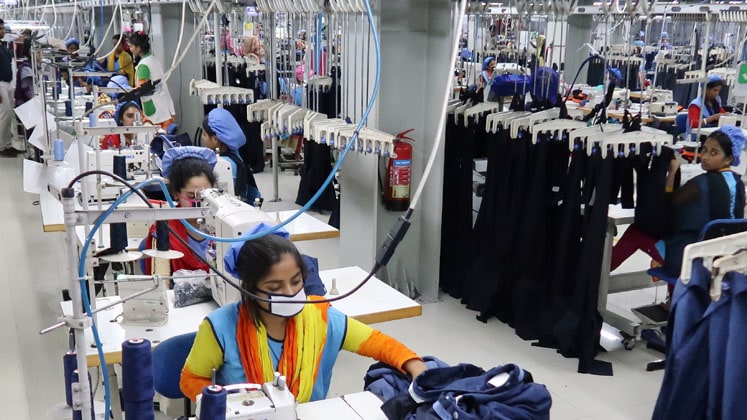
Lately, Bangladesh’s textile and garment industry confronts a massive challenge as India gains a higher cost advantage, posing a potential threat to capture a larger portion of the global market. Abdullah Mohammad Talha, MD of Noman Terry Towel Mills Limited, voices apprehensions about Bangladesh’s future competitiveness, given various factors favoring India.
India’s advantage stems from a crucial factor—the deepening relationship between India and the West. This alliance has put Bangladesh in a challenging position, limiting its potential to achieve robust competitiveness and break free from the middle-income trap. Unlike Bangladesh, India has diversified its assets and resources, enabling a multifaceted approach to economic growth.
India gains an edge due to its cheaper labour force compared to Bangladesh, where labour costs have gradually increased. Presently, Bangladesh’s pay structure is comparable to India, with garment helpers earning around US $ 150 per month and operators receiving up to US $ 180 per month.
Electricity costs contribute significantly to India’s cost advantage over Bangladesh, as India obtains electricity from the grid at approximately 7 cents per kW, while Bangladesh faces higher costs at around 12.7 cents per kW.
Abdullah Mohammad Talha urges proactive measures in Bangladesh, such as sound policies and combating corruption, to maintain the textile industry’s growth and strength. Without action, Bangladesh may lose its dominant position to India’s growing momentum in the global market.